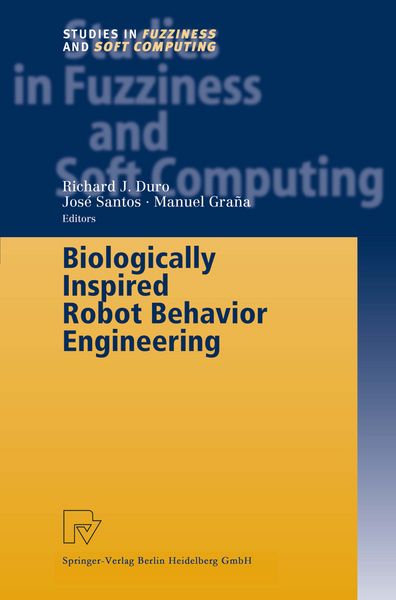
Produktbild: Biologically Inspired Robot Behavior Engineering
Band 109

Biologically Inspired Robot Behavior Engineering

148,99 €

inkl. gesetzl. MwSt., Versandkostenfrei


Beschreibung

Produktdetails

Einband

Taschenbuch

Erscheinungsdatum

21.10.2010

Herausgeber

Richard J. Duro + weitere

Verlag

Physica

Seitenzahl

439

Maße (L/B/H)

23,5/15,5/2,5 cm

Gewicht

700 g

Auflage

Softcover reprint of the original 1st ed. 2003

Sprache

Englisch

ISBN

978-3-7908-2517-6

Beschreibung

Produktdetails

Einband

Taschenbuch

Erscheinungsdatum

21.10.2010

Herausgeber

Verlag

Physica

Seitenzahl

439

Maße (L/B/H)

23,5/15,5/2,5 cm

Gewicht

700 g

Auflage

Softcover reprint of the original 1st ed. 2003

Sprache

Englisch

ISBN

978-3-7908-2517-6

Herstelleradresse

Physica Verlag
Tiergartenstr. 17
69121 Heidelberg
DE

Email: GPSR Kontakt

Noch keine Bewertungen vorhanden

Verfassen Sie die erste Bewertung zu diesem Artikel

Helfen Sie anderen Kundinnen und Kunden durch Ihre Meinung.

Kundinnen und Kunden meinen

Bewertungen (0)

  • Produktbild: Biologically Inspired Robot Behavior Engineering
  • 1. Evolutionary approaches to neural control of rolling, walking, swimming and flying animats or robots.- 2. Behavior coordination and its modification on monkey-type mobile robot.- 3. Visuomotor control in flies and behavior-based agents.- 4. Using evolutionary methods to parameterize neural models: a study of the lamprey central pattern generator.- 5. Biologically inspired neural network approaches to real-time collision-free robot motion planning.- 6. Self-adapting neural networks for mobile robots.- 7. Evolving robots able to integrate sensory-motor information over time.- 8. A non-computationally-intensive neurocontroller for autonomous mobile robot navigation.- 9. Some approaches for reusing behaviour based robot cognitive architectures obtained through evolution.- 10. Modular neural architectures for robotics.- 11. Designing neural control architectures for an autonomous robot using vision to solve complex learning tasks.- 12. Robust estimation of the optical flow based on VQ-BF.- 13. Steps towards one-shot vision-based self-localization.- 14. Computing the optimal trajectory of arm movement: the TOPS (Task Optimization in the Presence of Signal-dependent noise) model.- 15. A general learning approach to visually guided 3D-positioning and pose control of robot arms.