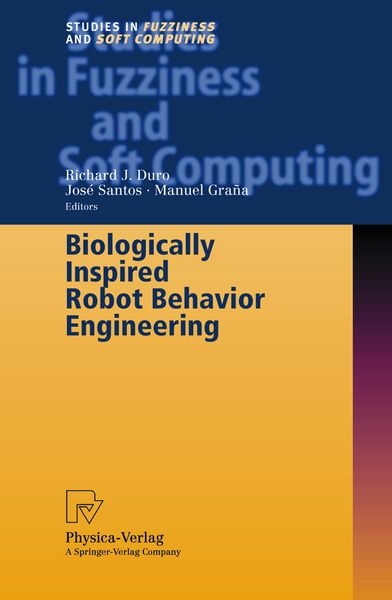
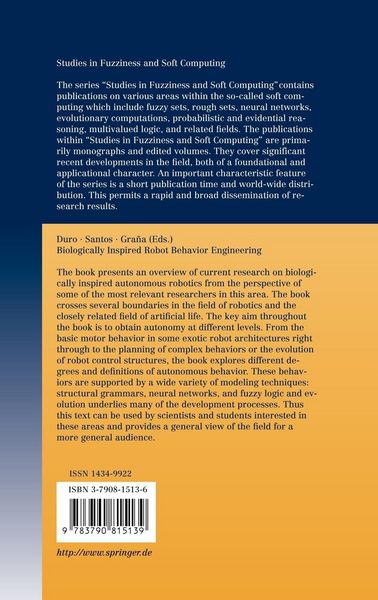
• Produktbild: Biologically Inspired Robot Behavior Engineering
  • Produktbild: Biologically Inspired Robot Behavior Engineering
  • Produktbild: Biologically Inspired Robot Behavior Engineering
Band 109 - 12%

Biologically Inspired Robot Behavior Engineering

12% sparen

144,99 € UVP 164,99 €

inkl. gesetzl. MwSt., Versandkostenfrei


Beschreibung

Produktdetails

Einband

Gebundene Ausgabe

Erscheinungsdatum

22.10.2002

Herausgeber

Richard J. Duro + weitere

Verlag

Physica

Seitenzahl

439

Maße (L/B/H)

24,1/16/3 cm

Auflage

1. Auflage

Sprache

Englisch

ISBN

978-3-7908-1513-9

Beschreibung

Produktdetails

Einband

Gebundene Ausgabe

Erscheinungsdatum

22.10.2002

Herausgeber

Verlag

Physica

Seitenzahl

439

Maße (L/B/H)

24,1/16/3 cm

Auflage

1. Auflage

Sprache

Englisch

ISBN

978-3-7908-1513-9

Herstelleradresse

Physica Verlag
Tiergartenstr. 17
69121 Heidelberg
DE

Email: ProductSafety@springernature.com

Kundinnen und Kunden meinen

0 Bewertungen

Informationen zu Bewertungen

Zur Abgabe einer Bewertung ist eine Anmeldung im Konto notwendig. Die Authentizität der Bewertungen wird von uns nicht überprüft. Wir behalten uns vor, Bewertungstexte, die unseren Richtlinien widersprechen, entsprechend zu kürzen oder zu löschen.

Die Bewertungen sind nach Format, Anzahl Sterne und Datum sortiert.

Verfassen Sie die erste Bewertung zu diesem Artikel

Helfen Sie anderen Kund*innen durch Ihre Meinung

Kundinnen und Kunden meinen

0 Bewertungen filtern

  • Produktbild: Biologically Inspired Robot Behavior Engineering
  • Produktbild: Biologically Inspired Robot Behavior Engineering
  • Produktbild: Biologically Inspired Robot Behavior Engineering
  • 1. Evolutionary approaches to neural control of rolling, walking, swimming and flying animats or robots.- 2. Behavior coordination and its modification on monkey-type mobile robot.- 3. Visuomotor control in flies and behavior-based agents.- 4. Using evolutionary methods to parameterize neural models: a study of the lamprey central pattern generator.- 5. Biologically inspired neural network approaches to real-time collision-free robot motion planning.- 6. Self-adapting neural networks for mobile robots.- 7. Evolving robots able to integrate sensory-motor information over time.- 8. A non-computationally-intensive neurocontroller for autonomous mobile robot navigation.- 9. Some approaches for reusing behaviour based robot cognitive architectures obtained through evolution.- 10. Modular neural architectures for robotics.- 11. Designing neural control architectures for an autonomous robot using vision to solve complex learning tasks.- 12. Robust estimation of the optical flow based on VQ-BF.- 13. Steps towards one-shot vision-based self-localization.- 14. Computing the optimal trajectory of arm movement: the TOPS (Task Optimization in the Presence of Signal-dependent noise) model.- 15. A general learning approach to visually guided 3D-positioning and pose control of robot arms.