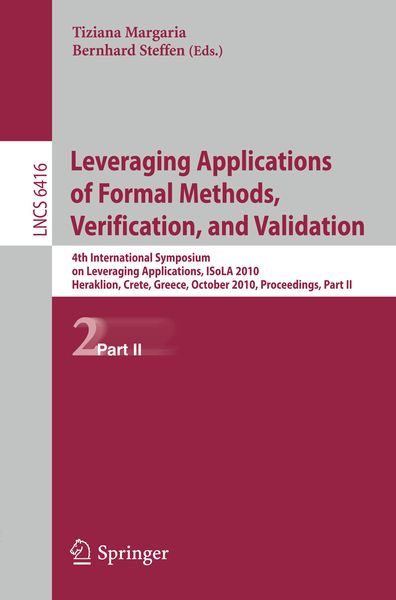
Produktbild: Leveraging Applications of Formal Methods, Verification, and Validation
Band 6416

Leveraging Applications of Formal Methods, Verification, and Validation 4th International Symposium on Leveraging Applications, ISoLA 2010, Heraklion, Crete, Greece, October 18-21, 2010, Proceedings, Part II

51,99 €

inkl. gesetzl. MwSt., Versandkostenfrei


Beschreibung

Produktdetails

Einband

Taschenbuch

Erscheinungsdatum

19.10.2010

Herausgeber

Tiziana Margaria + weitere

Verlag

Springer Berlin

Seitenzahl

498

Maße (L/B/H)

24,1/15,6/2,4 cm

Gewicht

724 g

Auflage

2010

Sprache

Englisch

ISBN

978-3-642-16560-3

Beschreibung

Portrait

Bernhard Steffen studierte Mathematik an der Christian-Albrechts Universität zu Kiel, wo er anschließend auch in der Informatik promovierte. Nach Forschungsaufenthalten am Laboratory for Foundations in Computer Science in Edinburgh und an der Universität Aarhus, wurde er 1990 an die RWTH Aachen berufen, von wo er 1993 an die Universität Passau auf den Lehrstuhl für Programmiersysteme wechselte. Seit 1997 leitet er den Lehrstuhl für Programmiersysteme und Compilerbau an der TU-Dortmund. Bernhard Steffen ist Gründer der internationalen Konferenz über Tools and Algorithm for the Conbstruction and Analysis of Systems (TACAS) und des internationalen Journals über Software Tools for Technology Transfer (STTT).

Produktdetails

Einband

Taschenbuch

Erscheinungsdatum

19.10.2010

Herausgeber

Verlag

Springer Berlin

Seitenzahl

498

Maße (L/B/H)

24,1/15,6/2,4 cm

Gewicht

724 g

Auflage

2010

Sprache

Englisch

ISBN

978-3-642-16560-3

Herstelleradresse

Springer-Verlag GmbH
Heidelberger Platz 3
14197 Berlin
Deutschland
Email: sdc-bookservice@springer.com
Url: www.springer.com
Telephone: +49 30 827870
Fax: +49 30 8214091

Kundinnen und Kunden meinen

0 Bewertungen

Informationen zu Bewertungen

Zur Abgabe einer Bewertung ist eine Anmeldung im Konto notwendig. Die Authentizität der Bewertungen wird von uns nicht überprüft. Wir behalten uns vor, Bewertungstexte, die unseren Richtlinien widersprechen, entsprechend zu kürzen oder zu löschen.

Die Bewertungen sind nach Format, Anzahl Sterne und Datum sortiert.

Verfassen Sie die erste Bewertung zu diesem Artikel

Helfen Sie anderen Kund*innen durch Ihre Meinung

Kundinnen und Kunden meinen

0 Bewertungen filtern

  • Produktbild: Leveraging Applications of Formal Methods, Verification, and Validation
  • EternalS: Mission and Roadmap.- to the EternalS Track: Trustworthy Eternal Systems via Evolving Software, Data and Knowledge.- HATS: Highly Adaptable and Trustworthy Software Using Formal Methods.- SecureChange: Security Engineering for Lifelong Evolvable Systems.- 3DLife: Bringing the Media Internet to Life.- LivingKnowledge: Kernel Methods for Relational Learning and Semantic Modeling.- Task Forces in the EternalS Coordination Action.- Modeling and Analyzing Diversity.- Modeling and Managing System Evolution.- Self-adaptation and Evolution by Learning.- Overview of Roadmapping by EternalS.- Formal Methods in Model-Driven Development for Service-Oriented and Cloud Computing.- Adaptive Composition of Conversational Services through Graph Planning Encoding.- Performance Prediction of Service-Oriented Systems with Layered Queueing Networks.- Error Handling: From Theory to Practice.- Modeling and Reasoning about Service Behaviors and Their Compositions.- Design and Verification of Systems with Exogenous Coordination Using Vereofy.- A Case Study in Model-Based Adaptation of Web Services.- Quantitative Verification in Practice.- Quantitative Verification in Practice.- Ten Years of Performance Evaluation for Concurrent Systems Using CADP.- Towards Dynamic Adaptation of Probabilistic Systems.- UPPAAL in Practice: Quantitative Verification of a RapidIO Network.- Schedulability Analysis Using Uppaal: Herschel-Planck Case Study.- Model-Checking Temporal Properties of Real-Time HTL Programs.- CONNECT: Status and Plans.- Towards an Architecture for Runtime Interoperability.- On Handling Data in Automata Learning.- A Theory of Mediators for Eternal Connectors.- On-the-Fly Interoperability through Automated Mediator Synthesis and Monitoring.- Dependability Analysis and Verification for Connected Systems.- Towards a Connector Algebra.- Certification of Software-Driven Medical Devices.- Certification of Software-Driven Medical Devices.- Arguing for Software Quality in an IEC 62304 Compliant Development Process.- Trustable Formal Specification for Software Certification.- Design Choices for High-Confidence Distributed Real-Time Software.- Assurance Cases in Model-Driven Development of the Pacemaker Software.- Modeling and Formalizing Industrial Software for Verification, Validation and Certification.- Improving Portability of Linux Applications by Early Detection of Interoperability Issues.- Specification Based Conformance Testing for Email Protocols.- Covering Arrays Generation Methods Survey.- Resource and Timing Analysis.- A Scalable Approach for the Description of Dependencies in Hard Real-Time Systems.- Verification of Printer Datapaths Using Timed Automata.- Resource Analysis of Automotive/Infotainment Systems Based on Domain-Specific Models – A Real-World Example.- Source-Level Support for Timing Analysis.- Practical Experiences of Applying Source-Level WCET Flow Analysis on Industrial Code.- Worst-Case Analysis of Heap Allocations.- Partial Flow Analysis with oRange.- Towards an Evaluation Infrastructure for Automotive Multicore Real-Time Operating Systems.- Context-Sensitivity in IPET for Measurement-Based Timing Analysis.- On the Role of Non-functional Properties in Compiler Verification.