• Produktbild: Leveraging Applications of Formal Methods, Verification and Validation
  • Produktbild: Leveraging Applications of Formal Methods, Verification and Validation
Band 17

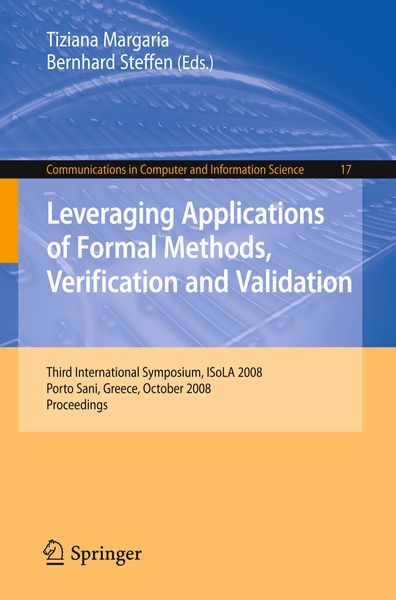
Leveraging Applications of Formal Methods, Verification and Validation Third International Symposium, ISoLA 2008, Porto Sani, Greece, October 13-15, 2008, Proceedings

148,99 €

inkl. gesetzl. MwSt., Versandkostenfrei


Beschreibung

Produktdetails

Einband

Taschenbuch

Erscheinungsdatum

14.10.2008

Herausgeber

Tiziana Margaria + weitere

Verlag

Springer Berlin

Seitenzahl

869

Maße (L/B/H)

23,5/15,5/4,8 cm

Gewicht

1329 g

Auflage

2008

Sprache

Englisch

ISBN

978-3-540-88478-1

Beschreibung

Portrait

Bernhard Steffen studierte Mathematik an der Christian-Albrechts Universität zu Kiel, wo er anschließend auch in der Informatik promovierte. Nach Forschungsaufenthalten am Laboratory for Foundations in Computer Science in Edinburgh und an der Universität Aarhus, wurde er 1990 an die RWTH Aachen berufen, von wo er 1993 an die Universität Passau auf den Lehrstuhl für Programmiersysteme wechselte. Seit 1997 leitet er den Lehrstuhl für Programmiersysteme und Compilerbau an der TU-Dortmund. Bernhard Steffen ist Gründer der internationalen Konferenz über Tools and Algorithm for the Conbstruction and Analysis of Systems (TACAS) und des internationalen Journals über Software Tools for Technology Transfer (STTT).

Produktdetails

Einband

Taschenbuch

Erscheinungsdatum

14.10.2008

Herausgeber

Verlag

Springer Berlin

Seitenzahl

869

Maße (L/B/H)

23,5/15,5/4,8 cm

Gewicht

1329 g

Auflage

2008

Sprache

Englisch

ISBN

978-3-540-88478-1

Herstelleradresse

Springer-Verlag GmbH
Tiergartenstr. 17
69121 Heidelberg
DE

Email: GPSR Kontakt

Kundinnen und Kunden meinen

0 Bewertungen

Informationen zu Bewertungen

Zur Abgabe einer Bewertung ist eine Anmeldung im Konto notwendig. Die Authentizität der Bewertungen wird von uns nicht überprüft. Wir behalten uns vor, Bewertungstexte, die unseren Richtlinien widersprechen, entsprechend zu kürzen oder zu löschen.

Die Bewertungen sind nach Format, Anzahl Sterne und Datum sortiert.

Verfassen Sie die erste Bewertung zu diesem Artikel

Helfen Sie anderen Kund*innen durch Ihre Meinung

Kundinnen und Kunden meinen

0 Bewertungen filtern

  • Produktbild: Leveraging Applications of Formal Methods, Verification and Validation
  • Produktbild: Leveraging Applications of Formal Methods, Verification and Validation
  • Invited Talks.- Architecture Based Specification and Verification of Embedded Software Systems (Work in Progress).- Information System Engineering Supporting Observation, Orientation, Decision, and Compliant Action.- Keynote.- Modelling Coordination and Compensation.- Tools and Applications in Industrial Software Quality Control.- Animating Event B Models by Formal Data Models.- Automated Formal Testing of C API Using T2C Framework.- of Multi-core Systems in Automotive Applications.- Tailoring and Optimising Software for Automotive Multicore Systems.- Fault Handling Approaches on Dual-Core Microcontrollers in Safety-Critical Automotive Applications.- Timing Validation of Automotive Software.- Model-Driven SOA.- Towards Using Reo for Compliance-Aware Business Process Modeling.- On the Risk Management and Auditing of SOA Based Business Processes.- SCA and jABC: Bringing a Service-Oriented Paradigm to Web-Service Construction.- Applications of Formal Approaches to Service-Oriented Computing.- A Use-Case Driven Approach to Formal Service-Oriented Modelling.- Sensoria Patterns: Augmenting Service Engineering with Formal Analysis, Transformation and Dynamicity.- Safety and Response-Time Analysis of an Automotive Accident Assistance Service.- A Framework for Analyzing and Testing the Performance of Software Services.- A Framework for Contract-Policy Matching Based on Symbolic Simulations for Securing Mobile Device Application.- Trustworthy Computing: Theories, Methods, Tools and Experience in China and South East Asia.- ASERE: Assuring the Satisfiability of Sequential Extended Regular Expressions.- Computing Must and May Alias to Detect Null Pointer Dereference.- A Partial Order Reduction Technique for Parallel Timed Automaton Model Checking.- Program Verification by Reduction to Semi-algebraic Systems Solving.- Debugging Statecharts Via Model-Code Traceability.- Model Checking CSP Revisited: Introducing a Process Analysis Toolkit.- Formal Use of Design Patterns and Refactoring.- A Component-Based Access Control Monitor.- Non-functional Requirements in Embedded Systems.- Navigating the Requirements Jungle.- Non-functional Avionics Requirements.- A Simulation Approach for Performance Validation during Embedded Systems Design.- Optimizing Automatic Deployment Using Non-functional Requirement Annotations.- Experiences with Evolutionary Timing Test of Automotive Software Components.- Measurement-Based Timing Analysis.- ALL-TIMES – A European Project on Integrating Timing Technology.- Processes, Methods and Tools for Developing Educational Modules to Support Teaching and Technology Transfer.- Weaving a Formal Methods Education with Problem-Based Learning.- Encouraging the Uptake of Formal Methods Training in an Industrial Context.- Computer-Supported Collaborative Learning with Mind-Maps.- Agile IT: Thinking in User-Centric Models.- Specialization and Instantiation Aspects of a Standard Process for Developing Educational Modules.- Ubiquitous and Context Aware Systems.- A Formal Framework for Modeling Context-Aware Behavior in Ubiquitous Computing.- Contexts and Context Awareness in View of the Diagram Predicate Framework.- The Use of Adaptive Semantic Hypermedia for Ubiquitous Collaboration Systems.- The Use of Formal Ontology to Specify Context in Ubiquitous Computing.- High Service Availability in MaTRICS for the OCS.- Supporting Requirements Definition and Quality Assurance in Ubiquitous Software Project.- Formal Methods for Analysing and Verifying Very Large Systems.- Squeeze All the Power Out of Your Hardware to Verify Your Software!.- Static Partial-Order Reduction of Concurrent Systems in Polynomial Time.- An Extensible Space-Based Coordination Approach for Modeling Complex Patterns in Large Systems,.- Tools for Service-Oriented Discovery of Knowledge.- On the Design of Knowledge Discovery Services Design Patterns and Their Application in a Use Case Implementation.- The ASK System and the Challenge of Distributed Knowledge Discovery.- A Scenario Implementation in R for SubtypeDiscovery Examplified on Chemoinformatics Data.- Requirements for Ontology Based Design Project Assessment.- Organizing the World’s Machine Learning Information.- Tackling the Challenges of Software Development Process for SMEs with Rigorous Support and Open Source.- Workflow Testing.- The jABC Approach to Rigorous Collaborative Development of SCM Applications.- Gesper: Support to Capitalize on Experience in a Network of SMEs.- Regular Papers.- Directed Generation of Test Data for Static Semantics Checker.- Event-Based Approach to Modelling Dynamic Architecture: Application to Mobile Ad-Hoc Network.- Trusted Theorem Proving: A Case Study in SLD-Resolution.- High Level Analysis, Design and Validation of Distributed Mobile Systems with CoreASM.- Optimizing the System Observability Level for Diagnosability.- Weaving Authentication and Authorization Requirements into the Functional Model of a System Using Z Promotion.- Simple Gedanken Experiments in Leveraging Applications of Formal Methods.- Composition of Web Services Using Wrappers.