Gutscheinbedingungen

**Gültig bis 17.08.2026 auf Schreibwaren & Office-Artikel online auf thalia.at, in der Thalia App und in teilnehmenden Thalia Buchhandlungen in Österreich mit Schulsortiment. In den Buchhandlungen nur gültig auf lagernde Ware. Einzelne Artikel können ausgeschlossen sein. Ausgenommen sind preisgebundene Artikel. Pro Einkauf einmal einlösbar. Nur gültig gegen Vorlage oder im Onlineshop hinterlegter Bonuscard. Infos zur Einlösung in der Buchhandlung sind auf der Bonuscard-Vorteilspreisseite zu finden. Click & Collect nur bei Onlinevorabzahlung möglich. Keine Einlösung bei Scan & Go-Bezahlung. Keine Barauszahlung. Nicht kombinierbar mit anderen Aktionen und Gutscheinen. Gutschein wird auf max. 500€ Bestellwert angerechnet. Nicht gültig für Geschenkkarten, Versandkosten und Services.

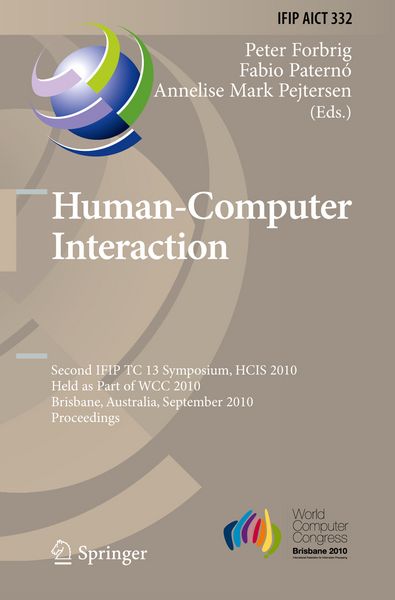
Produktbild: Human-Computer Interaction
Band 332

Human-Computer Interaction Second IFIP TC 13 Symposium, HCIS 2010, Held as Part of WCC 2010, Brisbane, Australia, September 20-23, 2010, Proceedings

51,99 €

inkl. gesetzl. MwSt., Versandkostenfrei


Beschreibung

Produktdetails

Einband

Gebundene Ausgabe

Erscheinungsdatum

23.08.2010

Abbildungen

XIV, 314 p.

Herausgeber

Peter Forbrig + weitere

Verlag

Springer Berlin

Seitenzahl

314

Maße (L/B/H)

24,1/16/2,1 cm

Gewicht

658 g

Auflage

2010

Sprache

Englisch

ISBN

978-3-642-15230-6

Beschreibung

Rezension

From the reviews:

“A cutting-edge selection of contemporary human-computer interaction research appears in these 37 presentations. Each paper has an abstract, keywords, and a reference list at the end. … All papers address the interface between humans and computers. … Consequently, I recommend the collection to provide an overview of what is currently being considered primarily in a university setting.” (Brad Reid, ACM Computing Reviews, November, 2011)

Portrait

Peter Forbrig is a professor of software engineering in the Department of Computer Science, University of Rostock, Germany. He has a Ph.D. in mathematics and an advanced degree in computer science. During recent years he has been involved in software engineering projects, with a focus on pattern-based programming and the Unified Modeling Language UML.

Produktdetails

Einband

Gebundene Ausgabe

Erscheinungsdatum

23.08.2010

Abbildungen

XIV, 314 p.

Herausgeber

Verlag

Springer Berlin

Seitenzahl

314

Maße (L/B/H)

24,1/16/2,1 cm

Gewicht

658 g

Auflage

2010

Sprache

Englisch

ISBN

978-3-642-15230-6

Herstelleradresse

Springer-Verlag KG
Sachsenplatz 4-6
1201 Wien
AT

Email: GPSR Kontakt

Noch keine Bewertungen vorhanden

Verfassen Sie die erste Bewertung zu diesem Artikel

Helfen Sie anderen Kundinnen und Kunden durch Ihre Meinung.

Kundinnen und Kunden meinen

Bewertungen (0)

  • Produktbild: Human-Computer Interaction
  • Keynote.- The Power and the Puzzles of Auditory Interfaces.- Specification and Modeling.- Improving the Search for User Interface Design Patterns through Typed Relationships.- Contributions of Psychology to the Design of Diagnostic Decision Support Systems.- A Composite Task Meta-model as a Reference Model.- Future Dining Table: Dish Recommendation Based on Dining Activity Recognition.- User-Centered Development.- Developing a User-Centered Mobile Service Interface Based on a Cognitive Model of Attention Allocation.- Structured Digital Storytelling for Eliciting Software Requirements in the ICT4D Domain.- Experiencing User-Centered Design (UCD) Practice (Case Study: Interactive Route Navigation Map of Bangkok Underground and Sky Train).- Development of Wearable Device by Kid’s Friendly Design for Kid’s Safety.- Usable Systems.- Towards a Usability Coaching Method for Institutionalizing Usability in Organisations.- The Focus on Usability in Testing Practices in Industry.- Added Value of Eye Tracking in Usability Studies: Expert and Non-expert Participants.- Supporting the Spreadsheet Idea for Interactive Database Applications.- Social and Cultural Problems.- What Is Culture? Toward Common Understandings of Culture in HCI.- Personalized Support, Guidance, and Feedback by Embedded Assessment and Reasoning: What We Can Learn from Educational Computer Games.- Investigating Sociability and Affective Responses of Elderly Users through Digitally-Mediated Exercises: A Case of the Nintendo Wii.- Acquaintances Clustering for Social Relationship-Based Indexing of Digital Photos.- Mobile and Web Applications.- Generating Exploratory Search Interfaces for the Semantic Web.- Can Adaptive Interfaces Improve the Usability of Mobile Applications?.- Video Game Design for MobilePhones.- Epistemology, Emotions and Personalization.- EPISOSE: An Epistemology-Based Social Search Framework for Exploratory Information Seeking.- Artificial Emotion Generation Based on Personality, Mood, and Emotion for Life-Like Facial Expressions of Robots.- Human Error Categorization: An Extension to Classical Proposals Applied to Electrical Systems Operations.- Exploring the Influence of Cultural Diversity in Collaborative Design Teams: Preliminary Findings.- Theoretical Model of User Acceptance: In the View of Measuring Success in Web Personalization.- Posters.- An Approach to Information Presentation Employing Game Principles and Physics Based Interaction.- Exploration in 3D Multimodal Virtual Environment for Nonvisual Spatial Recognition.- Experiments with Adaptable Interfaces for Elderly People.- The Practice of Interaction Design.- Artefacts as a Cultural and Collaborative Probe in Interaction Design.- An Easy to Use Augmented Reality Authoring Tool for Use in Examination Purpose.- From Microsoft Word 2003 to Microsoft Word 2007: Design Heuristics, Design Flaws and Lessons Learnt.- The Effect of Age, Gender, and Previous Gaming Experience on Game Play Performance.- New Attitude to Learning in Virtual Environments - Mining Physiological Data for Automated Feedback.- Personalized Sightseeing Tours Support Using Mobile Devices.- Reaction on a Change of User Context in Complex Mobile User Adaptive System.- Augmented Reality for Deaf Students: Can Mobile Devices Make It Possible?.