Gutscheinbedingungen

**Gültig nur für Bestellungen an die Wunsch-Poststation bis 10.06.2026 auf Spielzeug, Schreibwaren, Filme, Geschenke & Trends, Musik, tolino eReader & Zubehör, Hörbücher und Hörbuch-Downloads (außer Abo), nicht preisgebundene Bücher und Kalender online auf thalia.at und in der Thalia App. Einzelne Artikel können ausgeschlossen sein. Aufgrund der Buchpreisbindung sind deutschsprachige Bücher und eBooks ausgenommen. Zusätzlich ausgenommen sind preisgebundene Artikel, Abos & Flatrates, eBooks, Games, Geschenkkarten/-boxen, Shelfies, Software, Zeitschriften sowie einzelne Artikel von tonies®. Pro Einkauf einmal einlösbar. Kein Click & Collect möglich. Keine Barauszahlung. Nicht kombinierbar mit anderen Aktionen und Gutscheinen. Gutschein wird auf max. 500€ Bestellwert angerechnet. Nicht gültig für Versandkosten und Services.

  • Produktbild: From Motor Learning to Interaction Learning in Robots
  • Produktbild: From Motor Learning to Interaction Learning in Robots
Band 264 - 10%

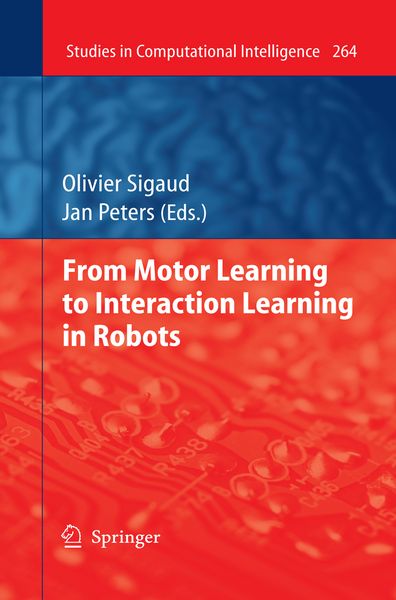
From Motor Learning to Interaction Learning in Robots

10% sparen

197,99 € UVP 219,99 €

inkl. gesetzl. MwSt., Versandkostenfrei


Beschreibung

Produktdetails

Einband

Gebundene Ausgabe

Erscheinungsdatum

04.02.2010

Herausgeber

Olivier Sigaud + weitere

Verlag

Springer Berlin

Seitenzahl

538

Maße (L/B/H)

24,1/16/3,9 cm

Gewicht

1087 g

Auflage

2010

Sprache

Englisch

ISBN

978-3-642-05180-7

Beschreibung

Produktdetails

Einband

Gebundene Ausgabe

Erscheinungsdatum

04.02.2010

Herausgeber

Verlag

Springer Berlin

Seitenzahl

538

Maße (L/B/H)

24,1/16/3,9 cm

Gewicht

1087 g

Auflage

2010

Sprache

Englisch

ISBN

978-3-642-05180-7

Herstelleradresse

Springer-Verlag KG
Sachsenplatz 4-6
1201 Wien
AT

Email: ProductSafety@springernature.com

Kundinnen und Kunden meinen

0 Bewertungen

Informationen zu Bewertungen

Zur Abgabe einer Bewertung ist eine Anmeldung im Konto notwendig. Die Authentizität der Bewertungen wird von uns nicht überprüft. Wir behalten uns vor, Bewertungstexte, die unseren Richtlinien widersprechen, entsprechend zu kürzen oder zu löschen.

Die Bewertungen sind nach Format, Anzahl Sterne und Datum sortiert.

Verfassen Sie die erste Bewertung zu diesem Artikel

Helfen Sie anderen Kund*innen durch Ihre Meinung

Kundinnen und Kunden meinen

0 Bewertungen filtern

  • Produktbild: From Motor Learning to Interaction Learning in Robots
  • Produktbild: From Motor Learning to Interaction Learning in Robots
  • From Motor Learning to Interaction Learning in Robots.- From Motor Learning to Interaction Learning in Robots.- I: Biologically Inspired Models for Motor Learning.- Distributed Adaptive Control: A Proposal on the Neuronal Organization of Adaptive Goal Oriented Behavior.- Proprioception and Imitation: On the Road to Agent Individuation.- Adaptive Optimal Feedback Control with Learned Internal Dynamics Models.- The SURE_REACH Model for Motor Learning and Control of a Redundant Arm: From Modeling Human Behavior to Applications in Robotics.- Intrinsically Motivated Exploration for Developmental and Active Sensorimotor Learning.- II: Learning Policies for Motor Control.- Learning to Exploit Proximal Force Sensing: A Comparison Approach.- Learning Forward Models for the Operational Space Control of Redundant Robots.- Real-Time Local GP Model Learning.- Imitation and Reinforcement Learning for Motor Primitives with Perceptual Coupling.- A Bayesian View on Motor Control and Planning.- Methods for Learning Control Policies from Variable-Constraint Demonstrations.- Motor Learning at Intermediate Reynolds Number: Experiments with Policy Gradient on the Flapping Flight of a Rigid Wing.- III: Imitation and Interaction Learning.- Abstraction Levels for Robotic Imitation: Overview and Computational Approaches.- Learning to Imitate Human Actions through Eigenposes.- Incremental Learning of Full Body Motion Primitives.- Can We Learn Finite State Machine Robot Controllers from Interactive Demonstration?.- Mobile Robot Motion Control from Demonstration and Corrective Feedback.- Learning Continuous Grasp Affordances by Sensorimotor Exploration.- Multimodal Language Acquisition Based on Motor Learning and Interaction.- Human-Robot Cooperation Based on Interaction Learning.