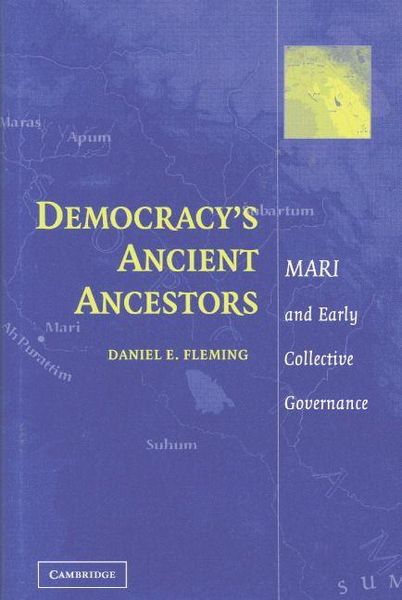

Democracy's Ancient Ancestors Mari and Early Collective Governance
-
- Hardcover ausgewählt
- Taschenbuch
- eBook
-
Sprache:Englisch
108,99 €
inkl. gesetzl. MwSt.,
Beschreibung
Produktdetails
Einband
Gebundene Ausgabe
Erscheinungsdatum
28.04.2015
Verlag
Cambridge AcademicSeitenzahl
390
Maße (L/B/H)
23,5/15,7/2,7 cm
Gewicht
740 g
Sprache
Englisch
ISBN
978-0-521-82885-7
Democracy's Ancient Ancestors examines the political landscape of the ancient Near East through the archive of over 3000 letters found in the royal palace of Mari. These letters display a rich diversity of political actors, encompassing major kingdoms, smaller states and various tribal towns. Mari's unique contribution to the ancient evidence is its view of tribal organization, made possible especially by the fact that its king Zimri-Lim was first of all a tribal ruler, who claimed Mari as an administrative base and source of prestige. These archaic political traditions are not essentially unlike the forms of pre-democratic Greece, and they offer fresh reason to recognize a cultural continuity between the classical world of the Aegean and the older Near East. This book bridges several areas of interest, including archaeology, ancient and classical history, early Middle and Near East, and political and social history.
Noch keine Bewertungen vorhanden
Verfassen Sie die erste Bewertung zu diesem Artikel
Helfen Sie anderen Kundinnen und Kunden durch Ihre Meinung.
Kurze Frage zu unserer Seite
Vielen Dank für Ihr Feedback
Wir nutzen Ihr Feedback, um unsere Produktseiten zu verbessern. Bitte haben Sie Verständnis, dass wir Ihnen keine Rückmeldung geben können. Falls Sie Kontakt mit uns aufnehmen möchten, können Sie sich aber gerne an unseren Kund*innenservice wenden.
zum Kundenservice