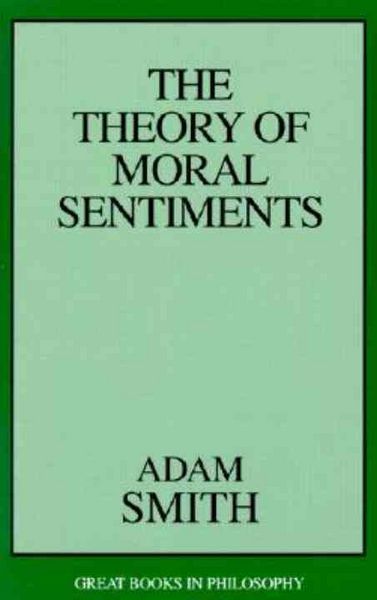
The Theory of Moral Sentiments
-
- Hardcover
- Taschenbuch ausgewählt
- eBook
-
Sprache:Englisch
-
Verlag:Random House N.Y.
- Legare Street Press 29,99 €
- Editorium 21,99 €
- Gyan Books 29,99 €
- Www.bnpublishing.net 19,99 €
- Cassell 16,99 €
- Sanage Publishing House Llp 31,99 €
- Liberty Fund Inc 17,99 €
- Random House N.Y. 17,99 € ausgewählt
- Alpha Edition 34,99 €
- Digireads.com 18,99 €
- Creative Media Partners, LLC 29,99 €
- Cosimo Classics 27,99 €
- Cedar Lake Classics 29,99 €
- Dover Publications 15,99 €
- Hansebooks 31,80 €
- Imprint Academic 34,99 €
- Antiquum Novum Verlag 31,99 €
17,99 €
inkl. gesetzl. MwSt.,
- Kostenlose Lieferung ab 30 € Einkaufswert
- Versandkostenfrei für Bonuscard-Kund*innen
Beschreibung
Produktdetails
Einband
Taschenbuch
Erscheinungsdatum
01.05.2000
Verlag
Random House N.Y.Seitenzahl
546
Maße (L/B/H)
21,2/13,9/2,7 cm
Gewicht
614 g
Sprache
Englisch
ISBN
978-1-57392-800-7
To those who know Adam Smith principally by his classic treatise on economics, The Wealth of Nations, this earlier work may come as a revelation. Smith is often misrepresented in the public imagination as a cold, calculating rationalist espousing the pursuit of self-interest in the marketplace of laissez-faire capitalism, regardless of the human cost. This grossly inaccurate portrait may go back to Karl Marx, who seems not to have read Smith's work very carefully and thus criticized him as an unfeeling advocate of a system that exploited and alienated workers.
The Theory of Moral Sentiments, however, clearly demonstrates that besides mundane economic pursuits, Smith was just as interested, if not more so, in the capacity of people to bestow and to esteem benevolence, and to strive for virtue even while they are pursuing their own self-interest. The root of our motivation to act benevolently toward others, says Smith, is our natural propensity to sympathize with others. By the same token, our need to have others sympathize with us fuels our desire to be esteemed by others for our benevolence and generally virtuous character. But beyond the need for social approbation, we also have a genuine desire to live according to the dictates of conscience (called by Smith the "Impartial Spectator"). This is our highest impulse and leads us continually to strive for excellence in all spheres of life quite apart from any recognition or encouragement from others. It may be prudent in our economic life to follow our self-interest to secure the basic necessities, but this is only the first stage of personal development toward the much higher goal of living a morally virtuous life.
Although The Theory of Moral Sentiments is not well known today, it was widely read and highly praised by the leading intellectuals of the day including David Hume and Edmund Burke. The book went through six different editions between 1759 and 1790 and was also translated into French by the widow of Condorcet. To gain a complete picture of Adam Smith and his ideas, every reader of The Wealth of Nations should also become familiar with his classic treatment of ethics.
Noch keine Bewertungen vorhanden
Verfassen Sie die erste Bewertung zu diesem Artikel
Helfen Sie anderen Kundinnen und Kunden durch Ihre Meinung.
Kurze Frage zu unserer Seite
Vielen Dank für Ihr Feedback
Wir nutzen Ihr Feedback, um unsere Produktseiten zu verbessern. Bitte haben Sie Verständnis, dass wir Ihnen keine Rückmeldung geben können. Falls Sie Kontakt mit uns aufnehmen möchten, können Sie sich aber gerne an unseren Kund*innenservice wenden.
zum Kundenservice