
Gutscheinbedingungen

**Gültig bis 06.07.2026 auf fremdsprachige Bücher online auf thalia.at, in der Thalia App ab einem Mindestbestellwert von 30€ und in allen Thalia Buchhandlungen in Österreich. In den Buchhandlungen nur gültig auf lagernde Ware. Einzelne Artikel können ausgeschlossen sein. Ausgenommen sind preisgebundene Artikel & eBooks. Pro Einkauf einmal einlösbar. Nur gültig gegen Vorlage oder im Onlineshop hinterlegter Bonuscard. Infos zur Einlösung in der Buchhandlung sind auf der Bonuscard-Vorteilspreisseite zu finden. Click & Collect nur bei Onlinevorabzahlung möglich. Keine Einlösung bei Scan & Go-Bezahlung. Keine Barauszahlung. Nicht kombinierbar mit anderen Aktionen und Gutscheinen. Gutschein wird auf max. 500€ Bestellwert angerechnet. Nicht gültig für Versandkosten und Services.

  • Produktbild: Social Movements and Organization Theory
  • Produktbild: Social Movements and Organization Theory

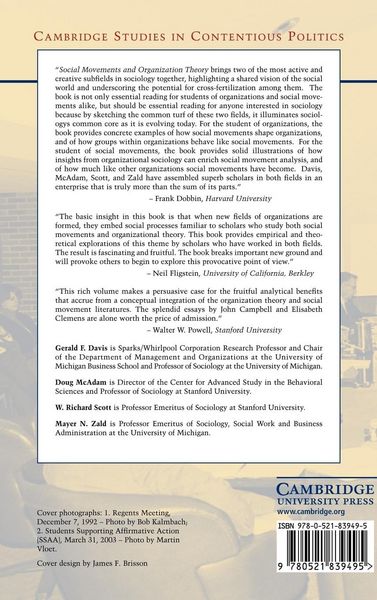
Social Movements and Organization Theory

123,99 €

inkl. gesetzl. MwSt., Versandkostenfrei


Beschreibung

Produktdetails

Einband

Gebundene Ausgabe

Erscheinungsdatum

18.04.2009

Herausgeber

Gerald F. Davis + weitere

Verlag

Cambridge Academic

Seitenzahl

456

Maße (L/B/H)

23,5/15,7/3,1 cm

Gewicht

840 g

Sprache

Englisch

ISBN

978-0-521-83949-5

Beschreibung

Produktdetails

Einband

Gebundene Ausgabe

Erscheinungsdatum

18.04.2009

Herausgeber

Verlag

Cambridge Academic

Seitenzahl

456

Maße (L/B/H)

23,5/15,7/3,1 cm

Gewicht

840 g

Sprache

Englisch

ISBN

978-0-521-83949-5

Herstelleradresse

Libri GmbH
Europaallee 1
36244 Bad Hersfeld
DE

Email: Libri GmbH

Noch keine Bewertungen vorhanden

Verfassen Sie die erste Bewertung zu diesem Artikel

Helfen Sie anderen Kundinnen und Kunden durch Ihre Meinung.

Kundinnen und Kunden meinen

Bewertungen (0)

  • Produktbild: Social Movements and Organization Theory
  • Produktbild: Social Movements and Organization Theory
  • Part I. Creating a Common Framework: 1. Organizations and movements Doug McAdam and W. Richard Scott; 2. Where do we stand? Common mechanisms in organizations and social movements research John L. Campbell; Part II. Political and Mobilization Context: 3. Institutional variation in the evolution of social movements: competing logics and the spread of recycling advocacy groups Michael Lounsbury; 4. Elite mobilizations for antitakeover legislation, 1982-1990 Timothy Vogus and Gerald F. Davis; 5. Institutionalization as a contested, multilevel process: the case of rate regulation in American fire insurance Marc Schneiberg and Sarah A. Soule; 6. From struggle to settlement: the crystallization of a field of lesbian/gay organizations in San Francisco, 1969-1973 Elizabeth Armstrong; Part III. Social Movement Organizations: Form and Structure: 7. Persistence and change among federated social movement organizations John McCarthy; 8. Globalization and transnational social movement organizations Jackie Smith; Part IV. Movements Penetrating Organizations: 9. How do social movements penetrate organizations? Environmental impact and organizational response Mayer N. Zald, Calvin Morrill, and Hayagreeva Rao; 10. Organizational change as an orchestrated social movement: recruitment to a corporate quality initiative David Strang and Dong-Il Jung; 11. Subventing our stories of subversion Maureen A. Scully and W. E. Douglas Creed; Part V. Conclusion: 12. Social change, social theory, and the convergence of movements and organizations Gerald F. Davis and Mayer N. Zald; 12. Two kinds of stuff: the current encounter of social movements and organizations Elizabeth Clemens.