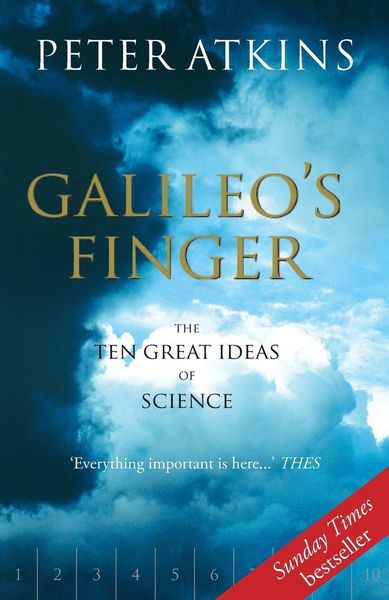
Galileo's Finger The Ten Great Ideas of Science
-
- Englisch ausgewählt
29,99 €
inkl. gesetzl. MwSt.,
- Kostenlose Lieferung ab 30 € Einkaufswert
- Versandkostenfrei für Bonuscard-Kund*innen
Beschreibung
Produktdetails
Einband
Taschenbuch
Erscheinungsdatum
27.05.2004
Abbildungen
numerous halftones & figures
Verlag
Oxford University PressSeitenzahl
398
Maße (L/B/H)
19,8/12,9/2,1 cm
Gewicht
422 g
Sprache
Englisch
ISBN
978-0-19-860941-4
His choice of the ten great ideas are:
* Evolution occurs by natural selection, in which the early attempts at explaining the origin of species is followed by an account of the modern approach and some of its unsolved problems.
* Inheritance is encoded in DNA, in which the story of the emergence of an understanding of inheritance is followed through to the mapping of the human genome.
* Energy is conserved, in which we see how the central concept of energy gradually dawned on scientists as they mastered the motion of particles and the concept of heat.
* All change is the consequence of the purposeless collapse of energy and matter into disorder, in which the extraordinarily simple concept of entropy is used to account for events in the world.
* Matter is atomic, in which we see how the concept of atoms emerged and how the different personalities of the elements arise from the structures of their atoms.
* Symmetry limits, guides, and drives, in which we see how concepts related to beauty can be extended to understand the nature of fundamental particles and the forces that act between them.
* Waves behave like particles and particles behave like waves, in which we see how old familiar ideas gave way to the extraordinary insights of quantum theory and transformed our perception of matter.
* The universe is expanding, in which we see how a combination of astronomy and a knowledge of elementary particles accounts for the origin of the universe and its long term future.
* Spacetime is curved by matter, in which we see the emergence of the theories of special and general relativity and come to understand the nature of space and time.
* If arithmetic is consistent, then it is incomplete, in which we learn the origin of numbers and arithmetic, see how the philosophy of mathematics lets us understand the nature of this most cerebral of subjects, and are brought to the limits of its power.
C. P. Snow once said 'not knowing the second law of thermodynamics is like never having read a work by Shakespeare'. This is an extraordinary, exciting book that not only will make you literate in science but give you deep enjoyment on the way.
Noch keine Bewertungen vorhanden
Verfassen Sie die erste Bewertung zu diesem Artikel
Helfen Sie anderen Kundinnen und Kunden durch Ihre Meinung.
Kurze Frage zu unserer Seite
Vielen Dank für Ihr Feedback
Wir nutzen Ihr Feedback, um unsere Produktseiten zu verbessern. Bitte haben Sie Verständnis, dass wir Ihnen keine Rückmeldung geben können. Falls Sie Kontakt mit uns aufnehmen möchten, können Sie sich aber gerne an unseren Kund*innenservice wenden.
zum Kundenservice