KI-Beratung Beta

Gutscheinbedingungen

**Gültig bis 30.11.2026 auf Spielzeug, Schreibwaren, Filme, Geschenke & Trends, Musik, tolino eReader & Zubehör, Hörbücher und Hörbuch-Downloads, nicht preisgebundene Bücher und Kalender online auf thalia.at und in der Thalia App. Einzelne Artikel können ausgeschlossen sein. Aufgrund der Buchpreisbindung sind deutschsprachige Bücher und eBooks ausgenommen. Zusätzlich ausgenommen sind Abos & Flatrates, Games, Geschenkkarten/-boxen, Shelfies, Software, Zeitschriften sowie einzelne Artikel von tonies®. Pro Einkauf einmal einlösbar. Nur gültig mit im Onlineshop hinterlegter Bonuscard. Click & Collect nur bei Onlinevorabzahlung möglich. Keine Barauszahlung. Nicht kombinierbar mit anderen Aktionen und Gutscheinen. Gutschein wird auf max. 500€ Bestellwert angerechnet. Nicht gültig für Versandkosten und Services.

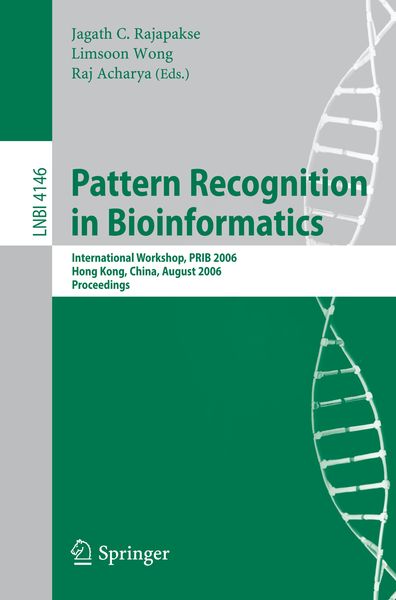
  • Produktbild: Pattern Recognition in Bioinformatics
  • Produktbild: Pattern Recognition in Bioinformatics
Band 4146

Pattern Recognition in Bioinformatics International Workshop, PRIB 2006, Hong Kong, China, August 20, 2006, Proceedings

51,99 €

inkl. gesetzl. MwSt., Versandkostenfrei


Beschreibung

The field of bioinformatics has two main objectives: the creation and maintenance of biological databases, and the discovery of knowledge from life sciences data in order to unravel the mysteries of biological function, leading to new drugs and therapies for human disease. Life sciences data come in...

Beschreibung

The field of bioinformatics has two main objectives: the creation and maintenance of biological databases, and the discovery of knowledge from life sciences data in order to unravel the mysteries of biological function, leading to new drugs and therapies for human disease. Life sciences data come in the form of biological sequences, structures, pathways, or literature. One major aspect of discovering biological knowledge is to search, predict, or model specific patterns of a given dataset, which have some relevance to an important biological phenomenon or another dataset. To date, many pattern recognition algorithms have been applied or catered to address a wide range of bioinformatics problems. The 2006 Workshop of Bioinformatics in Pattern Recognition (PRIB 2006) marks the beginning of a series of workshops that is aimed at gathering researchers applying pattern recognition algorithms in an attempt to resolve problems in computational biology and bioinformatics. This volume presentsthe proceedings of Workshop PRIB 2006 held in Hong Kong, China, on August 20, 2006. It includes 19 technical contributions that were selected by the Program Committee from 43 submissions. We give a brief introduction to pattern recognition in bioinformatics in the first paper. The rest of the volume consists of three parts. Part 1: signal and motif detection, and gene selection. Part 2: models of DNA, RNA, and protein structures. Part 3: biological databases and imaging.

Produktdetails

Einband

Taschenbuch

Erscheinungsdatum

10.08.2006

Abbildungen

XII, 186 p.

Herausgeber Jagath C. Rajapakse + weitere

Produktdetails

Einband

Taschenbuch

Erscheinungsdatum

10.08.2006

Abbildungen

XII, 186 p.

Herausgeber
Verlag Springer Berlin
Seitenzahl

186

Maße (L/B/H)

23,5/15,5/1,2 cm

Gewicht

312 g

Auflage

2006

Sprache

Englisch

ISBN

978-3-540-37446-6

Herstelleradresse

Springer-Verlag KG
Sachsenplatz 4-6
1201 Wien
AT

Email: ProductSafety@springernature.com

Noch keine Bewertungen vorhanden

Verfassen Sie die erste Bewertung zu diesem Artikel

Helfen Sie anderen Kundinnen und Kunden durch Ihre Meinung.

Kundinnen und Kunden meinen

Bewertungen (0)

  • Produktbild: Pattern Recognition in Bioinformatics
  • Produktbild: Pattern Recognition in Bioinformatics
  • Pattern Recognition in Bioinformatics: An Introduction.- Pattern Recognition in Bioinformatics: An Introduction.- 1: Signal and Motif Detection; Gene Selection.- Machine Learning Prediction of Amino Acid Patterns in Protein N-myristoylation.- A Profile HMM for Recognition of Hormone Response Elements.- Graphical Approach to Weak Motif Recognition in Noisy Data Sets.- Comparative Gene Prediction Based on Gene Structure Conservation.- Computational Identification of Short Initial Exons.- Pareto-Gamma Statistic Reveals Global Rescaling in Transcriptomes of Low and High Aggressive Breast Cancer Phenotypes.- Investigating the Class-Specific Relevance of Predictor Sets Obtained from DDP-Based Feature Selection Technique.- A New Maximum-Relevance Criterion for Significant Gene Selection.- 2: Models of DNA, RNA, and Protein Structures.- Spectral Graph Partitioning Analysis of In Vitro Synthesized RNA Structural Folding.- Predicting Secondary Structure of All-Helical Proteins Using Hidden Markov Support Vector Machines.- Prediction of Protein Subcellular Localizations Using Moment Descriptors and Support Vector Machine.- Using Permutation Patterns for Content-Based Phylogeny.- 3: Biological Databases and Imaging.- The Immune Epitope Database and Analysis Resource.- Intelligent Extraction Versus Advanced Query: Recognize Transcription Factors from Databases.- Incremental Maintenance of Biological Databases Using Association Rule Mining.- Blind Separation of Multichannel Biomedical Image Patterns by Non-negative Least-Correlated Component Analysis.- Image and Fractal Information Processing for Large-Scale Chemoinformatics, Genomics Analyses and Pattern Discovery.- Hybridization of Independent Component Analysis, Rough Sets, and Multi-Objective Evolutionary Algorithms for Classificatory Decomposition of Cortical Evoked Potentials.