KI-Beratung Beta

Gutscheinbedingungen

**Gültig bis 18.11.2026 auf englischsprachige Klassiker (klassiker-32728) online auf thalia.at und in der Thalia App. Einzelne Artikel können ausgeschlossen sein. Ausgenommen sind preisgebundene Artikel & eBooks. Pro Einkauf einmal einlösbar. Click & Collect nur bei Onlinevorabzahlung möglich. Keine Barauszahlung. Nicht kombinierbar mit anderen Aktionen und Gutscheinen. Gutschein wird auf max. 500€ Bestellwert angerechnet. Nicht gültig für Geschenkkarten, Versandkosten und Services.

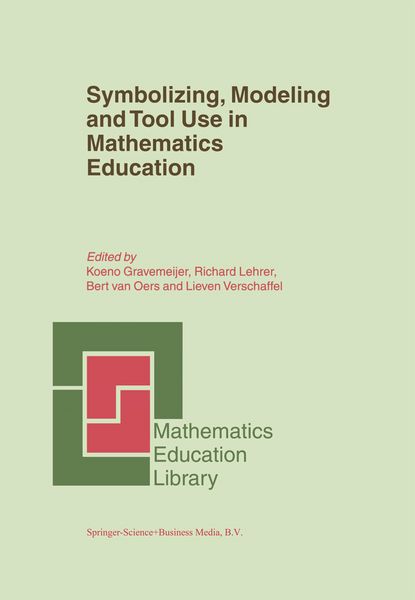
Produktbild: Symbolizing, Modeling and Tool Use in Mathematics Education
Band 30 - 12%

Symbolizing, Modeling and Tool Use in Mathematics Education

12% sparen

144,99 € UVP 164,99 €

inkl. gesetzl. MwSt., Versandkostenfrei


Beschreibung

The almost universal rejection of the notion of symbols as `carriers of meaning' has created the need to find an alternative for the use of models as embodiments of mathematical concepts. By taking its point of departure as a concern for the way students actually use tools and symbols, and for what these...

Beschreibung

The almost universal rejection of the notion of symbols as `carriers of meaning' has created the need to find an alternative for the use of models as embodiments of mathematical concepts. By taking its point of departure as a concern for the way students actually use tools and symbols, and for what these signify for them, this book explores the option of building on symbolizing, modelling and tool use as personally meaningful activities of students. This theme is approached from different angles and different perspectives. One dimension is that of setting, varying from the study of informal, spontaneous activity of students, to an explicit focus on instructional design, and goals and effects of instruction. Another dimension is the theoretical framework of the researcher, varying from constructivism, to activity theory, cognitive-psychology and instructional-design theory. This book will appeal to a wide audience, varying from researchers, instructional designers, educators, and graduate students.

Produktdetails

Einband

Gebundene Ausgabe

Erscheinungsdatum

31.12.2002

Abbildungen

IV, 308 p.

Herausgeber K.P Gravemeijer + weitere

Produktdetails

Einband

Gebundene Ausgabe

Erscheinungsdatum

31.12.2002

Abbildungen

IV, 308 p.

Herausgeber
Verlag Springer Netherland
Seitenzahl

308

Maße (L/B/H)

30,3/21,5/2,3 cm

Gewicht

1015 g

Sprache

Englisch

ISBN

978-1-4020-1032-3

Herstelleradresse

Springer-Verlag KG
Sachsenplatz 4-6
1201 Wien
AT

Email: ProductSafety@springernature.com

Noch keine Bewertungen vorhanden

Verfassen Sie die erste Bewertung zu diesem Artikel

Helfen Sie anderen Kundinnen und Kunden durch Ihre Meinung.

Kundinnen und Kunden meinen

Bewertungen (0)

Weitere Artikel finden Sie in

  • Produktbild: Symbolizing, Modeling and Tool Use in Mathematics Education
  • and overview.- Preamble: from models to modeling.- Section I: Emergent modeling.- to section I: Informal representations and their improvements.- The mathematization of young children’s language.- Symbolizing space into being.- Mathematical representations as systems of notations-in-use.- Students’ Criteria for Representational Adequacy.- Transitions in emergent modeling.- Section II: The role of Models, Symbols and Tools in instructional design.- to section II: The role of Models, Symbols and Tools in instructional design.- Emergent models as an instructional design heuristic.- Modeling, Symbolizing, and Tool Use in Statistical Data Analysis.- Didactic objects and didactic models in radical constructivism.- Taking into account different views: Three brief comments on papers by Gravemeijer & Stephan, Cobb and Thompson.- Section III: Models, situated practices, and generalization.- to section III: Models, situated practices, and generalization.- On Guessing the Essential Thing.- Everyday knowledge and mathematical modeling of school word problems.- On the development of human representional competence from and evolutionary point of view: From Episodic To Virtual Culture.- Modeling Reasoning.