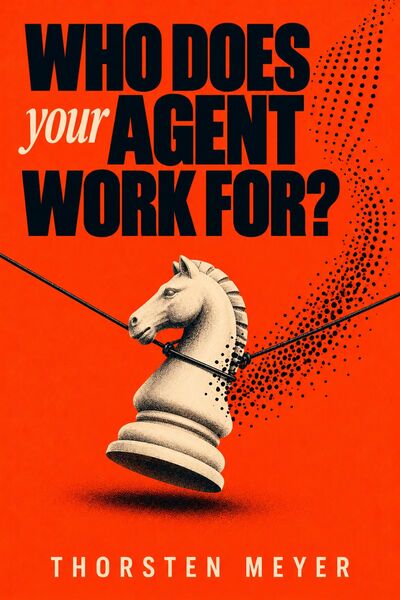
Personal AI agents now remember what we like, choose what we see, buy things for us and answer in our name. This book is for anyone who has tapped "Allow" and wondered what they agreed to.
It starts with a small yes. An assistant offers to remember your preferences, and you tap Allow. In several of the best-known assistants, memory is on unless you switch it off, where the feature is offered. A week of such yeses, each reasonable on its own, can add up to a transfer of information, decisions, money and the right to speak in your name that no one decided on as a whole. The book calls this the delegation trap.
Who Does Your Agent Work For? asks one practical question: how much of your life are you comfortable handing over, and on what terms? It answers with three tests taken from the economist Albert O. Hirschman. Loyalty: whose side is the agent on, when its maker may earn from merchants, advertisers or its own shop? Voice: can you see what it remembers and why it acted, and correct it? Exit: can you leave, and take what it knows?
Following a composite household, Malik and his mother Nadia, the book shows how an agent's memory mixes what you told it, what it observed and what it inferred, and why the inferred layer is the hardest to see. It looks at agents that earn from purchases and ads, and at what Britain learned when it took providers' commissions out of investment advice. It shows how a shortlist can steer without a single false statement, from the airline reservation screens of the 1980s to assistants that agree too readily. It sets out the rights European law already gives you, from access to your data to an explanation of automated decisions, and where they stop: an agent's conclusions about you stay mostly outside the right to take your data with you. It weighs running an agent yourself and what keeping the memory at home costs. A chapter on Exit asks why the agent that knows you best is the hardest to leave, and what the assistants' own data exports actually let you take with you.
Each chapter ends with a "Check it yourself" box of steps you can do in a few minutes. The book closes with a one-page personal delegation policy: what your agents may do alone, what they must ask first and what they must never do, with a spending limit and dates to review their memory and to practice leaving, plus a five-minute version. The appendices hold letter templates for requesting your data in the EU and in California, the policy as a worksheet, and a dated settings checklist for ChatGPT, Gemini, Claude, Copilot and the self-hosted Open WebUI.
Written for European readers first, with short boxes on the United States and the United Kingdom, the book needs no technical background. Every product, policy and legal statement is dated and traced to its source, preferably the primary one, and the notes list those sources with the date they were read. The legal and settings status is November 2, 2026. The book is general information, not legal, financial, tax or medical advice.
The book is open about how it was made: under the author's direction, AI agents researched the sources, drafted the chapters and revised them; every chapter was reviewed twice, independently, by AI reviewers; the exit drill in Chapter 5 is told through a composite household, from the companies' documentation and published research; the author set the plan and the rules and made the main editorial decisions, the agents the day-to-day ones; and he holds editorial responsibility but did not read the complete text before publication. A final editorial pass was done by an AI editor.