KI-Beratung Beta

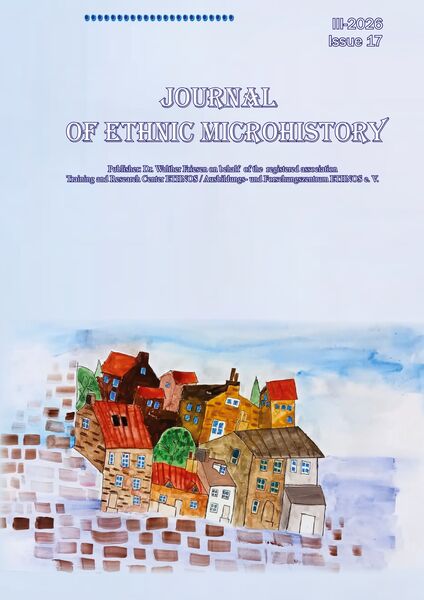
  • Produktbild: Journal of Ethnic Microhistory
  • Produktbild: Journal of Ethnic Microhistory
Band 17 Neu

Journal of Ethnic Microhistory Issue 17, III-2026

12,40 €

inkl. gesetzl. MwSt., zzgl. Versandkosten


  • Kostenlose Lieferung ab 30 € Einkaufswert
  • Versandkostenfrei für Bonuscard-Kund*innen

Beschreibung

The 17th issue (III-2026) of the Journal of Ethnic Microhistory contains four articles.1. The article, written by Alex Dreger and based on a publication in the Dortmund newspaper on 16 April 1879, examines the academic performance of Jewish children in German higher-level schools compared to Protestant...

Beschreibung

The 17th issue (III-2026) of the Journal of Ethnic Microhistory contains four articles.1. The article, written by Alex Dreger and based on a publication in the Dortmund newspaper on 16 April 1879, examines the academic performance of Jewish children in German higher-level schools compared to Protestant and Catholic pupils. Dreger argues that ''it would be more appropriate to consider factors such as the parents' level of education rather than religious affiliation. Indeed, research shows that the student bodies of German ''Gymnasien'' are predominantly made up of pupils whose parents hold university degrees themselves.''2. Following two major smallpox outbreaks in 1870 and 1873 that claimed over 180,000 lives, mandatory vaccination was introduced on 8 April 1874. Through the Imperial Vaccination Act, German Chancellor Otto von Bismarck sought to eradicate the disease once and for all. The Act came into force on 1 April 1875. The debate surrounding mandatory vaccination focused on whether the common good or an individual's right to bodily autonomy was more important. Three years later, the ''Dortmund Newspaper'' (''Dortmunder Zeitung'') launched a discussion under the headline ''On the Vaccination Issue'' (''Zur Impffrage'').3. In his article, Dr Robert Korn analyses literary sources that influenced the forms of satire and humour as elements of dissident subculture in the Soviet Union. In the Soviet Union, anecdotes transformed real-life phenomena into vivid imagery by generalising and exaggerating situations until they became grotesque or even absurd. However, reality itself was often so striking that no embellishment was necessary. In conclusion, Dr Korn cites several popular anecdotes concerning the political leaders of the USSR.4. The second part of ''Sketches'' (the first part was published in issue 16 of the journal) describes various Russia-German groups. Most of these groups migrated to Russia at the end of the 18th and 19th centuries. The author criticises the ''invitation campaign'' staged by the usurper Catherine II. The article also references an early 18th-century source titled ''An Unknown Letter from A. A. Winius to Peter the Great'', in which the Russian statesman Andreas Andreaszon Winius (1641-1717), son of the Russian industrialist Andries Dionyszoon Winius (1605-1662), proves his Frisian origins.

Produktdetails

Einband

Taschenbuch

Erscheinungsdatum

12.11.2026

Verlag BoD – Books on Demand
Seitenzahl

40

Produktdetails

Einband

Taschenbuch

Erscheinungsdatum

12.11.2026

Verlag BoD – Books on Demand
Seitenzahl

40

Maße (L/B/H)

29,7/21/0,3 cm

Gewicht

147 g

Auflage

1

Sprache

Englisch

ISBN

978-3-695-78021-1

Herstelleradresse


Email: info@bod.de

Noch keine Bewertungen vorhanden

Verfassen Sie die erste Bewertung zu diesem Artikel

Helfen Sie anderen Kundinnen und Kunden durch Ihre Meinung.

Kundinnen und Kunden meinen

Bewertungen (0)

Die Leseprobe wird geladen.
  • Produktbild: Journal of Ethnic Microhistory
  • Produktbild: Journal of Ethnic Microhistory