KI-Beratung Beta

Gutscheinbedingungen

**Gültig bis 30.11.2026 auf Spielzeug, Schreibwaren, Filme, Geschenke & Trends, Musik, tolino eReader & Zubehör, Hörbücher und Hörbuch-Downloads, nicht preisgebundene Bücher und Kalender online auf thalia.at und in der Thalia App. Einzelne Artikel können ausgeschlossen sein. Aufgrund der Buchpreisbindung sind deutschsprachige Bücher und eBooks ausgenommen. Zusätzlich ausgenommen sind Abos & Flatrates, Games, Geschenkkarten/-boxen, Shelfies, Software, Zeitschriften sowie einzelne Artikel von tonies®. Pro Einkauf einmal einlösbar. Nur gültig mit im Onlineshop hinterlegter Bonuscard. Click & Collect nur bei Onlinevorabzahlung möglich. Keine Barauszahlung. Nicht kombinierbar mit anderen Aktionen und Gutscheinen. Gutschein wird auf max. 500€ Bestellwert angerechnet. Nicht gültig für Versandkosten und Services.

Produktbild: Renewable Energy and Environmental Sustainability
Vorbesteller Neu

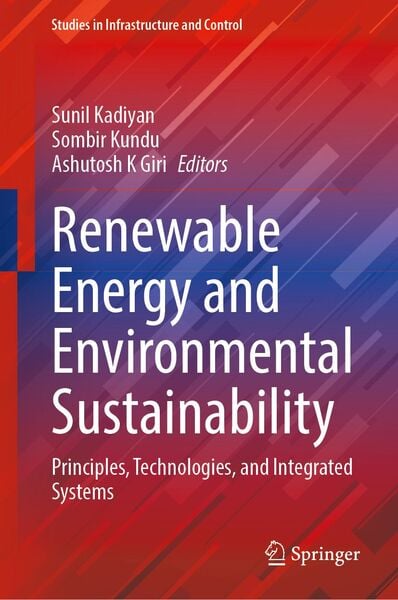
Renewable Energy and Environmental Sustainability Principles, Technologies, and Integrated Systems

219,99 €

inkl. gesetzl. MwSt., Versandkostenfrei


Beschreibung

This book presents a comprehensive and systematic framework for renewable energy and environmental sustainability, with a strong emphasis on the integration of diverse renewable energy sources, energy conversion technologies, and sustainable system architectures. It explains the fundamental principles...

Beschreibung

This book presents a comprehensive and systematic framework for renewable energy and environmental sustainability, with a strong emphasis on the integration of diverse renewable energy sources, energy conversion technologies, and sustainable system architectures. It explains the fundamental principles and advanced concepts required for the design and operation of low-carbon, energy-efficient, and environmentally responsible energy systems. By addressing both resource assessment and system integration, the book provides a holistic understanding of modern sustainable energy infrastructures. The book discusses renewable energy technologies such as solar, wind, hydro, biomass, geothermal, and hydrogen energy systems, along with their integration into hybrid and smart energy networks. Advanced power electronics interfaces, grid-connected and standalone system architectures, and control strategies are presented in detail to ensure efficient power conversion, high power quality, and reliable operation under variable environmental and load conditions. Emphasis is placed on adaptive, robust, and optimization-based control techniques that enhance system stability, operational flexibility, and overall efficiency. The book bridges the gap between theoretical development and real-world implementation by presenting validated system models, numerical illustrations, and representative case studies.

Portrait

Dr. Sunil Kadiyan is an Associate Professor in the Department of Mechanical Engineering at Ganga Institute of Technology and Management (GITAM), Kablana, Haryana, India. He obtained his bachelor’s degree in mechanical engineering from NCCE, Israna (Kurukshetra University) in 2008, followed by a master’s degree in mechanical engineering from Deenbandhu Chhotu Ram University of Science and Technology (DCRUST), Murthal in 2011. He earned his Ph.D. in Materials Science and Nanotechnology from DCRUST, Murthal in 2020, with research focused on severe plastic deformation and microstructure evolution of engineering alloys. He began his academic career in 2011 at Panipat Institute of Technology and Management, Samalkha, where he served for nearly nine years as an Assistant Professor and contributed to both academic and administrative activities. Since November 2021, he has been associated with GITAM, Kablana, where he is actively involved in teaching, research, and institutional quality initiatives. Dr. Kadiyan has published extensively in high-impact international journals and conferences indexed in SCI/SCIE and Scopus, with publications appearing in Elsevier, Springer, Taylor & Francis, Wiley, IEEE, and IOP venues.

Dr. Sombir Kundu received his B.Tech. degree in Electrical Engineering from Maharishi Dayanand University (MDU), Rohtak, Haryana, India, in 2011, and his M.Tech. degree in Electrical Engineering (Power Systems) from Deenbandhu Chhotu Ram University of Science and Technology (DCRUST), Murthal, Haryana, India, in 2014. He received his Ph.D. degree in Electrical Engineering from Delhi Technological University (DTU), New Delhi, India, in 2023. He began his academic career in August 2014 as an Assistant Professor in the Department of Electrical Engineering, School of Engineering and Technology, a unit of Ganga Technical Campus, Bahadurgarh, Haryana, India. In May 2022, he joined the Department of Electrical Engineering, Ganga Institute of Technology and Management, Jhajjar, Haryana, India, as an Assistant Professor. He is currently serving as an Associate Professor in the Department of Electrical Engineering at MMEC, Maharishi Markandeshwar (Deemed to be University), Mullana, Ambala, Haryana, India. Dr. Kundu has authored and co-authored 47 research publications in reputed international journals and conferences, including publications in IEEE Transactions and journals published by Elsevier, Wiley, Taylor & Francis, and Springer. He has also contributed five book chapters published by Elsevier and CRC Press and has edited a book published by Springer Nature, Singapore.

Dr. Ashutosh K Giri received his Bachelor of Engineering in Electrical Engineering from College of Technology, G. B. Pant University of Agriculture and Technology, Pantnagar Uttarakhand, India, in 2002, M.E in Electrical Engineering with specialization in Power System from the L.D. College of Engineering, Ahmedabad, Gujarat, India in 2005 and PhD from the department of Electrical Engineering, Sardar Vallabh National Institute of Technology, Surat, India in 2020. In May 2011, he joined the Department of Electrical Engineering, Government Engineering College, Bharuch, as an Assistant Professor. He has authored and co-authored more than 100 research articles in reputed journals such as IEEE Transactions, IET Journal, Wiley, Tailor Francis, Springer etc. This includes 52 journal papers, 18 conference papers, 18 book chapters published in Elsevier, Springer Publication and CRC Press and 6 published books. He is working on two sponsored research projects. He has supervised three PhD theses and supervising or co-supervising 3 more PhD students and have coordinated 6 Short Term Courses. He has delivered more than 47 national and international level expert talks at various reputed universities across India.
Produktdetails

Einband

Gebundene Ausgabe

Erscheinungsdatum

01.05.2027

Abbildungen

Approx. 300 p. 100 illus.

Herausgeber Sunil Kadiyan + weitere

Produktdetails

Einband

Gebundene Ausgabe

Erscheinungsdatum

01.05.2027

Abbildungen

Approx. 300 p. 100 illus.

Herausgeber
Verlag Springer
Seitenzahl

72

Maße (B/H)

15,5/23,5 cm

Sprache

Englisch

ISBN

978-3-032-47628-9

Herstelleradresse

Springer Nature Customer Service Center GmbH
Europaplatz 3
69115 Heidelberg
DE
ProductSafety@springernature.com

Noch keine Bewertungen vorhanden

Verfassen Sie die erste Bewertung zu diesem Artikel

Helfen Sie anderen Kundinnen und Kunden durch Ihre Meinung.

Kundinnen und Kunden meinen

Bewertungen (0)

  • Produktbild: Renewable Energy and Environmental Sustainability
  • Chapter 1: Energy, Environment, and Sustainability – An Overview.- Chapter 2 Fundamentals of Energy Conversion and Resource Assessment.- Chapter 3 Solar Energy and Sustainable Utilization.- Chapter 4 Wind Energy Systems and Ecological Considerations.- Chapter 5 Hydropower, Tidal, and Wave Energy - Balancing Power and Ecology.- Chapter 6 Geothermal Energy and Sustainable Resource Management.- Chapter 7 Biomass and Bioenergy for a Circular and Sustainable Economy.- Chapter 8 Hydrogen and Fuel Cells for a Sustainable Future.- Chapter 9 Energy Storage and Sustainable Grid Management.- Chapter 10 Hybrid Renewable Systems and Sustainable Micro-grids.- Chapter 11 Smart Grid Integration and Environmental Impacts.- Chapter 12 Life Cycle Assessment and Environmental Impact of Renewable Systems.- Chapter 13 Policies, Regulations, and Sustainable Energy Transition.