KI-Beratung Beta

Produktbild: Electrospinning and Nanofiber Technology
Vorbesteller Neu

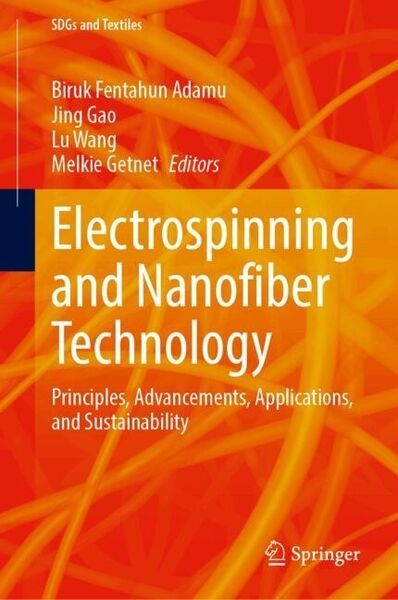
Electrospinning and Nanofiber Technology Principles, Advancements, Applications, and Sustainability

Aus der Reihe SDGs and Textiles

274,99 €

inkl. gesetzl. MwSt., Versandkostenfrei


Beschreibung

This book addresses the critical need for innovative nanofibers and advanced processing techniques in electrospinning, establishing it as an essential resource aimed the rapid growth of research and innovations related to nanofibers and electrospinning. Worldwide, nanofibers

are among the most extensively...

Beschreibung

This book addresses the critical need for innovative nanofibers and advanced processing techniques in electrospinning, establishing it as an essential resource aimed the rapid growth of research and innovations related to nanofibers and electrospinning. Worldwide, nanofibers

are among the most extensively exploited research areas across various fields; thus, this book serves as a compressive reference as it covers fundamental principles, materials, the latest innovative techniques, diverse applications, and sustainability, while also examining advanced processing methods that improve sustainable production. It examines cutting-edge electrospinning techniques, including coaxial electrospinning, emulsion electrospinning, multi-needle electrospinning, needleless electrospinning, aligned fiber electrospinning,

alternative current based and pulsed voltage electrospinning technologies. Additionally, green electrospinning methods that promote sustainability will be discussed. The challenges and future prospects of electrospinning and nanofiber technology will also be addressed.

Adopting a multidisciplinary approach that combines knowledge from materials science, textile engineering, and environmental science, the book provides a comprehensive examination of sustainability. This renders it especially appropriate for sustainable development professionals, in addition to researchers and students engaged in environmental science, textile science and engineering, and materials science across all educational levels.

Portrait

Biruk Fentahun Adamu is an Assistant Professor at the Ethiopian Institute of Textile and Fashion Technology, Bahir Dar University, Ethiopia. He holds a Ph.D. in Textile Engineering from Donghua University, China, awarded through the Chinese Government Scholarship (2019–2025). He has over 12 years of teaching and research experience. He has published 37+ journal articles, authored 10 book chapters (including three in Cotton Science and Processing Technology, Springer Nature), and reviewed over 100 manuscripts. He teaches MSc courses such as Advanced Material Manufacturing, Textile and Garment Testing, and Woven Fabric Manufacturing. His research focuses on electrospinning, nanofibrous mats, fiber processing, biomedical textiles, and advanced materials.

Jing Gao is Professor and PhD Supervisor at the College of Textiles, Donghua University, China. She is Associate Director of the High-tech Textile Department and Deputy Director of the Key Laboratory of Bio-based Fiber Materials of Textile Industry. She earned her Ph.D. in Textile Engineering from Donghua University. Her research includes biomedical textiles, electrospun nanofibers, wound dressings, drug delivery systems, smart textiles, and functional composites. She has led or participated in 20+ national and provincial projects, including China’s National Key R&D Program, 863 Program, NSFC, and industry collaborations. She has published 100+ papers, filed 25 invention patents (13 granted) and 3 utility models (1 granted), and received over 10 provincial/ministerial awards in science and teaching.

Lu Wang is Professor at Donghua University and Director of the Key Laboratory of Textile Science and Technology, Ministry of Education, China. She earned her BSc and MSc from Donghua University and Ph.D. in Biomedical Textiles from the University of Haute-Alsace, France. Since 2003, she has focused on biomedical textiles including vascular grafts, sutures, meshes, dressings, and degradable implants. She has led projects under China’s 111 Project, National Key R&D Program, NSFC, and Shanghai Science and Technology Commission, and participated in international collaborations (EU Asia-Link, Australia CAWIN, US NSF). She has published 250+ papers, holds 132 patents (108 granted), contributed to 11 books, and received multiple national and provincial awards.

Melkie Getnet Tadesse is Assistant Professor of Textile Chemistry at Bahir Dar University, Ethiopia. He earned his BSc (2007) and MSc (2013) in Textile Technology from Bahir Dar University and Ph.D. in Textile Materials Technology (2019) through a joint program involving University of Borås (Sweden), Gheorghe Asachi Technical University (Romania), and Soochow University (China). He has postdoctoral experience supported by the ExiST project and the Alexander von Humboldt Foundation (Germany, 2022–2025). His research interests include intelligent textiles, conductive textiles, supercapacitors, plasma technology, and AI-based textile modeling (FNN, CNN). He has reviewed 242+ manuscripts, published 55+ papers and book chapters, holds an h-index of 20 and i10-index of 25, with 1021+ citations since 2017. He is currently an AvH Fellow and Assistant Professor at Bahir Dar University.
Produktdetails

Einband

Gebundene Ausgabe

Erscheinungsdatum

11.04.2027

Abbildungen

Approx. 500 p. 150 illus., 50 illus. in color.

Herausgeber Biruk Fentahun Adamu + weitere

Produktdetails

Einband

Gebundene Ausgabe

Erscheinungsdatum

11.04.2027

Abbildungen

Approx. 500 p. 150 illus., 50 illus. in color.

Herausgeber
Verlag Springer Singapore
Seitenzahl

14

Maße (B/H)

15,5/23,5 cm

Sprache

Englisch

ISBN

978-981-9287-02-4

Herstelleradresse

Springer Nature Customer Service Center GmbH
Europaplatz 3
69115 Heidelberg
DE
ProductSafety@springernature.com

Noch keine Bewertungen vorhanden

Verfassen Sie die erste Bewertung zu diesem Artikel

Helfen Sie anderen Kundinnen und Kunden durch Ihre Meinung.

Kundinnen und Kunden meinen

Bewertungen (0)

  • Produktbild: Electrospinning and Nanofiber Technology
  • Chapter one: Introduction to Nanofibers and Electrospinning.- Chapter Two: The Physics of Electrospinning: From Polymer solution to jet to fiber.- Chapter Three: Materials for Electrospinning and Their Sustainability Aspects.- Chapter Four: Parameters and Process Control in Electrospinning.- Chapter Five: Functionalization and Surface Modification of Electrospun Nanofibers.- Chapter Six: Structure, Morphology, and Characterization of Nanofibers.- Chapter Seven: Recent Advancements and Sustainable Developments in Electrospinning Technology.- Chapter Eight: Smart and Responsive Electrospun Nanofibers.- Chapter Nine: Applications of Electrospinning Technology in Biomedical Materials.- Chapter Ten: Application of Electrospinning Technology in Energy Harvesting and Storage.- Chapter Eleven: Applications of Electrospinning Technology in Environmental and Sustainability.- Chapter Twelve: Electrospun Nanofibrous Architectures for Sports Medicine: From Tissue Regeneration to Smart Devices.- Chapter Thirteen: Applications of Electrospinning Technology in Industrial and Textile.- Chapter Fifteen: Sustainability and Green Electrospinning.- Chapter Sixteen: Challenges and Future Development Directions in Electrospinning technology.