KI-Beratung Beta

Produktbild: Genetic Programming Theory and Practice XXIII
Vorbesteller Neu

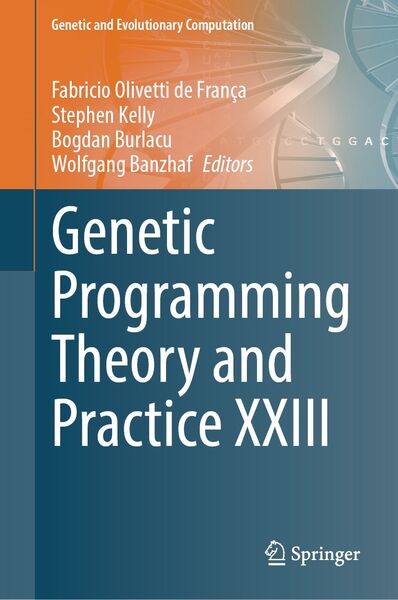
Genetic Programming Theory and Practice XXIII

219,99 €

inkl. gesetzl. MwSt., Versandkostenfrei


Beschreibung

Genetic Programming Theory and Practice brings together some of the most impactful researchers in the field of Genetic Programming (GP), each one working on unique and interesting intersections of theoretical development and practical applications of this evolutionary-based machine learning paradigm....

Beschreibung

Genetic Programming Theory and Practice brings together some of the most impactful researchers in the field of Genetic Programming (GP), each one working on unique and interesting intersections of theoretical development and practical applications of this evolutionary-based machine learning paradigm. Topics of particular interest for this year's volume include powerful modeling techniques through GP-based symbolic regression, novel selection mechanisms that help guide the evolutionary process, modular approaches to GP, and applications in cybersecurity, biomedicine and program synthesis, as well as papers by practitioners of GP that focus on usability and real-world results. In summary, readers will get a glimpse of the current state-of-the-art in GP research.

Portrait

Fabricio Olivetti de Franca is a Professor of Computer Science at the Federal University of ABC, current head of the Heuristics, Analysis and Learning Laboratory (HAL) and the coordinator of the graduate program of computer science at the same university. His work in symbolic regression comprehends the creation of new techniques promoting interpretability, the integration of domain knowledge, and efficiency of the search. He received his PhD in Electrical Engineering from State University of Campinas (UNICAMP). He is also one of the main contributors of SRBench having helped to host multiple competitions for symbolic regression and the current version of SRBench.

Wolfgang Banzhaf is the John R. Koza Chair for Genetic Programming, the first endowed chair dedicated to Evolutionary Computation in the United States, and a professor in the Department of Computer Science and Engineering at Michigan State University, East Lansing, USA. His research interests are in the field of bio-inspired computing, notably evolutionary computation and complex adaptive system, and in particular genetic programming and artificial life. He is the (co-)author of more than 300 scientific contributions and 7 patents. His books and edited volumes include “Genetic Programming – An Introduction” (1998), “Linear Genetic Programming” (2007), “Artificial Chemistries” (2015) and most recently the “Handbook of Evolutionary Machine Learning” (2024).

Stephen Kelly is an artist and Assistant Professor in the Department of Computing and Software at McMaster University. His computer science research investigates how emergent forms of memory and hierarchy allow digital evolution to build algorithms in dynamic, partially-observable, and multi-task temporal sequence prediction environments. His research-creation works are mechatronic art/science hybrids which use nature-inspired computing as raw material for storytelling, activism, and public engagement. He received his PhD in computer science from Dalhousie University, BFA from the Nova Scotia College of Art and Design, and completed an NSERC post-doctoral fellowship at the BEACON Center for the study of Evolution in Action at Michigan State University.

Bogdan Burlacu is a Lecturer in the Department of Automatic Control and Applied Informatics at the "Gheorghe Asachi" Technical University of Iasi, Romania. His research focuses on symbolic regression, evolutionary computation, and high performance computing. He holds a PhD in Machine Learning and is the author of the Operon library, a high-performance open-source framework for genetic programming and symbolic regression. He also serves as a Senior Software Engineer at Nearform.

Produktdetails

Einband

Gebundene Ausgabe

Erscheinungsdatum

24.02.2027

Abbildungen

X, 315 p. 93 illus.

Herausgeber Fabricio Olivetti de França + weitere

Produktdetails

Einband

Gebundene Ausgabe

Erscheinungsdatum

24.02.2027

Abbildungen

X, 315 p. 93 illus.

Herausgeber
Verlag Springer Singapore
Seitenzahl

315

Maße (B/H)

15,5/23,5 cm

Sprache

Englisch

ISBN

978-981-9286-50-8

Herstelleradresse

Springer Nature Customer Service Center GmbH
Europaplatz 3
69115 Heidelberg
DE
ProductSafety@springernature.com

Noch keine Bewertungen vorhanden

Verfassen Sie die erste Bewertung zu diesem Artikel

Helfen Sie anderen Kundinnen und Kunden durch Ihre Meinung.

Kundinnen und Kunden meinen

Bewertungen (0)

  • Produktbild: Genetic Programming Theory and Practice XXIII
  • .- GP and the Quest for AGI — When Goodhart’s Law Turned Out to Be Useful.

    .- Semantics-Aware Context-Free Grammars for Interpretable Biomedical Classification Models.

    .- An Analysis of Pareto Fronts and Lexicase Selection.

    .- Analyzing the Fitness Landscape of a Challenging Real-World Antenna Design Problem: A Case Study.

    .- Every Map an Evolution, Every Room a Generation: Towards Co-Evolution in a Procedurally-Generated Video Game.

    .- Genetic Programming, Time-Series Data Processing, and Dynamical Systems.

    .- GPU-Accelerated Beagle GP Framework with Novel Monte Carlo Ranking Selection Algorithm for Populations in the Millions of Individuals.

    .- Trust, but Verify: Rigorously Profiling Best-Effort High-Performance Computing for Digital Evolution.

    .- Getting Categorical: Moving from Symbolic Regression to Classification.

    .- Identifying potentiating events in evolutionary search using replay experiments.

    .- Individual Populations to Islands to Cells: Population Dynamics While Evolving Parameterized Quantum Circuits.

    .- The Needs of the Few - Information Theory Aided Ensemble Selection for Robustly Generalizing Causal Models.

    .- One Feature Space Does Not Fit All: Evolutionary Feature Construction for KNN-Based Multi-Output Regression.