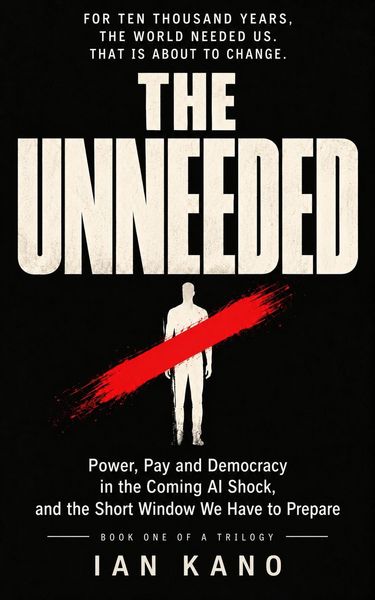
The Unneeded
-
- Einzelkauf Download ausgewählt
-
Sprache:Englisch
0,00 €
inkl. gesetzl. MwSt.Artikel erhalten
Beschreibung
Produktdetails
Format
ePUB
Kopierschutz
Ja
Family Sharing
Ja
Text-to-Speech
Ja
Erscheinungsdatum
19.10.2026
Verlag
Ian KanoSeitenzahl
(Printausgabe)
Dateigröße
1448 KB
Sprache
Englisch
EAN
9789696293941
Every job, every wage, every vote you have ever counted on rests on one quiet fact: someone needed your work.
In October 2020, a car with no one at the wheel began picking up paying passengers in Phoenix. In May 2025, a forty-ton truck drove from Dallas to Houston with no driver, cleared to do so by its own company's safety case. These were not gradual improvements. They were thresholds, and once a machine crosses one, the human job behind it does not shrink. It disappears.
Drawing on six research papers and real-world data, The Unneeded shows why the coming shift will not arrive slowly, one industry at a time, as we have been promised. The know-how is already built. When machines become reliable enough to work alone, sector after sector will tip together. The book's models suggest that between one in six and more than one in three workers could be left without work, with public anger rising in as little as three years where it once took a decade.
In this book you will discover:
- Why automation of physical work will arrive in clusters, not one job at a time
- The "precedent boundary": which work machines can learn, and which only people can do
- How falling human necessity erodes the bargaining power behind wages, welfare and democracy
- What a citizen wealth fund would cost if we start now, and why a decade's delay multiplies the bill up to sevenfold
- Eight principles for keeping people in charge of the machines that replace their work
But this is not a book of doom. It is a book about a window. Act now, and the cost of protecting people is manageable. Wait, and the leverage ordinary people need to shape the outcome will be gone. Ian Kano sets out what must be decided while there is still time to decide it, including the one line no machine should ever cross without a human hand on it.
The question is not whether machines will do the work. It is whether we will still have a say once they do.
Noch keine Bewertungen vorhanden
Verfassen Sie die erste Bewertung zu diesem Artikel
Helfen Sie anderen Kundinnen und Kunden durch Ihre Meinung.
Kurze Frage zu unserer Seite
Vielen Dank für Ihr Feedback
Wir nutzen Ihr Feedback, um unsere Produktseiten zu verbessern. Bitte haben Sie Verständnis, dass wir Ihnen keine Rückmeldung geben können. Falls Sie Kontakt mit uns aufnehmen möchten, können Sie sich aber gerne an unseren Kund*innenservice wenden.
zum Kundenservice