KI-Beratung Beta

Gutscheinbedingungen

**Gültig am 27.11.2026 auf Spielzeug, Schreibwaren, Filme, Geschenke & Trends, Musik, tolino eReader & Zubehör, Hörbücher und Hörbuch-Downloads, nicht preisgebundene Bücher und Kalender online auf thalia.at und in der Thalia App. Einzelne Artikel können ausgeschlossen sein. Aufgrund der Buchpreisbindung sind deutschsprachige Bücher und eBooks ausgenommen. Zusätzlich ausgenommen sind Abos & Flatrates, Games, Geschenkkarten/-boxen, Shelfies, Software, Zeitschriften sowie einzelne Artikel von tonies®. Pro Einkauf einmal einlösbar. Click & Collect nur bei Onlinevorabzahlung möglich. Keine Barauszahlung. Nicht kombinierbar mit anderen Aktionen und Gutscheinen. Gutschein wird auf max. 500€ Bestellwert angerechnet. Nicht gültig für Versandkosten und Services.

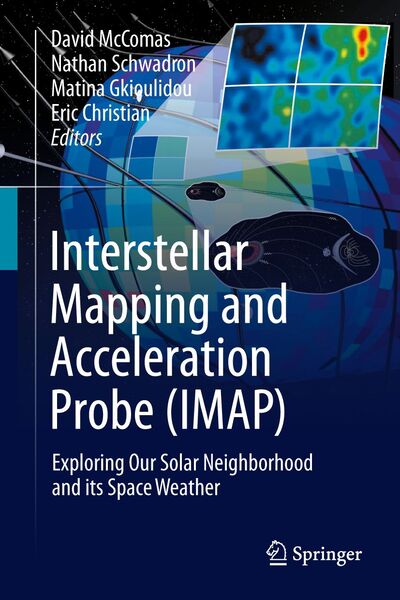
Produktbild: Interstellar Mapping and Acceleration Probe (IMAP)
Vorbesteller Neu

Interstellar Mapping and Acceleration Probe (IMAP) Exploring Our Solar Neighborhood and its Space Weather

219,99 €

inkl. gesetzl. MwSt., Versandkostenfrei


Beschreibung

This book is about NASA’s Interstellar Mapping and Acceleration Probe (IMAP), a pioneering mission designed to investigate how energetic particles are accelerated in space and how the solar wind interacts with the local interstellar medium. Building on the legacy of the IBEX mission, IMAP explores the...

Beschreibung

This book is about NASA’s Interstellar Mapping and Acceleration Probe (IMAP), a pioneering mission designed to investigate how energetic particles are accelerated in space and how the solar wind interacts with the local interstellar medium. Building on the legacy of the IBEX mission, IMAP explores the heliosphere, the boundaries of our solar system, and the processes that shape our galactic environment through a coordinated suite of ten advanced instruments.

This volume brings together contributions from mission scientists and experts to present a comprehensive overview of IMAP’s scientific goals, instrumentation, and mission design. The chapters describe the theoretical and observational foundations of heliospheric and interstellar research, while highlighting the key discoveries and open questions that define the field at the dawn of the IMAP era.

Serving both as a reference and an introduction to this new mission, the book is intended for researchers, graduate students, and advanced undergraduate students in space physics, heliophysics, astrophysics, planetary science, and related disciplines. A basic background in physics and astronomy will help readers fully benefit from the material.

Reprinted from Space Science Reviews, Interstellar Mapping and Acceleration Probe (IMAP), Vol. 221-222, 2025-2026.

Portrait

David J. McComas is Professor of Astrophysical Sciences and Participating Faculty in Mechanical and Aerospace Engineering at Princeton University. He served as Princeton University's Vice President for the Princeton Plasma Physics Laboratory (PPPL) from 2016 to 2024. Dr. McComas serves or has served as Mission Principal Investigator for NASA’s IMAP, IBEX, and TWINS missions. He has served on the National Academies Space Studies Board, the NASA Advisory Council, and as Chair of the NASA Advisory Council Science Committee, as well as on numerous national and international scientific panels. Professor McComas is a Fellow of the American Physical Society (APS), the American Geophysical Union (AGU), and the American Association for the Advancement of Science (AAAS). His honors include the Arctowski Medal, Hannes Alfvén Medal, COSPAR Space Science Award, NASA Exceptional Public Service Medal, and AGU's James B. Macelwane Award. His research focuses on heliophysics and solar-terrestrial interactions.

Nathan A. Schwadron is a Scientist at Los Alamos National Laboratory. He received his B.A. in Physics from Oberlin College and his Ph.D. from the University of Michigan. Dr. Schwadron serves as Deputy Principal Investigator of the Interstellar Mapping and Acceleration Probe (IMAP) mission and leads the IMAP-Lo instrument. He previously served as Principal Investigator of the Cosmic Ray Telescope for the Effects of Radiation (CRaTER) and continues to lead the IBEX Mission Science Operations Center and the Parker Solar Probe ISʘIS Science Center. A Fellow of the AAAS and AGU, his research focuses on particle acceleration and transport, space radiation, and lunar surface processes.

Matina Gkioulidou is a heliophysicist whose research spans space weather, magnetospheric dynamics, and heliosphere-interstellar medium interactions. She earned her bachelor's degree from Aristotle University of Thessaloniki and her Ph.D. from the University of California, Los Angeles (UCLA). She is Project Scientist and Co-Investigator on NASA's Interstellar Mapping and Acceleration Probe (IMAP) mission and led the development of the IMAP-Ultra Energetic Neutral Atom (ENA) imager. She also serves as Deputy Instrument Scientist for the JENI instrument on ESA's Jupiter Icy Moons Explorer (JUICE) mission. Dr. Gkioulidou has authored more than 100 peer-reviewed publications and has served on several NASA and NSF advisory committees. Her research emphasizes energetic particle instrumentation and experimental space physics.

Eric R. Christian is Associate Laboratory Chief of the Heliospheric Science Laboratory at NASA's Goddard Space Flight Center and Lead Scientist of the Energetic Particle Laboratory. He serves as Deputy Principal Investigator for the Integrated Science Investigation of the Sun (ISOIS) instrument suite on Parker Solar Probe and for the Interstellar Mapping and Acceleration Probe (IMAP) mission. He is Mission Scientist for the Interstellar Boundary Explorer (IBEX) and Project Scientist for the Advanced Composition Explorer (ACE). Dr. Christian is also Instrument Scientist for the CRIS and SIS instruments on ACE and Lead Co-Investigator on instruments aboard the STEREO and IMAP missions. A Fellow of the American Association for the Advancement of Science (AAAS), he has received numerous NASA awards. His research focuses on energetic particles and particle detector systems.
Produktdetails

Einband

Gebundene Ausgabe

Erscheinungsdatum

16.04.2027

Abbildungen

Approx. 685 p. 80 illus., 60 illus. in color.

Herausgeber David McComas + weitere

Produktdetails

Einband

Gebundene Ausgabe

Erscheinungsdatum

16.04.2027

Abbildungen

Approx. 685 p. 80 illus., 60 illus. in color.

Herausgeber
Verlag Springer Netherland
Seitenzahl

960

Maße (B/H)

15,5/23,5 cm

Sprache

Englisch

ISBN

978-94-024-2402-7

Herstelleradresse

Libri GmbH
Europaallee 1
36244 Bad Hersfeld
DE

Email: gpsr@libri.de

Noch keine Bewertungen vorhanden

Verfassen Sie die erste Bewertung zu diesem Artikel

Helfen Sie anderen Kundinnen und Kunden durch Ihre Meinung.

Kundinnen und Kunden meinen

Bewertungen (0)

  • Produktbild: Interstellar Mapping and Acceleration Probe (IMAP)
  • Interstellar Mapping and Acceleration Probe (IMAP).- Interstellar Mapping And Acceleration Probe: The NASA IMAP Mission.- The IMAP Observatory Overview.- Science and Mission Operations of the Interstellar Mapping and Acceleration Probe (IMAP).- IMAP’s Role in Understanding Particle Injection and Energization Throughout the Heliosphere.- Exploring the Outer Heliosphere Through ENA Observations from IMAP.- Direct Samples of Interstellar and Interplanetary Material with IMAP.- Solar Wind and Pickup Ion (SWAPI) Instrument on NASA’s Interstellar Mapping and Acceleration Probe (IMAP).- The Compact Dual Ion Composition Experiment (CoDICE) for the IMAP Mission.- The High-Energy Ion Telescope (HIT) for the Interstellar Mapping And Acceleration Probe (IMAP) Mission.- The Solar Wind Electron (SWE) Instrument for the Interstellar Mapping and Acceleration Probe Mission.- The IMAP Magnetometer.- The IMAP-Lo Instrument.- The Interstellar Mapping And Acceleration Probe High Energy (IMAP-Hi) Neutral Atom Imager.- The IMAP-Ultra Energetic Neutral Atom (ENA) Imager.- Interstellar Dust Experiment (IDEX) Onboard NASA’s Interstellar Mapping And Acceleration Probe (IMAP).- GLObal Solar Wind Structure (GLOWS).- Space Weather Science to Enhance Forecasting with the NASA IMAP Active Link for RealTime (I-ALiRT) System.