KI-Beratung Beta

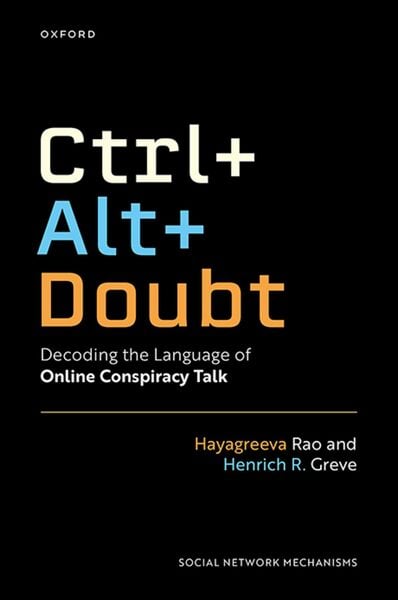
Produktbild: Ctrl+Alt+Doubt

Ctrl+Alt+Doubt Decoding the Language of Online Conspiracy Talk

23,20 €

inkl. gesetzl. MwSt.

Beschreibung

Conspiracy theories are as old as society^-^but never have they spread so fast or so visibly. In an age of social media, moments of crisis and conflict ignite waves of conspiratorial storytelling that reshape how people interpret events, assign blame, and mobilize action. Ctrl+Alt+Doubt offers a new...

Beschreibung

Conspiracy theories are as old as society^-^but never have they spread so fast or so visibly. In an age of social media, moments of crisis and conflict ignite waves of conspiratorial storytelling that reshape how people interpret events, assign blame, and mobilize action. Ctrl+Alt+Doubt offers a new way to understand why conspiracy theories grow and persist. Rather than treating them as cognitive errors, psychological pathologies, or products of echo chambers, Rao and Greve analyze conspiracy theories as linguistic constructions^-^stories built from recognizable semantic patterns. Using tools from distributional semantics, they map the semantic space of conspiracy talk and show how meanings are assembled, recombined, and diffused online. Drawing on cases from COVID-19 and the Black Lives Matter protests, Rao and Greve show that conspiracy theorizing is a form of bricolage: people tinker with cultural fragments to craft explanations that reduce uncertainty and threat. New conspiracy beliefs are most likely to take hold when they are linguistically close to beliefs people already hold. The book traces how conspiracy theories spread through superspreaders, fear-laden language, bots, and shared hashtags^-^revealing conspiracy theorizing as a form of proto-coordination that generates community, amplifies outrage, and enables collective sensemaking among opponents of social movements. By foregrounding language and interaction, Ctrl+Alt+Doubt bridges cultural sociology, computational linguistics, and diffusion theory^-^offering a powerful framework for understanding how conspiracy theories spread and how interventions might be designed to blunt their social harm.

Produktdetails

Format

PDF

Kopierschutz

Ja

Family Sharing

Nein

Text-to-Speech

Nein

Produktdetails

Format

PDF

Format

eBooks im PDF-Format haben eine festgelegte Seitengröße und eignen sich daher nur bedingt zum Lesen auf einem tolino eReader oder Smartphone. Für den vollen Lesegenuss empfehlen wir Ihnen bei PDF-eBooks die Verwendung eines Tablets oder Computers.

Kopierschutz

Ja

Kopierschutz

Zum Lesen dieses eBooks auf Geräten der tolino Familie sowie auf sonstigen eReadern und am PC benötigen Sie eine ByteBook-ID. Weitere Hinweise zum Lesen von kopiergeschützten eBooks finden Sie unter Hilfe/Downloads.

Family Sharing

Nein

Family Sharing

Mit Family Sharing können Sie eBooks innerhalb Ihrer Familie (max. sechs Mitglieder im gleichen Haushalt) teilen. Sie entscheiden selbst, welches Buch Sie mit welchem Familienmitglied teilen möchten. Auch das parallele Lesen durch verschiedene Familienmitglieder ist durch Family Sharing möglich. Um eBooks zu teilen oder geteilt zu bekommen, muss jedes Familienmitglied ein Konto bei Thalia oder einem anderen tolino-Buchhändler haben. Weitere Informationen finden Sie unter Hilfe/Family-Sharing.

Text-to-Speech

Nein

Text-to-Speech

Bedeutet Ihnen Stimme mehr als Text? Mit der Funktion Text-to-Speech können Sie sich im tolino webReader und in der aktuellen Thalia – Lesen & Hören App das eBook vorlesen lassen. Weitere Informationen finden Sie unter Hilfe/Text-to-Speech.

Erscheinungsdatum

15.07.2026

Verlag Oxford University Press
Seitenzahl

176 (Printausgabe)

Dateigröße

5035 KB

Sprache

Englisch

EAN

9780197772300

Barrierefreiheit
  • keine Information zur Barrierefreiheit bekannt

Noch keine Bewertungen vorhanden

Verfassen Sie die erste Bewertung zu diesem Artikel

Helfen Sie anderen Kundinnen und Kunden durch Ihre Meinung.

Kundinnen und Kunden meinen

Bewertungen (0)

Weitere Artikel finden Sie in

Die Leseprobe wird geladen.
  • Produktbild: Ctrl+Alt+Doubt