Neu
Beschreibung
Produktdetails
Format
ePUB
Kopierschutz
Nein
Family Sharing
Ja
Text-to-Speech
Ja
Erscheinungsdatum
29.09.2026
Verlag
Edizioni Aurora BorealeSeitenzahl
(Printausgabe)
Dateigröße
571 KB
Sprache
Englisch
EAN
9791224736042
Edward Herbert Thompson (1857-1935) was an American archaeologist, explorer, and diplomat. His figure is indelibly linked to the on-site rediscovery of the Maya civilization in Yucatán and, in particular, to the momentous explorations of the site of Chichén Itzá.
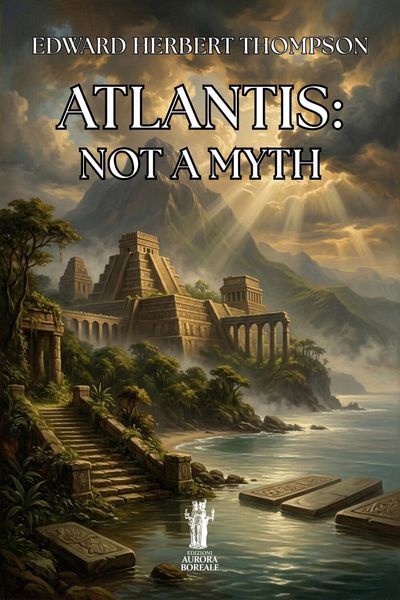
In 1879, at the age of just twenty-two, he published Atlantis: Not a Myth in the periodical Popular Science Monthly. In this short but incisive essay, he argued-drawing upon the theories disseminated at the time by Abbé Charles Étienne Brasseur de Bourbourg-that the monumental vestiges of Central America and the mounds of North America bore witness to the presence of a refined antediluvian civilization originating from or connected to the Atlantean continent described by Plato.
Although he later abandoned the Atlantean diffusionist hypothesis in favor of an indigenous Mesoamerican origin when confronted directly with the evidence on the ground, that article marked the turning point of his life. Indeed, the piece caught the attention of Stephen Salisbury Jr., a wealthy vice president of the American Antiquarian Society, and the businessman Charles P. Bowditch. The two decided to finance Thompson's research in Yucatán, on the condition that he go and test his theories in the field.
When in October 1879 the pages of Popular Science Monthly welcomed the essay Atlantis: Not a Myth, the name of Edward Herbert Thompson did not yet appear in the annals of American archaeology. It was the passionate, erudite, and visionary voice of a youth barely twenty-two years of age, fueled by the fire of intellectual adventure and an intuition that would indelibly shape his entire life.
Far from being a mere period curiosity, this writing stands upon a historical and scientific watershed of extraordinary fruitfulness: that late nineteenth century in which archaeology was taking its first steps between the allure of myth and the rigor of method, before progressive academic specialization erected often impassable barriers against the audacity of grand comparative syntheses.
Rereading Atlantis: Not a Myth today means rediscovering a text permeated by a profound philosophical tension. In its closing lines, Thompson issues an admonition that resonates with remarkable timeliness: an invitation to overcome dogmatic prejudice, to recognize the boundaries of acquired knowledge, and to look upon the human past as a vast, largely unexplored sea. It is the hope of seeing an "Edison of history" arise, capable of reuniting the remote voice of primeval dawns with the clarity of the present, reminding us, in the poet's words, that the noblest study of mankind remains, unfailingly, man himself.
In 1879, at the age of just twenty-two, he published Atlantis: Not a Myth in the periodical Popular Science Monthly. In this short but incisive essay, he argued-drawing upon the theories disseminated at the time by Abbé Charles Étienne Brasseur de Bourbourg-that the monumental vestiges of Central America and the mounds of North America bore witness to the presence of a refined antediluvian civilization originating from or connected to the Atlantean continent described by Plato.
Although he later abandoned the Atlantean diffusionist hypothesis in favor of an indigenous Mesoamerican origin when confronted directly with the evidence on the ground, that article marked the turning point of his life. Indeed, the piece caught the attention of Stephen Salisbury Jr., a wealthy vice president of the American Antiquarian Society, and the businessman Charles P. Bowditch. The two decided to finance Thompson's research in Yucatán, on the condition that he go and test his theories in the field.
When in October 1879 the pages of Popular Science Monthly welcomed the essay Atlantis: Not a Myth, the name of Edward Herbert Thompson did not yet appear in the annals of American archaeology. It was the passionate, erudite, and visionary voice of a youth barely twenty-two years of age, fueled by the fire of intellectual adventure and an intuition that would indelibly shape his entire life.
Far from being a mere period curiosity, this writing stands upon a historical and scientific watershed of extraordinary fruitfulness: that late nineteenth century in which archaeology was taking its first steps between the allure of myth and the rigor of method, before progressive academic specialization erected often impassable barriers against the audacity of grand comparative syntheses.
Rereading Atlantis: Not a Myth today means rediscovering a text permeated by a profound philosophical tension. In its closing lines, Thompson issues an admonition that resonates with remarkable timeliness: an invitation to overcome dogmatic prejudice, to recognize the boundaries of acquired knowledge, and to look upon the human past as a vast, largely unexplored sea. It is the hope of seeing an "Edison of history" arise, capable of reuniting the remote voice of primeval dawns with the clarity of the present, reminding us, in the poet's words, that the noblest study of mankind remains, unfailingly, man himself.
Noch keine Bewertungen vorhanden
Verfassen Sie die erste Bewertung zu diesem Artikel
Helfen Sie anderen Kundinnen und Kunden durch Ihre Meinung.
Kurze Frage zu unserer Seite
Vielen Dank für Ihr Feedback
Wir nutzen Ihr Feedback, um unsere Produktseiten zu verbessern. Bitte haben Sie Verständnis, dass wir Ihnen keine Rückmeldung geben können. Falls Sie Kontakt mit uns aufnehmen möchten, können Sie sich aber gerne an unseren Kund*innenservice wenden.
zum Kundenservice