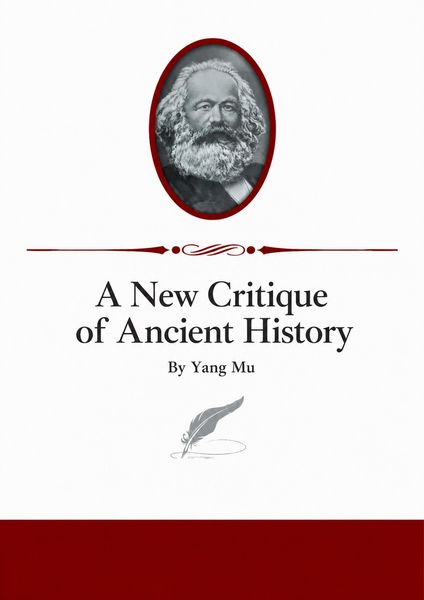
A New Critique of Ancient History
-
- Einzelkauf Download ausgewählt
-
Sprache:Englisch
6,49 €
inkl. gesetzl. MwSt.Beschreibung
Produktdetails
Format
ePUB
Kopierschutz
Ja
Family Sharing
Ja
Text-to-Speech
Ja
Erscheinungsdatum
29.09.2026
Verlag
Minghao LiuSeitenzahl
(Printausgabe)
Dateigröße
4555 KB
Sprache
Englisch
EAN
9798996583225
A New Critique of Ancient History
About the Book
To truly understand Marx is to take up his concept of the "economic formation of society" and use it to study the social and historical development of ancient China. The Zhou, Spring and Autumn, and Warring States periods belong to the era of the "Asiatic mode of production," and any account of them must begin with the origins of the Zhou people, combining historical evidence with theoretical analysis.
A New Critique of Ancient History is a series of specialized studies written from the historical sources after a theory-driven "reading" of Marx. Through close critical investigation, it demonstrates that the legendary Hou Ji was an agricultural deity and officenot a human being, and not the blood ancestor of the Zhou royal house.
The Zhou people originated among the Ji-surnamed clan, rose in eastern Longdong, and flourished at Zhouyuan in Shaanxi. They inherited Xia culture, absorbed Shang culture, and fused with the Siwa and Xindian cultures. Out of this convergence grew a great familial community of the "Asiatic mode of production," bound by blood under the patriarchal chiefs of the Ji clan and joined by marriage alliances with the Jiang-surnamed clan that had branched off from the ancient Qiang.
With Shang Yang's reforms in Qin, the blood-based clan system disintegrated, and the "economic formation of society" of ancient China passed from the "Asiatic" family mode of production into the diverse modes of production of the "Asiatic society" of the Qin, Han, and later eras.
The book thus unites two approaches: a "reading" of Marx's economic-social formations proceeding from theory, and a new critique of ancient history proceeding from the sourceshistory and theory combined.
Contents
• Preface
• Critical Investigation of the Genealogy of the Pre-Dynastic Lords of the Zhou Royal House in the "Basic Annals of Zhou"
• The "Hou Ji" of "Sheng Min" in the "Major Odes" of the Mao Odes Was an Agricultural Deity and Office, Not the Zhou Royal House's Ancestor by Blood: A Critical Examination
• Critical Investigation of Buzhu and Ju in the "Genealogy" of the Pre-Dynastic Lords of the Zhou Royal House in the Records of the Grand Historian
• Historical Evidence concerning the Migration to Bin in "Duke Liu" of the "Major Odes" in the Mao Recension of the Book of Songs
• Critical Investigation of the Historical Facts concerning Danfu's Migration to Qi in "Mian" of the "Major Odes" in the Mao Recension of the Book of Songs
• Traces of the "Asiatic" "Mode of Production" within the "Economic Formation of Society" in the Pre-Zhou Patriarchal Extended Family in "Seventh Month" in the "Bin Odes" of the Mao Recension
• Critical Investigations into Pre-Zhou History through Old Chinese Phonology
• Critical Investigations into Pre-Zhou History through Xia and Shang Archaeology
• Pre-Zhou History in Historical Climatology and the Geographical Environment
About the Author
Mu Yang (pen name of Yang Guoxiang, 19432023) was born in Benxi, Liaoning. He graduated from the Department of History at Lanzhou University and studied under the renowned historian Zhao Lisheng, serving as class monitor among the seven graduate students Professor Zhao recruited on his return in 1978. Clear-minded and indifferent to fame and profit, he held no titles and devoted himself quietly to scholarship. His life's work carried forward his teacher's research on the history of China's land system. Years of sedentary desk work and smoking led to arterial thrombosis of the lower limbs; after a failed operation, his right leg was amputated above the knee shortly before his death. He devoted his life to a single pursuit: following his teacher to the very end.
Classification
The historical development of ancient Chinese society.
Noch keine Bewertungen vorhanden
Verfassen Sie die erste Bewertung zu diesem Artikel
Helfen Sie anderen Kundinnen und Kunden durch Ihre Meinung.
Kurze Frage zu unserer Seite
Vielen Dank für Ihr Feedback
Wir nutzen Ihr Feedback, um unsere Produktseiten zu verbessern. Bitte haben Sie Verständnis, dass wir Ihnen keine Rückmeldung geben können. Falls Sie Kontakt mit uns aufnehmen möchten, können Sie sich aber gerne an unseren Kund*innenservice wenden.
zum Kundenservice