KI-Beratung Beta

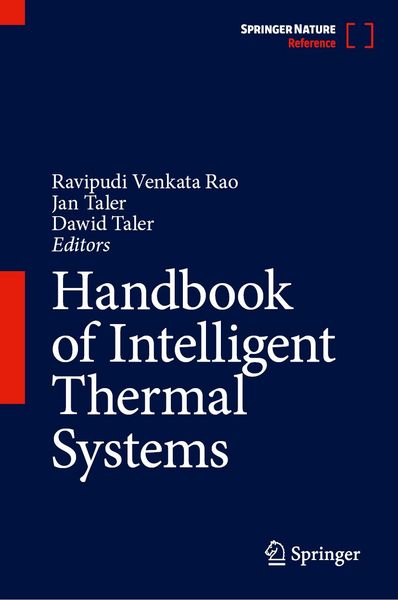
Produktbild: Handbook of Intelligent Thermal Systems
Vorbesteller Neu

Handbook of Intelligent Thermal Systems

769,99 €

inkl. gesetzl. MwSt., Versandkostenfrei


Beschreibung

The subject of this handbook lies at the confluence of thermal engineering, artificial intelligence (AI), and optimization science. It explores the development, analysis, and application of intelligent thermal systems—systems that leverage computational intelligence and data-driven methods to enhance...

Beschreibung

The subject of this handbook lies at the confluence of thermal engineering, artificial intelligence (AI), and optimization science. It explores the development, analysis, and application of intelligent thermal systems—systems that leverage computational intelligence and data-driven methods to enhance design, performance, and decision-making in thermal domains. As global energy demands rise and sustainability becomes critical, improving the efficiency and intelligence of thermal systems is not just desirable—it is essential.

This handbook covers a wide range of topics central to the evolution of intelligent thermal systems. It begins with foundational thermal engineering concepts and progresses toward the integration of AI techniques such as machine learning, deep learning, reinforcement learning, fuzzy logic, and hybrid and ensemble methods. It also presents various optimization methods—particularly metaheuristic algorithms like Genetic Algorithms (GA), Particle Swarm Optimization (PSO), Differential Evolution (DE), Artificial Bee Colony (ABC), Ant Colony Optimization (ACO), Teaching-Learning-Based Optimization (TLBO), Jaya algorithm, Rao algorithms, Grey Wolf Optimizer (GWO), Best-Worst-Random (BWR), and Best-Mean-Random (BMR)—applied to complex thermal systems. These include heat exchangers, refrigeration systems, HVAC systems, combustion devices, thermal power systems, thermal energy storage, solar and renewable thermal systems, industrial thermal processes, thermal control in aerospace and automotive fields, microchannel cooling and heat sinks, heat pipes, and thermal systems in electronics and data centers.

A key emphasis is placed on AI- and optimization-assisted modeling, prediction, and control of thermal systems and processes, demonstrating how these tools can significantly reduce experimental costs and accelerate design cycles. Readers will also gain insight into hybrid modeling strategies, digital twins, surrogate-based optimization, and real-time thermal management using AI-based controllers. The major benefit to readers is a comprehensive, interdisciplinary resource that combines theory, methodology, and real-world case studies. Researchers, practicing engineers, and advanced students will find value in the book’s unified treatment of AI and optimization in thermal contexts. Unlike traditional thermal engineering texts, this handbook presents cutting-edge tools capable of addressing the nonlinearity, uncertainty, and multi- and many-objective nature of modern thermal system challenges.

Furthermore, the book serves as a practical guide for implementation, including algorithmic frameworks, computational strategies, and software examples—making it suitable for both academic and industrial environments. Another strong selling point is its application-oriented focus: each chapter illustrates how intelligent methods lead to tangible improvements in performance, sustainability, and energy efficiency.

This handbook fills a crucial gap in the literature by presenting intelligent, AI-driven approaches to thermal system design and optimization. It reflects the paradigm shift occurring in thermal sciences and equips readers with the knowledge and tools to lead innovation in this fast-evolving field.
Portrait

Ravipudi Venkata Rao  is a Professor (Higher Administrative Grade) in the Department of Mechanical Engineering at Sardar Vallabhbhai National Institute of Technology, Surat, India. He has more than 32 years of teaching and research experience. He completed his B.Tech. in 1988, M.Tech. in 1991, Ph.D. in 2002, and obtained his D.Sc. in 2017. His research interests include advanced optimization algorithms and their applications in design, thermal and manufacturing engineering, fuzzy multiple attribute decision-making (MADM) methods, and their industrial applications. He has authored 8 books and published over 370 research papers in national and international journals and conference proceedings. He has received several national and international awards for his research contributions. Dr. Rao serves as a reviewer for over 80 national and international journals and is on the editorial boards of several international journals. He has also been a visiting professor at Cracow University of Technology, Poland; BITS Pilani, Dubai Campus; and the Asian Institute of Technology, Bangkok.

Jan Taler  is a Senior Professor and Head of the Department of Energy in the Faculty of Environmental and Energy Engineering at Cracow University of Technology, Poland. He has more than 45 years of teaching and research experience, having completed his M.Sc. in 1974, Ph.D. in 1977, and D.Sc. in 1987. He has published more than 400 articles in scientific journals, authored 12 books, and contributed over 25 chapters to scientific monographs and entries in the  Encyclopedia of Thermal Stresses . His research focuses on heat transfer engineering and thermal power engineering, with special interests in inverse heat conduction problems, measurement of heat flux and heat transfer coefficients, ash fouling and slagging in steam boilers, dynamics of large steam boilers, and optimization of thermal systems. He has participated in numerous research projects funded by industry and the Polish Committee for Scientific Research. Many of his innovative technical solutions have been implemented in power plants.

Dawid Taler  is a Full Professor and Head of the Department of Thermal Processes, Air Protection, and Waste Disposal at Cracow University of Technology, Poland. He has over 25 years of teaching and research experience, having completed his M.Sc. in 1999, Ph.D. in 2002, and D.Sc. in 2009. He has published more than 250 articles in scientific journals and conference proceedings. His research focuses on heat transfer engineering and thermal power engineering, with special interests in the optimal design of heat exchangers, thermal and fluid measurements, numerical and CFD modeling of flow and thermal processes, dynamics of heat exchangers and steam boilers, inverse heat transfer problems, thermal stresses, thermal power plants, renewable energy sources, heating systems, and the optimal design of thermal systems and devices. He has led many research projects funded by industry and Polish government agencies.

Produktdetails

Einband

Gebundene Ausgabe

Erscheinungsdatum

18.07.2027

Abbildungen

Approx. 1200 p. 200 illus., 100 illus. in color.

Herausgeber Ravipudi Venkata Rao + weitere

Produktdetails

Einband

Gebundene Ausgabe

Erscheinungsdatum

18.07.2027

Abbildungen

Approx. 1200 p. 200 illus., 100 illus. in color.

Herausgeber
Verlag Springer Singapore
Seitenzahl

98

Maße (B/H)

15,5/23,5 cm

Sprache

Englisch

ISBN

978-981-9274-84-0

Herstelleradresse

Libri GmbH
Europaallee 1
36244 Bad Hersfeld
DE

Email: gpsr@libri.de

Noch keine Bewertungen vorhanden

Verfassen Sie die erste Bewertung zu diesem Artikel

Helfen Sie anderen Kundinnen und Kunden durch Ihre Meinung.

Kundinnen und Kunden meinen

Bewertungen (0)

  • Produktbild: Handbook of Intelligent Thermal Systems
  • Section 1: Foundations and Framework.- Section 2: Artificial Intelligence Techniques.- Section 3: Optimization Algorithms and Strategies.- Section 4: Intelligent Modelling and Control of Thermal Systems.- Section 5: Applications in Thermal Systems.- Section 6: Case Studies, Simulation Tools, and Future Directions.