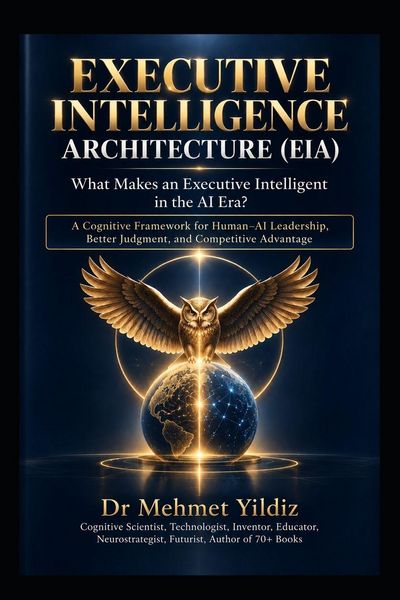
Executive Intelligence Architecture (EIA) What Makes an Executive Intelligent in the AI Era?
-
- Englisch ausgewählt
49,99 €
inkl. gesetzl. MwSt.,
Beschreibung
Produktdetails
Einband
Taschenbuch
Erscheinungsdatum
21.09.2026
Verlag
Independently PublishedSeitenzahl
402
Maße (L/B/H)
22,9/15,2/2,1 cm
Gewicht
537 g
Sprache
Englisch
EAN
9798176105650
What makes an executive intelligent in the AI era?
For decades, we've tried to answer this question through IQ, leadership competencies, emotional intelligence, experience, education, personality, and business performance. More recently, we have added adaptability, digital intelligence, social intelligence, and AI literacy to the conversation. Each contributes something important, but I believe we are still missing the larger picture.
The problem is fragmentation. An executive may possess exceptional analytical intelligence yet struggle to understand people. Another may have remarkable emotional and social intelligence but lack the cognitive discipline required for complex strategic decisions. A technologically sophisticated leader may understand AI while failing to recognize its organizational, ethical, or human consequences. Even highly experienced executives can repeat old assumptions when circumstances change.
AI makes this problem more consequential. Executives now have access to machines that can retrieve knowledge, analyze enormous volumes of information, generate alternatives, detect patterns, simulate scenarios, and act through autonomous agents. Yet greater computational intelligence does not automatically produce better executive judgment.
This realization is the gap the Executive Intelligence Architecture (EIA) framework addresses. Drawing on my background in cognitive science, enterprise architecture, technology, and decades of professional observation, I approach executive intelligence as an architecture rather than another quotient. Instead of asking which single intelligence matters most, I examine how different forms of intelligence work together when executives face uncertainty, complexity, pressure, opportunity, technological disruption, competing values, and consequential decisions.
The framework examines IQ, Emotional Intelligence (EQ), Adversity Intelligence (AQ), Social Intelligence, Spiritual Intelligence, Digital Intelligence, AI-Augmented Intelligence, Metacognition, and Noetic Intelligence. I do not treat these constructs as scientifically equivalent or reduce them to a convenient collection of scores. Their theoretical foundations, evidence, purposes, and limitations differ. What matters is understanding what each contributes and how these capabilities interact in executive life.
At the center of the book is an eight-pillar architecture in this sequence: Cognition → Intelligence → Judgment → Action → Learning → Wisdom → Eminence → Impact. AI runs through this architectural sequence rather than sitting beside it. Future executives will think and act in environments where cognition is distributed among humans, teams, data, algorithms, digital platforms, and intelligent agents. This perspective changes the executive challenge from simply possessing intelligence to orchestrating intelligence.
I examine human-AI collaboration, cognitive augmentation, calibrated trust, emotional regulation, resilience under adversity, social cognition, cognitive bias, metacognition, ethical judgment, purpose, meaning, learning, decision-making under uncertainty, and the emerging possibility of Noetic Intelligence.
I answer a hard question: What remains distinctively important about human executive intelligence when machines can perform more of the cognitive work that once distinguished knowledgeable professionals?
My answer leads from cognition to impact. The executives who succeed in the AI era may not be those who know the most, use the most AI, make the fastest decisions, or score highest on any individual measure of intelligence. They may be those who learn to coordinate analytical ability, emotion, social understanding, adaptability, technology, artificial intelligence, reflection, values, and wisdom in the right context. The competitive advantage of the AI era may shift from possessing intelligence to orchestrating it and knowing what to do
Noch keine Bewertungen vorhanden
Verfassen Sie die erste Bewertung zu diesem Artikel
Helfen Sie anderen Kundinnen und Kunden durch Ihre Meinung.
Kurze Frage zu unserer Seite
Vielen Dank für Ihr Feedback
Wir nutzen Ihr Feedback, um unsere Produktseiten zu verbessern. Bitte haben Sie Verständnis, dass wir Ihnen keine Rückmeldung geben können. Falls Sie Kontakt mit uns aufnehmen möchten, können Sie sich aber gerne an unseren Kund*innenservice wenden.
zum Kundenservice