KI-Beratung Beta

Gutscheinbedingungen

**Gültig bis 30.11.2026 auf Spielzeug, Schreibwaren, Filme, Geschenke & Trends, Musik, tolino eReader & Zubehör, Hörbücher und Hörbuch-Downloads, nicht preisgebundene Bücher und Kalender online auf thalia.at und in der Thalia App. Einzelne Artikel können ausgeschlossen sein. Aufgrund der Buchpreisbindung sind deutschsprachige Bücher und eBooks ausgenommen. Zusätzlich ausgenommen sind Abos & Flatrates, Games, Geschenkkarten/-boxen, Shelfies, Software, Zeitschriften sowie einzelne Artikel von tonies®. Pro Einkauf einmal einlösbar. Nur gültig mit im Onlineshop hinterlegter Bonuscard. Click & Collect nur bei Onlinevorabzahlung möglich. Keine Barauszahlung. Nicht kombinierbar mit anderen Aktionen und Gutscheinen. Gutschein wird auf max. 500€ Bestellwert angerechnet. Nicht gültig für Versandkosten und Services.

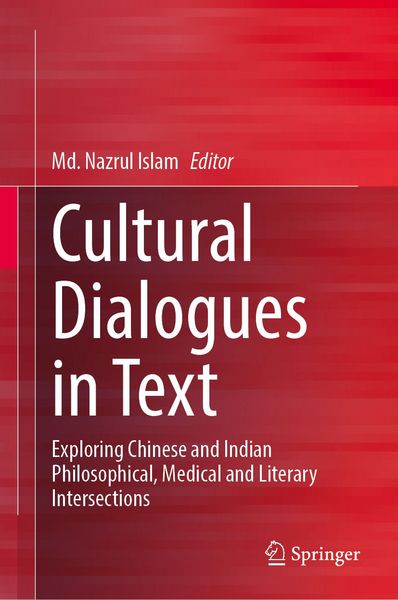
Produktbild: Cultural Dialogues in Text
Vorbesteller Neu

Cultural Dialogues in Text Exploring Chinese and Indian Philosophical, Medical and Literary Intersections

153,99 €

inkl. gesetzl. MwSt., Versandkostenfrei


Beschreibung

This book delves into the rich and complex relationships between the intellectual traditions of two of the world’s oldest civilizations. This book offers a comparative analysis of the philosophical, literary, and medical texts from both cultures, tracing their overlapping ideologies, shared concerns,...

Beschreibung

This book delves into the rich and complex relationships between the intellectual traditions of two of the world’s oldest civilizations. This book offers a comparative analysis of the philosophical, literary, and medical texts from both cultures, tracing their overlapping ideologies, shared concerns, and distinct worldviews. Through the lens of ancient, medieval, and modern works, this book investigates the dialogues between these civilizations, emphasizing the continuity and divergence in their approaches to the human experience. The central question explored in this book is how the civilizations of China and India intersect. What are the commonalities and differences between these two ancient cultures? Methodologically, this study adopts a qualitative approach, utilizing thematic content analysis of classical texts, scriptures, and key writings as the primary technique to synthesize the data. This book begins with an exploration of seminal philosophical and religious texts such as the Analects of Confucius from China, juxtaposed with India’s Vedas and Upanishads, and other foundational scriptures. These texts serve as the cornerstone for understanding how both cultures approached metaphysics, ethics, governance, and the nature of existence. Next, the book extends its inquiry into the medical traditions of China and India, comparing the classical texts that laid the foundation for their respective healing systems. In the final section, the book brings the discussion into the modern era by examining how these ancient traditions continue to resonate in contemporary literature, film, and social discourse. Authors like Rabindranath Tagore, Aravind Adiga (The White Tiger), and Liang Qichao, Kang Youwei as well as contemporary films such as Xueba and Hindi Medium, serve as case studies for the cross-cultural exchanges that have shaped modern narratives, revealing how the intersections of China and India’s past continue to influence their present-day literary and cinematic outputs.

Portrait

Dr. Nazrul Islam is an Associate Professor of Digital Social Science at Beijing Normal-Hong Kong Baptist University, China. He holds a PhD in Sociology from the University of Hong Kong and an MSc in Community Health and Health Management from Heidelberg University, Germany. His research spans traditional medicine, food studies, gender, and China’s Belt and Road Initiative (BRI). With over twenty years of experience in teaching, research, and academia, Dr. Islam has worked across Asia, Europe, Canada, and Australia. He is the author of a monograph published by Springer (2017) and editor of six books, including four with Springer (2024, 2023, 2019, 2016), one with Routledge (2026), and one with Palgrave Macmillan (2021). Dr. Islam has also published numerous high-impact articles in SSCI journals such as Current Sociology (by Sage), Health Sociology Review (by Routledge), Asian Journal of Social Sciences (by Elsevier), Social Theory & Health (by Springer), and Food & Foodways (by Routledge), South Asia: Journal of South Asian Studies (by Routledge), Indian Journal of Gender Studies (by Sage), and so on with over three hundred fifty citations. Dr. Islam has held visiting positions at esteemed institutions, including the University of Sydney, Australia (2024), the University of British Columbia, Canada (2016), the University of Hong Kong, Hong Kong SAR (2008–2011), and Ateneo de Manila University, the Philippines (2003). He has been awarded the prestigious German Academic Exchange Service (DAAD) Fellowship, United Nations University (UNU) Fellowship, and the University of Hong Kong Postgraduate Studentship. Additionally, Dr. Islam has been recognized as a Guangdong Provincial High-Level Talent in China (since 2019) and a Global Talent in Australia (since 2021).

Produktdetails

Einband

Gebundene Ausgabe

Erscheinungsdatum

24.02.2027

Abbildungen

XIX, 160 p. 34 illus., 15 illus. in color.

Herausgeber Md. Nazrul Islam

Produktdetails

Einband

Gebundene Ausgabe

Erscheinungsdatum

24.02.2027

Abbildungen

XIX, 160 p. 34 illus., 15 illus. in color.

Herausgeber Md. Nazrul Islam
Verlag Springer Singapore
Seitenzahl

160

Maße (B/H)

15,5/23,5 cm

Sprache

Englisch

ISBN

978-981-9272-74-7

Herstelleradresse

Libri GmbH
Europaallee 1
36244 Bad Hersfeld
DE

Email: gpsr@libri.de

Noch keine Bewertungen vorhanden

Verfassen Sie die erste Bewertung zu diesem Artikel

Helfen Sie anderen Kundinnen und Kunden durch Ihre Meinung.

Kundinnen und Kunden meinen

Bewertungen (0)

  • Produktbild: Cultural Dialogues in Text
  • Chapter 1. Hierarchy and Harmony.- Chapter 2. Between Dharma and Dao.- Chapter 3. The Health Silk Road in the Greater Bay Area. Chapter 4. Balance in the Cycle.- Chapter 5. The Intersection of Traditional Chinese Medicine and Ayurveda.- Chapter 6. Rabindranath Tagore as a Method in China’s Quest for Modernity.- Chapter 7. The Construction of China's Image and the Production of Eastern Outlook in Tagore’s 1924 Lecture Tour in China.- Chapter 8. Imagining China: Literary and Geopolitical Shifts in The White Tiger.- Chapter 9. Navigating the Educational Field.- Chapter 10. Rethinking Cultural Discount.