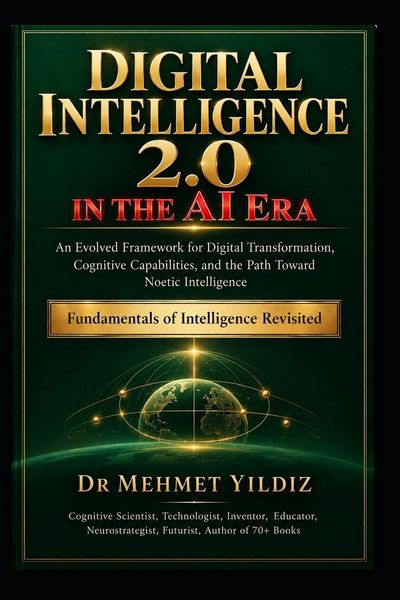
DIGITAL INTELLIGENCE 2.0 in the AI Era An Evolved Framework for Digital Transformation, Cognitive Capabilities, and the Path Toward Noetic Intelligence
-
- Englisch ausgewählt
55,99 €
inkl. gesetzl. MwSt.,
Beschreibung
Produktdetails
Einband
Taschenbuch
Erscheinungsdatum
18.09.2026
Verlag
Independently PublishedSeitenzahl
550
Maße (L/B/H)
22,9/15,2/2,8 cm
Gewicht
728 g
Sprache
Englisch
EAN
9798175255738
When I wrote the first version of Digital Intelligence in 2019, I was trying to address a problem I had observed for many years in large organizations. Enterprises were becoming more digital, but more technology didn't necessarily make them more intelligent. 7 years later, that distinction matters even more.
Now, we have extraordinary access to cloud platforms, massive amounts of data, analytics, automation, intelligent assistants, AI agents, generative AI, mobile computing, connected devices, and digital ecosystems. Yet I still see familiar problems: fragmented architectures, poor-quality data, rising technology costs, legacy systems, duplicated capabilities, security risks, overwhelmed employees, skills gaps, competing priorities, and AI initiatives struggling to demonstrate sustainable business value.
This perspective led me back to the question at the heart of my original work: What actually makes an organization digitally intelligent? My answer is still not "more technology." In fact, one of this book's central arguments is that an organization can be highly digital without being digitally intelligent.
So I didn't want to take my 2019 book, add a few chapters about generative AI, replace some old technology names, and call it a new edition. Too much has changed for that approach. I went back to the underlying framework and reconsidered it through what we have learned about enterprise architecture, complexity, economics, innovation, simplification, agility, collaboration, technology, data, mobility, workforce capability, and now artificial intelligence.
This book looks at the pain points I see executives and professionals dealing with every day. How do we reduce complexity without weakening capability? How do we distinguish useful AI from expensive experimentation or hype? How do we prevent faster technology from creating faster waste? How can we turn enormous amounts of data into trustworthy context for decisions? What should we automate, what should we simplify, and what should remain under human judgment? How do we work with AI agents when they can act rather than merely answer questions? How do we increase productivity without overwhelming the people we are supposedly trying to help?
These are not exclusively technology questions. They are business questions. That is why I wrote this book for a broad audience. A CEO may read it through the lens of strategy and organizational capability. A CFO may see the economics of complexity, AI investment, productivity, and value. A CIO or CTO may concentrate on architecture, platforms, cloud, agents, integration, security, and technical debt. A CDO may see data differently when we move from accumulating information toward context, semantics, provenance, trust, and decision intelligence. A CHRO may recognize an emerging workforce in which people, AI assistants, and agents contribute different capabilities to the same work.
Architects, product leaders, program managers, consultants, entrepreneurs, researchers, educators, and students may find different entry points into the same problem. One conclusion became particularly clear to me while rewriting this book: AI makes architectural thinking more important, not less.
When creation becomes easier, selection becomes harder. If we can generate software faster, we need better judgment about what deserves to be built. If AI can produce endless information, human attention becomes more valuable. If agents can perform actions, authority and accountability matter more. If AI makes employees faster, we still need to ask whether the entire organization is becoming more productive or simply producing more work. Therefore, I introduce Noetic Intelligence as the next direction in my thinking.
I kept the book practical as these ideas developed that way throughout my career.
Noch keine Bewertungen vorhanden
Verfassen Sie die erste Bewertung zu diesem Artikel
Helfen Sie anderen Kundinnen und Kunden durch Ihre Meinung.
Kurze Frage zu unserer Seite
Vielen Dank für Ihr Feedback
Wir nutzen Ihr Feedback, um unsere Produktseiten zu verbessern. Bitte haben Sie Verständnis, dass wir Ihnen keine Rückmeldung geben können. Falls Sie Kontakt mit uns aufnehmen möchten, können Sie sich aber gerne an unseren Kund*innenservice wenden.
zum Kundenservice