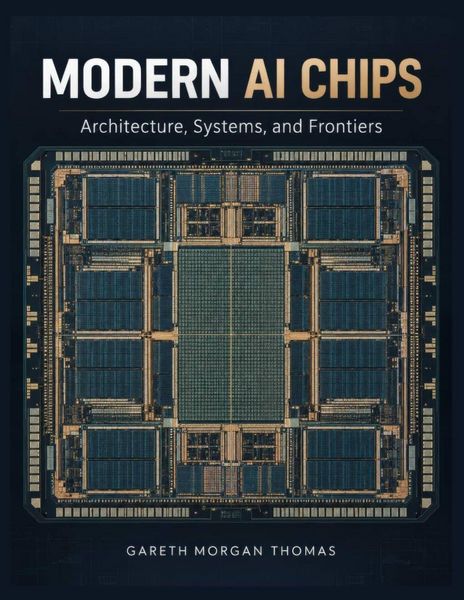
Modern AI Chips Architecture, Systems, and Frontiers
-
- Englisch ausgewählt
38,99 €
inkl. gesetzl. MwSt.,
Beschreibung
Produktdetails
Einband
Taschenbuch
Erscheinungsdatum
16.09.2026
Verlag
Independently PublishedSeitenzahl
458
Maße (L/B/H)
27,9/21,6/2,4 cm
Gewicht
1055 g
Sprache
Englisch
EAN
9798174765405
The AI race will not be decided by model size alone. It will be decided in silicon.
Every major advance in artificial intelligence eventually collides with a physical limit: memory bandwidth, data movement, power consumption, heat, interconnect speed, manufacturing yield, or cost.
That is why the most important question in AI hardware is not simply:
How many operations can this chip perform?
The real question is:
How much useful computation can the complete system sustain when the model, memory, software, power, cooling, and communication demands are included?
Modern AI Chips: Architecture, Systems, and Frontiers takes you inside the technologies determining the future of artificial intelligence-from numerical formats and tensor cores to HBM4, chiplets, wafer-scale processors, advanced packaging, data-centre interconnects, and edge AI.
You will discover:
- Why the memory wall now matters more than raw arithmetic throughput
- Why AI training and inference demand fundamentally different hardware
- How FP32, BF16, FP8, INT8, INT4, and FP4 change performance, accuracy, capacity, and cost
- Why HBM has become one of the most strategically important components in computing
- How tensor cores, systolic arrays, dataflow processors, and SRAM-centric architectures actually work
- How NVIDIA, AMD, Google, AWS, Groq, Cerebras, SambaNova, Taalas, and emerging Chinese GPU developers attack the same constraints differently
- Why chiplets, silicon interposers, hybrid bonding, and multi-reticle packaging are replacing traditional monolithic scaling
- How NVLink, Infinity Fabric, Ethernet, and other interconnect technologies determine cluster-level performance
- Why 1,000-watt-class accelerators are transforming data-centre power delivery and cooling
- How compilers, operator fusion, runtimes, and software ecosystems determine whether theoretical performance becomes usable performance
- Why TOPS, FLOPS, tokens per second, latency, throughput, and vendor benchmarks can mislead even experienced buyers
- How to evaluate an AI accelerator as a complete engineering system rather than a collection of headline specifications
This is not a superficial catalogue of processor announcements.
It is a systems-level examination of the architecture, semiconductor technology, memory, packaging, networking, thermals, software, and economics behind modern AI computation.
Whether you are an engineer, developer, technical investor, student, researcher, technology strategist, or serious industry observer, this book will give you the framework needed to look beyond marketing claims and identify where genuine hardware advantage resides.
Understand the machines beneath the models-and the physical limits shaping the next generation of artificial intelligence.
Noch keine Bewertungen vorhanden
Verfassen Sie die erste Bewertung zu diesem Artikel
Helfen Sie anderen Kundinnen und Kunden durch Ihre Meinung.
Kurze Frage zu unserer Seite
Vielen Dank für Ihr Feedback
Wir nutzen Ihr Feedback, um unsere Produktseiten zu verbessern. Bitte haben Sie Verständnis, dass wir Ihnen keine Rückmeldung geben können. Falls Sie Kontakt mit uns aufnehmen möchten, können Sie sich aber gerne an unseren Kund*innenservice wenden.
zum Kundenservice