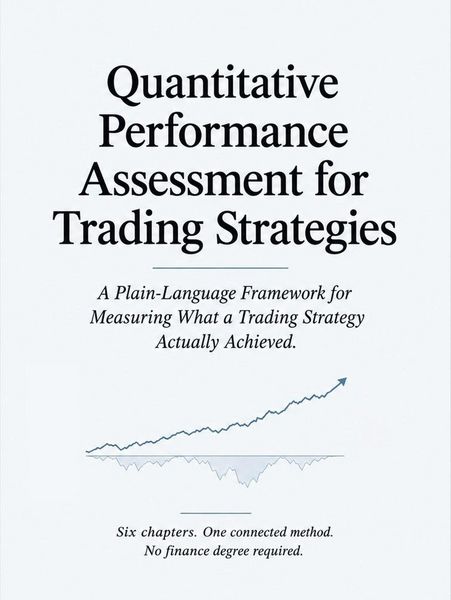
Quantitative Performance Assessment for Trading Strategies Quantitative Performance Assessment for Trading Strategies
-
- Einzelkauf Download ausgewählt
-
Sprache:Englisch
6,99 €
inkl. gesetzl. MwSt.Beschreibung
Produktdetails
Format
ePUB
Kopierschutz
Ja
Family Sharing
Ja
Text-to-Speech
Ja
Erscheinungsdatum
16.09.2026
Verlag
TSTRSeitenzahl
(Printausgabe)
Dateigröße
156 KB
Sprache
Englisch
EAN
9798237583724
A complete, plain-language framework for measuring what a trading strategy really did.
Most traders can tell you whether a strategy made money. Very few can tell you why whether the return came from genuine skill or from leverage, whether the risk taken to earn it was reasonable, or whether a single lucky stretch is carrying the entire track record. This course closes that gap. It takes the metrics professional funds use to judge performance Sharpe, Sortino, Calmar, skewness, tail ratios, regression-based decomposition and builds each one from first principles, in order, with every symbol defined before it's used and every formula paired with a worked number.
There are no shortcuts and no hand-waving. By the end, you won't just recognize these metrics when you see them in a tearsheet you'll know exactly what they're doing under the hood, where each one breaks down, and how to combine them into a single, defensible verdict on any strategy.
What's inside
Six chapters, building in order from raw returns to a unified decision framework:
Chapter 1 Foundations and Absolute Return Metrics. Before any ratio, any risk measure, any verdict: what did the strategy actually earn? Covers the generalized periodic data framework, deriving absolute and percentage returns, a full worked example, and timeframe scaling and compounding.
Chapter 2 Volatility and Symmetric Risk Measures. Risk is how widely outcomes spread around what you expected. Covers why symmetric measures win, standard deviation and the square-root-of-time rule, exponentially weighted volatility, and blending short-run with long-run estimates.
Chapter 3 Risk-Adjusted Returns. Leverage lets anyone manufacture a big return only the ratio is honest. Covers the Sharpe Ratio in derivatives trading, scaling Sharpe between timeframes, the Sortino Ratio and downside risk, and pre-cost versus post-cost performance.
Chapter 4 Drawdown and Asymmetric Performance Analysis. Real returns are not a neat bell curve; this chapter measures the lopsided parts. Covers calculating drawdown, maximum versus average drawdown, the generalized Calmar Ratio, skewness, and tail ratios.
Chapter 5 Advanced Performance Decomposition. Breaking a return stream apart to find out what actually produced it. Covers spot returns versus carry returns, isolating skill with linear regression, and a full worked regression example.
Chapter 6 Unified Integration, Synthesis and Decision Framework. Six chapters of metrics, and a method for deciding what to do when they disagree. Covers volatility standardisation as the unifying link, prioritising conflicting signals, the trading speed limit, and the unified performance table that brings every prior metric together on one page.
Who it's for
Traders and quants who want to move past "did I make money" and build a rigorous, repeatable process for evaluating strategies whether that's their own track record, a manager they're allocating to, or a backtest they don't yet trust. No advanced math background is assumed; every concept is built up in plain language before the formula appears.
Noch keine Bewertungen vorhanden
Verfassen Sie die erste Bewertung zu diesem Artikel
Helfen Sie anderen Kundinnen und Kunden durch Ihre Meinung.
Kurze Frage zu unserer Seite
Vielen Dank für Ihr Feedback
Wir nutzen Ihr Feedback, um unsere Produktseiten zu verbessern. Bitte haben Sie Verständnis, dass wir Ihnen keine Rückmeldung geben können. Falls Sie Kontakt mit uns aufnehmen möchten, können Sie sich aber gerne an unseren Kund*innenservice wenden.
zum Kundenservice