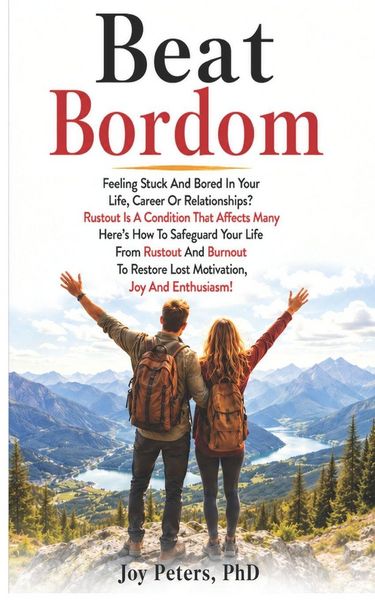
Beat Boredom Feeling Stuck And Bored In Your Life, Career Or Relationships? Rustout Is A Condition That Affects Many Here's How To Safeguard Your Life From Rustout And Burnout To Restore Lost Motivation, Joy And Enthusiasm!
-
- Englisch ausgewählt
11,99 €
inkl. gesetzl. MwSt.,
- Kostenlose Lieferung ab 30 € Einkaufswert
- Versandkostenfrei für Bonuscard-Kund*innen
Beschreibung
Produktdetails
Einband
Taschenbuch
Erscheinungsdatum
11.09.2026
Verlag
Laine Educational Media LLCSeitenzahl
88
Maße (L/B/H)
20,3/12,7/0,5 cm
Gewicht
97 g
Sprache
Englisch
EAN
9798170332496
There is a particular kind of tiredness that has nothing to do with sleep. You can get eight hours a night, take your vacation days, even come back from a long weekend away, and still feel it: a low, persistent hum of what's the point. Meetings that used to energize you now feel like static. The career you worked so hard to build sits comfortably around you, paid for, secure, and somehow hollow. The relationships that once felt vital now feel comfortably miserable, run on autopilot, pleasant but not great, functional yet disfunctional, and they are there in your presence but seem strangely distant. You are not in crisis. Nothing is visibly wrong. And yet something is unmistakably off. If this sounds familiar, you are not lazy, broken, or ungrateful. You are experiencing a condition that has a name, even though almost no one talks about it: rust-out.
Most of us know burnout when we see it. It's loud. It shows up as exhaustion, cynicism, and a body that finally forces you to stop through illness, a breakdown, or a decision to walk away from something that's consuming you. Burnout gets books written about it, workplaces built around preventing it, and sympathy when it strikes, because it looks like what it is: too much, for too long. Rust-out is the opposite, and that's exactly why it's more dangerous. It isn't caused by too much. It's caused by too little; too little challenge, too little novelty, too little meaning sustained for so long that a person's motivation, curiosity, and sense of aliveness slowly corrodes, the way an idle engine seizes not from overuse but from disuse. Where burnout is a fire, rust-out is erosion. It doesn't announce itself. It accumulates. This is precisely why it disproportionately affects people who, on paper, are doing everything right. The seasoned professional who mastered their role years ago and has been coasting on that mastery ever since. The parent who built a stable, comfortable life and now finds the stability itself feels like a cage. The partner in a long relationship who loves their spouse but can't remember the last time they felt genuinely lit up by their own life. Rust-out doesn't strike people in crisis. It strikes people in comfort which is exactly why so many of them feel too guilty or confused to name what's happening.
If you're earlier in your career or a newer relationship, novelty tends to do the heavy lifting for you. Everything is still being figured out, so engagement comes naturally but time and competence change the equation. The very things that once felt like achievements, expertise, routine, predictability, security can quietly become the walls of a life that no longer asks anything new of you. This book is written specifically for people in that stage: the seasoned professional, the long-married partner, the parent whose kids are grown, the person who has, by most external measures, "made it" and who is now wondering, quietly and perhaps a little ashamedly, why making it doesn't feel like much of anything at all. This is not a book about quitting your job, leaving your relationship, or blowing up your life in search of meaning. Dramatic reinvention is rarely the answer to rust-out, and chasing it often creates new problems without solving the original one. Instead, this book will help you do three things, in order:
- Name what's actually happening to you - so you can stop mistaking rust-out for depression, ingratitude, or a personal failing, and start treating it as the specific, addressable condition it is.
- Understand how you got here - the quiet, reasonable decisions that, compounded over years, led to a life engineered for safety rather than aliveness.
- Rebuild motivation and enthusiasm systematically - through small, low-risk actions rather than sweeping change, so that momentum returns before you're forced to make a drastic decision from a place of desperation.
Noch keine Bewertungen vorhanden
Verfassen Sie die erste Bewertung zu diesem Artikel
Helfen Sie anderen Kundinnen und Kunden durch Ihre Meinung.
Kurze Frage zu unserer Seite
Vielen Dank für Ihr Feedback
Wir nutzen Ihr Feedback, um unsere Produktseiten zu verbessern. Bitte haben Sie Verständnis, dass wir Ihnen keine Rückmeldung geben können. Falls Sie Kontakt mit uns aufnehmen möchten, können Sie sich aber gerne an unseren Kund*innenservice wenden.
zum Kundenservice