KI-Beratung Beta

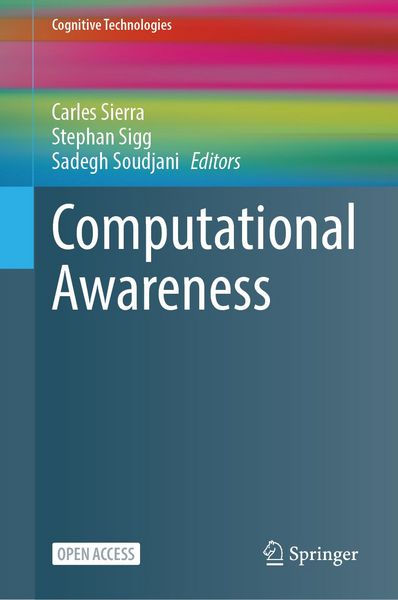
Produktbild: Computational Awareness
Vorbesteller Neu

Computational Awareness

Aus der Reihe Cognitive Technologies

54,99 €

inkl. gesetzl. MwSt., Versandkostenfrei


Beschreibung

This Open Access book presents computational awareness as an emerging interdisciplinary field concerned with artificial systems that can perceive, interpret, reason about and adapt to dynamic, uncertain and socially embedded environments. Drawing on the work of eight projects in the EIC Pathfinder Challenge...

Beschreibung

This Open Access book presents computational awareness as an emerging interdisciplinary field concerned with artificial systems that can perceive, interpret, reason about and adapt to dynamic, uncertain and socially embedded environments. Drawing on the work of eight projects in the EIC Pathfinder Challenge “Awareness Inside”, it situates computational awareness in relation to philosophical and cognitive accounts of awareness and consciousness, while focusing primarily on awareness as an operational capability that can be specified, engineered and evaluated. The volume brings together perspectives from artificial intelligence, robotics, cognitive science, neuroscience, human-computer interaction, multi-agent systems and ethics.

The book develops conceptual foundations and possible general theories of awareness, and then examines computational architectures, mechanisms and measures for realizing awareness in artificial systems. It covers symbolic and probabilistic reasoning, machine learning and cognitive architectures; multimodal and crossmodal integration of neurophysiological, gaze and behavioral signals; and collaborative and social awareness in artificial collectives and human-AI systems. These contributions examine how self-awareness, situational awareness, social awareness, mission awareness and value awareness can support more adaptive, safe and trustworthy intelligent systems.

The volume also considers the ethical risks and opportunities associated with artificial awareness, including anthropomorphism, human agency, privacy, opacity, trust and accountability, together with governance strategies for responsible design. Robotics case studies on autonomous tool design and value-aware social robots illustrate how computational awareness can be embodied in practice. The book will be of interest to researchers, engineers, graduate students, policymakers and others working on trustworthy AI and autonomous systems.

Portrait

Carles Sierra is Research Professor and Director of the Artificial Intelligence Research Institute (IIIA) of the Spanish National Research Council (CSIC), located in Barcelona. He is also an Adjunct Professor at Western Sydney University. His research interests include multiagent systems, autonomous agents, agreement technologies, negotiation, computational argumentation, trust and reputation models, knowledge representation, and the design of artificial social systems. He has played a leading role in the international AI community, serving as President of the European Association for Artificial Intelligence (EurAI) from 2020 to 2024, General Chair of AAMAS 2009, and Program Chair of IJCAI 2017. He was Editor-in-Chief of the Journal of Autonomous Agents and Multi-Agent Systems (JAAMAS) and is a Fellow of EurAI and ELLIS. Carles Sierra is a proud recipient of the ACM/SIGAI Autonomous Agents Research Award (2019) for his pioneering contributions to autonomous agents and multiagent systems. He received the Distinguished Service Award from IJCAI and from EurAI in 2025.

Stephan Sigg is with Aalto University, Finland in the Department of Information and Communications Engineering. His research interests include the design, analysis and optimisation of algorithms for distributed and ubiquitous systems. His work covers proactive computing, distributed adaptive beamforming, context-based secure key generation and device-free passive activity recognition. Stephan is an editor of the Proceedings of the ACM on Interactive, Mobile, Wearable, and Ubiquitous Computing as well as an associate editor for the IEEE Transactions on Mobile Computing and the ACM Transactions on the Internet of Things. He has served on the organizing  committees of conferences such as IEEE PerCom and ACM Ubicomp. In the EIC Pathfinder Challenge ‘Awareness Inside’, Stephan has coordinated the project Sust(AI)n.

Sadegh Soudjani is Professor and Chair in Cyber-Physical Systems at the University of Birmingham, where he directs the CPS Lab and serves as Director of Global Engagement in the School of Computer Science. He is also a Senior Research Group Leader at the Max Planck Institute for Software Systems in Germany. His research develops formal and data-driven methods for designing and verifying safe, reliable and scalable cyber-physical and autonomous systems operating under uncertainty, with applications in robotics, energy systems, and multi-agent systems. He previously held positions at Newcastle University and the University of Oxford. He has authored more than 180 research publications and led national, international and industry-funded research projects. He has received an ERC Consolidator Grant in 2023, was the recepient of the EPSRC New Investigator Award in 2021, and coordinated the EIC Pathfinder project SymAware.

Produktdetails

Einband

Gebundene Ausgabe

Erscheinungsdatum

14.02.2027

Abbildungen

XVI, 275 p. 30 illus.

Herausgeber Carles Sierra + weitere

Produktdetails

Einband

Gebundene Ausgabe

Erscheinungsdatum

14.02.2027

Abbildungen

XVI, 275 p. 30 illus.

Herausgeber
Verlag Springer
Seitenzahl

275

Maße (B/H)

15,5/23,5 cm

Sprache

Englisch

ISBN

978-3-032-42148-7

Herstelleradresse

Springer International Publishing AG
Gewerbestr. 11
6330 Cham
Schweiz
Url: www.springer.com

Noch keine Bewertungen vorhanden

Verfassen Sie die erste Bewertung zu diesem Artikel

Helfen Sie anderen Kundinnen und Kunden durch Ihre Meinung.

Kundinnen und Kunden meinen

Bewertungen (0)

  • Produktbild: Computational Awareness
  • Foreword.- Preface.- Acknowledgments.- 1. Introduction.- 2. Toward General Theories of Awareness: The EIC “Awareness Inside” Framework.- 3. Architectures for Computational Awareness.- 4. Measures of Awareness.- 5. Crossmodal Awareness.- 6. Collaborative and Social Awareness in Artificial Systems.- 7. Ethical Risks and Opportunities in Designing Artificial Awareness.- 8. Embodied Computational Awareness: Foundations and Use Cases in Robotics.