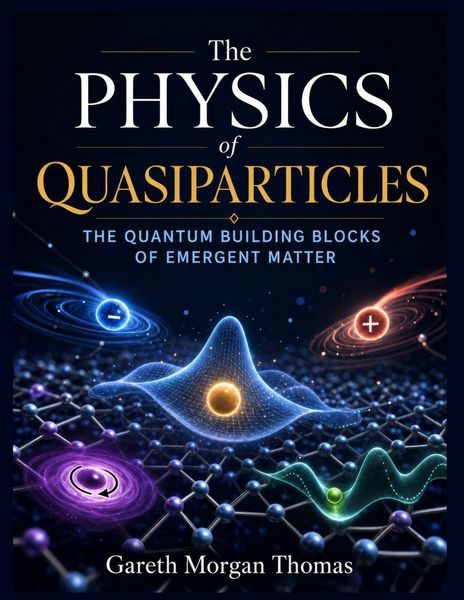

The Physics of Quasiparticles The Quantum Building Blocks of Emergent Matter
-
- Englisch ausgewählt
32,99 €
inkl. gesetzl. MwSt.,
Beschreibung
Produktdetails
Einband
Taschenbuch
Erscheinungsdatum
06.09.2026
Verlag
Independently PublishedSeitenzahl
322
Maße (L/B/H)
27,9/21,6/1,7 cm
Gewicht
751 g
Sprache
Englisch
EAN
9798172197550
You Can Memorize the Names of Quasiparticles-or Learn the Physics That Creates Them
A macroscopic material may contain approximately 10²3 interacting particles. Solving its complete many-body quantum state is effectively impossible.
Yet experiments reveal sharply defined excitations with measurable energies, momenta, charges, spins, lifetimes, and statistics.
Quasiparticles are how nature turns overwhelming complexity into usable physics.
The Physics of Quasiparticles, Second Edition develops this powerful idea as a unified technical framework-not as a disconnected catalogue of phonons, magnons, excitons, polarons, plasmons, anyons, and other exotic entities.
Beginning with emergence, effective theories, second quantization, Green's functions, self-energy, and symmetry breaking, the book builds the mathematical foundation required to understand how quasiparticles arise, how their properties are calculated, and how their existence is established experimentally.
It then advances into the frontiers of condensed matter and quantum technology: fractionalization, topological states, light-matter hybrids, superconducting excitations, moiré materials, non-Hermitian systems, and Majorana-based quantum devices.
This is not a book for merely recognizing terminology. It is a book for learning how to do the physics.
You will learn how to:
- Calculate quasiparticle spectra, lifetimes, effective masses, and spectral weights
- Use Green's functions, Dyson's equation, self-energy, and Bogoliubov transformations
- Derive the behavior of excitons, polarons, magnons, phonons, plasmons, and polaritons
- Analyze anyons, Majorana modes, Dirac and Weyl quasiparticles, skyrmions, and fractons
- Connect Hamiltonians and response functions to ARPES, STM, scattering, transport, and ultrafast spectroscopy
- Understand where the quasiparticle picture succeeds-and where strong correlation destroys it
- Apply computational methods including tight binding, Hubbard models, GW, DMFT, quantum Monte Carlo, tensor networks, and machine learning
- Trace quasiparticle physics into quantum computing, optoelectronics, sensing, energy conversion, analog gravity, and biological systems
A Complete Working Resource
The Second Edition contains 11 substantial chapters supported by more than 100 technical figures, worked examples, equations, checkpoints, practice problems, chapter summaries, and review questions.
Five extensive appendices consolidate the mathematical methods, quantum-field-theory foundations, numerical tools, reference tables, glossary material, problems, and further reading needed to use the book as a serious technical reference.
Ideal for:
- Advanced undergraduate and postgraduate physics students
- Condensed matter and materials-science researchers
- Quantum-technology and nanophotonics professionals
- Engineers entering strongly correlated or topological systems
- Independent readers ready to move beyond simplified quantum explanations
Most books introduce quasiparticles one species at a time. This book reveals the deeper structure connecting them all: the reorganization of interacting matter into effective excitations that can be calculated, measured, controlled, and engineered.
Once you understand that structure, phonons, magnons, polaritons, anyons, Majorana modes, and moiré excitations stop looking like unrelated curiosities. They become variations of one of the most powerful organizing principles in modern physics.
Stop collecting definitions. Start understanding emergent matter.
Get The Physics of Quasiparticles, Second Edition today.
Noch keine Bewertungen vorhanden
Verfassen Sie die erste Bewertung zu diesem Artikel
Helfen Sie anderen Kundinnen und Kunden durch Ihre Meinung.
Kurze Frage zu unserer Seite
Vielen Dank für Ihr Feedback
Wir nutzen Ihr Feedback, um unsere Produktseiten zu verbessern. Bitte haben Sie Verständnis, dass wir Ihnen keine Rückmeldung geben können. Falls Sie Kontakt mit uns aufnehmen möchten, können Sie sich aber gerne an unseren Kund*innenservice wenden.
zum Kundenservice