
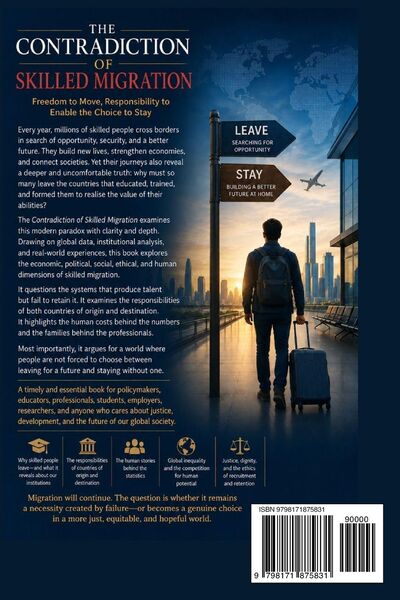
The Contradiction of "Skilled Migration"
-
- Englisch ausgewählt
11,99 €
inkl. gesetzl. MwSt.,
- Kostenlose Lieferung ab 30 € Einkaufswert
- Versandkostenfrei für Bonuscard-Kund*innen
Beschreibung
Produktdetails
Einband
Taschenbuch
Erscheinungsdatum
04.09.2026
Verlag
Amazon Digital Services LLC - KdpSeitenzahl
148
Maße (L/B/H)
22,9/15,2/0,9 cm
Gewicht
186 g
Sprache
Englisch
EAN
9798171875831
What if the greatest contradiction of skilled migration is not that people leave-but that so many capable people feel they must leave in order to build the lives their skills should have made possible at home?
The Contradiction of Skilled Migration examines one of the defining paradoxes of the modern world. Countries invest in educating doctors, nurses, engineers, scientists, researchers, teachers, tradespeople, and other professionals, yet many struggle to create the economic, institutional, and professional conditions necessary to retain them. At the same time, wealthier nations increasingly compete to attract this internationally trained talent to address their own labour shortages, demographic pressures, and economic needs.
Migration can transform lives. It can provide opportunity, security, professional recognition, higher incomes, and a better future for families. Migrants also make extraordinary contributions to the countries in which they settle.
But behind these successes lies a deeper question:
When does migration represent genuine freedom of choice, and when does it become a rational response to the absence of meaningful alternatives?
Drawing on research, international evidence, institutional analysis, and the human realities behind migration statistics, Chacko R. Robert explores the economic, political, social, ethical, and personal dimensions of skilled migration.
The book examines:
- Why skilled and educated people leave-and what their departure can reveal about institutions, labour markets, governance, and development.
- How unemployment, underemployment, inequality, corruption, weak institutions, limited professional opportunities, and inadequate recognition of skills can influence migration decisions.
- The consequences of brain drain for countries that invest in developing professionals only to lose their expertise elsewhere.
- The benefits and limitations of remittances, diaspora engagement, brain gain, and brain circulation.
- Why destination countries increasingly depend upon internationally trained workers-and the ethical responsibilities that accompany that dependence.
- The experiences migrants may face after arrival, including credential-recognition barriers, deskilling, employment insecurity, exploitation, discrimination, family separation, and the challenge of rebuilding life in another society.
- The responsibilities of both countries of origin and destination in creating a more equitable and sustainable system of global mobility.
At its heart, The Contradiction of Skilled Migration challenges the assumption that the freedom to migrate is, by itself, sufficient evidence of human freedom.
Skilled people are not merely units of human capital moving between labour markets. Behind every qualification is a person, a family, an education, a community, years of effort, and a future that could potentially have been built in more than one place.
This book does not argue against migration. It argues for something more ambitious: a world in which migration increasingly represents genuine choice rather than necessity created by institutional, economic, or structural failure.
The freedom to leave matters. But genuine human freedom must also include the freedom to stay.
A thought-provoking examination for readers interested in migration, public policy, economics, international development, labour markets, global inequality, human rights, social justice, and the future of skilled mobility.
Noch keine Bewertungen vorhanden
Verfassen Sie die erste Bewertung zu diesem Artikel
Helfen Sie anderen Kundinnen und Kunden durch Ihre Meinung.
Kurze Frage zu unserer Seite
Vielen Dank für Ihr Feedback
Wir nutzen Ihr Feedback, um unsere Produktseiten zu verbessern. Bitte haben Sie Verständnis, dass wir Ihnen keine Rückmeldung geben können. Falls Sie Kontakt mit uns aufnehmen möchten, können Sie sich aber gerne an unseren Kund*innenservice wenden.
zum Kundenservice