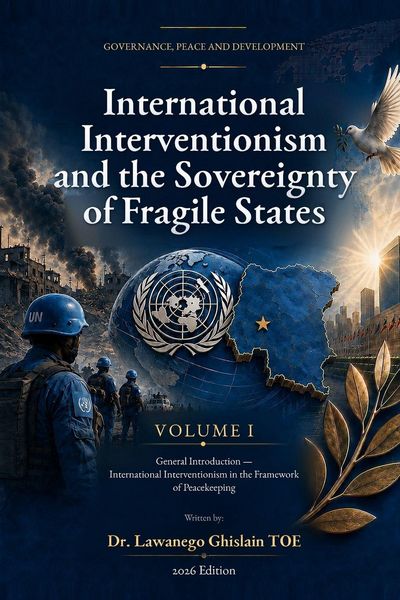
INTERNATIONAL INTERVENTIONISM AND THE SOVEREIGNTY OF FRAGILE STATES Volume I International Interventionism in the Framework of Peacekeeping Theory, Mechanisms and Contemporary Realism
-
- Englisch ausgewählt
33,99 €
inkl. gesetzl. MwSt.,
Beschreibung
Produktdetails
Einband
Taschenbuch
Erscheinungsdatum
03.09.2026
Verlag
Amazon Digital Services LLC - KdpSeitenzahl
296
Maße (L/B/H)
22,9/15,2/1,7 cm
Gewicht
399 g
Sprache
Englisch
EAN
9798171555818
Can a state be the target of intervention without its sovereignty being violated?
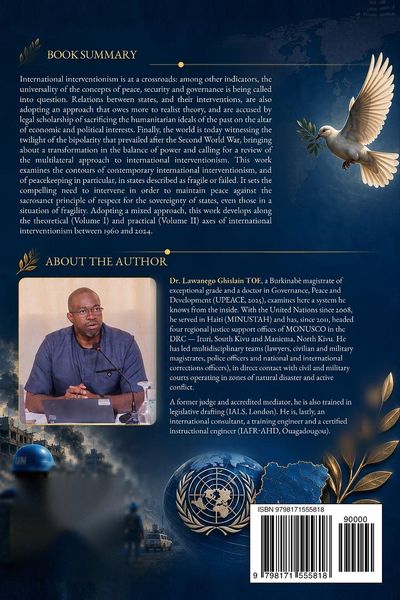
International interventionism is going through a crisis of legitimacy. The notions that once grounded it - peace, security, governance - are no longer read the same way from one continent to another. The powers that intervene invoke humanitarian grounds and are accused of serving economic and political interests instead. Meanwhile, the bipolarity inherited from 1945 is fading, redistributing roles within multilateralism.
This first volume lays out the theoretical framework. It traces the genealogy of peacekeeping, from the League of Nations to today's UN operations, and brings order to a vocabulary that is often confused: conflict prevention, peacemaking, peace enforcement, peacekeeping, post-conflict peacebuilding. It sets out the major schools of international relations - realism, liberalism, constructivism and their extensions - before testing them against the practice of Security Council mandates.
The book then examines what contemporary realism is doing to multilateral action: conflicts that regionalize, insecurity that shifts toward the Sahel, budget constraints, the return of power politics. Out of this confrontation comes the book's central thesis: intervening to protect humanity and keep the peace does not violate the sovereignty of a fragile state. On the contrary, it is one of the means of restoring that sovereignty - and an acknowledgment that the state still stands as one.
What Volume I covers- The conceptual foundations: definitions of peace, theories of conflict, systems of intervention
- The action of the United Nations: from the Charter to successive generations of peace operations
- The three principles of peacekeeping: consent, impartiality, non-use of force
- Contemporary security paradigms and the evolution of conflict from 1975 to 2024
- Interventionism tested by geopolitical rivalries, and the need to redefine it
Written by a judge who led four MONUSCO justice support offices in the Democratic Republic of the Congo, this work combines the apparatus of doctoral research with field experience. It is aimed at students and researchers in international relations, international law and political science, as well as practitioners of peace operations, diplomats, judges and humanitarian personnel.
Volume I of a two-volume set. Volume II is devoted to the field experience, with an in-depth study of MONUSCO in the DRC, its evaluation and its withdrawal. The full general bibliography is reproduced in each volume.
Noch keine Bewertungen vorhanden
Verfassen Sie die erste Bewertung zu diesem Artikel
Helfen Sie anderen Kundinnen und Kunden durch Ihre Meinung.
Kurze Frage zu unserer Seite
Vielen Dank für Ihr Feedback
Wir nutzen Ihr Feedback, um unsere Produktseiten zu verbessern. Bitte haben Sie Verständnis, dass wir Ihnen keine Rückmeldung geben können. Falls Sie Kontakt mit uns aufnehmen möchten, können Sie sich aber gerne an unseren Kund*innenservice wenden.
zum Kundenservice