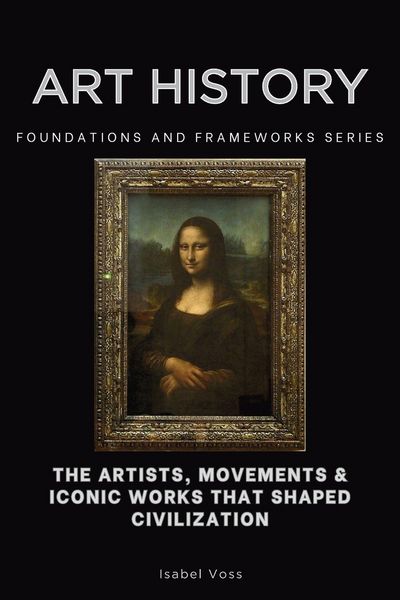
Art History The Artists, Movements & Iconic Works That Shaped Civilization
-
- Englisch ausgewählt
23,99 €
inkl. gesetzl. MwSt.,
- Kostenlose Lieferung ab 30 € Einkaufswert
- Versandkostenfrei für Bonuscard-Kund*innen
Beschreibung
Produktdetails
Einband
Taschenbuch
Erscheinungsdatum
28.08.2026
Verlag
PublishdriveSeitenzahl
142
Maße (L/B/H)
22,9/15,2/0,8 cm
Gewicht
217 g
Sprache
Englisch
EAN
9798900421162
Art history makes sense once you know how to look. This book teaches the six methods specialists actually use, then walks you through 40,000 years of art, from cave painting at Chauvet to work that sells as a digital file. Chapter 1 builds the foundations, six ways of reading an object that scholars, curators, and auction houses use daily. The eight chapters after it move in chronological order, so each period grows out of the pressures, money, and arguments of the one before it. Close to sixty images run alongside the text, and every chapter ends with discussion questions that have worked answers in the back. The chapters cover: - Formal analysis, iconography, provenance, attribution, patronage, and conservation, the six tools you apply to every work in the rest of the book - Prehistoric cave painting, Mesopotamian relief carved for kings, Egyptian tomb art and its three-thousand-year rules for drawing the body, and Greek sculpture as it loosens into figures that look about to move - Byzantine gold mosaics, Gothic stained glass, and Islamic geometric pattern - Brunelleschi solving linear perspective in Florence around 1420, then Donatello, Masaccio, Leonardo, Michelangelo, Raphael, and Titian - Van Eyck's oil glazes, Durer's prints, Caravaggio's harsh light, Bernini's marble caught mid-motion, and the roughly eighty self-portraits Rembrandt painted across his own life - Watteau's park scenes, David painting the dead Marat in his bath in 1793, Goya's late work, and Romantic weather in Turner and Friedrich - Courbet, Monet's repeated haystacks, Manet's Olympia, Van Gogh, Cezanne, Seurat's dots of color, and Gauguin - Cubism broken into facets by Picasso and Braque, Matisse turning color loose, German Expressionism, Futurism, and Duchamp entering a factory-made urinal in a 1917 exhibition under a fake name - Pollock's poured canvases, Warhol's silkscreened soup cans, Minimalism stripped to plain boxes, Conceptual art, and the Biennale circuit that runs the global scene now Written for students in a first art history or art appreciation course, museum visitors who want to know what they are looking at, and adults filling a gap in their own education. No background is assumed, no term shows up without a plain explanation, and the writing stays direct instead of academic. If you've ever stood in a gallery feeling like everyone around you was seeing something you missed, this book closes that gap. The back matter carries a timeline placing every period and major work in sequence, a glossary of roughly ninety terms, worked answers to all the discussion questions, and a reading list with a note on what each recommended title actually does well. Read it once and you have the vocabulary. Read it again and the sequence sticks. You finish with a set of questions you can put to any object in any museum, and a run of periods that finally holds together.
Noch keine Bewertungen vorhanden
Verfassen Sie die erste Bewertung zu diesem Artikel
Helfen Sie anderen Kundinnen und Kunden durch Ihre Meinung.
Kurze Frage zu unserer Seite
Vielen Dank für Ihr Feedback
Wir nutzen Ihr Feedback, um unsere Produktseiten zu verbessern. Bitte haben Sie Verständnis, dass wir Ihnen keine Rückmeldung geben können. Falls Sie Kontakt mit uns aufnehmen möchten, können Sie sich aber gerne an unseren Kund*innenservice wenden.
zum Kundenservice