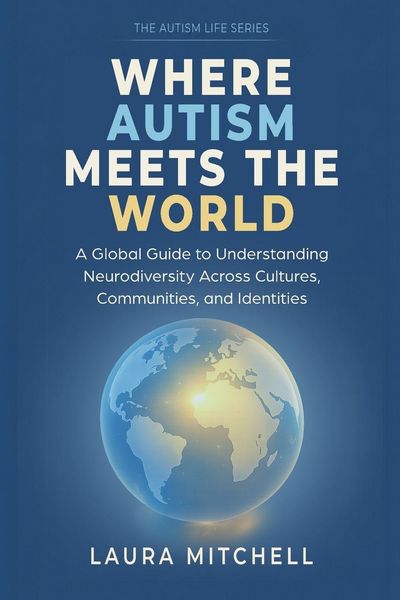
Where Autism Meets the World A Global Guide to Understanding Neurodiversity Across Cultures, Communities, and Identities
-
- Englisch ausgewählt
18,99 €
inkl. gesetzl. MwSt.,
- Kostenlose Lieferung ab 30 € Einkaufswert
- Versandkostenfrei für Bonuscard-Kund*innen
Beschreibung
Produktdetails
Einband
Taschenbuch
Erscheinungsdatum
27.06.2026
Verlag
Alan Saunders BooksSeitenzahl
244
Maße (L/B/H)
22,9/15,2/1,3 cm
Gewicht
360 g
Sprache
Englisch
EAN
9791399278286
Somewhere in Osaka right now, a mother is being told for the third time that her son doesn't meet the threshold for a diagnosis. Somewhere in rural Nigeria, a grandmother is certain her granddaughter's silences are the work of a spirit. Somewhere in São Paulo, a teenager is learning, in fragments, what the word "autistic" means for him. Same neurology, everywhere. Completely different story, depending only on where in the world you happen to be born. Laura Mitchell wrote Where Autism Meets the World to close that gap - between what autism actually is and what any given culture, healthcare system, or clinic has decided it must be. This isn't a parenting manual or a personal memoir. It's the book missing from most autism shelves: an honest, global look at how geography, income, history, and culture shape who gets diagnosed, who gets support, and whose experience even counts as evidence. Sixty-two million autistic people live in this world. Most of them live in countries that receive a fraction of the research funding spent studying the rest. Inside, you'll find: Why diagnosis is a privilege of geography and income, and what that gap actually costs children in under-resourced countries How the same behaviour reads as "impaired" in one culture and simply polite in another - and what that says about diagnosis itself Traditional healing frameworks examined alongside modern clinical care, without dismissing either Race, gender, and class explored through the growing research on autism and intersectionality The global advocacy movement reshaping who decides what autistic support should look like A direct, practical close written separately to parents, educators, clinicians, researchers, and policymakers - not one generic conclusion for everyone What makes this book different: autistic adults are treated throughout as primary evidence, not colour commentary alongside someone else's findings. When research and lived testimony disagree, that disagreement gets examined, not smoothed over. The world is not broken. Some of us just experience it differently - and the difference says more about the world than it says about us. That's the whole argument. Let's keep going.
Noch keine Bewertungen vorhanden
Verfassen Sie die erste Bewertung zu diesem Artikel
Helfen Sie anderen Kundinnen und Kunden durch Ihre Meinung.
Kurze Frage zu unserer Seite
Vielen Dank für Ihr Feedback
Wir nutzen Ihr Feedback, um unsere Produktseiten zu verbessern. Bitte haben Sie Verständnis, dass wir Ihnen keine Rückmeldung geben können. Falls Sie Kontakt mit uns aufnehmen möchten, können Sie sich aber gerne an unseren Kund*innenservice wenden.
zum Kundenservice