KI-Beratung Beta

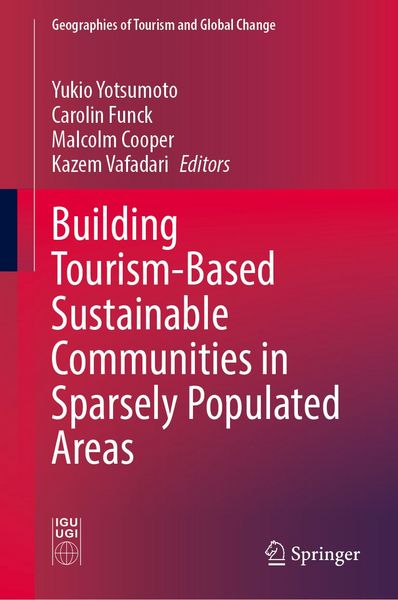
Produktbild: Building Tourism-Based Sustainable Communities in Sparsely Populated Areas
Vorbesteller Neu

Building Tourism-Based Sustainable Communities in Sparsely Populated Areas

164,99 €

inkl. gesetzl. MwSt., Versandkostenfrei


Beschreibung

Produktdetails

Einband

Gebundene Ausgabe

Erscheinungsdatum

24.02.2027

Abbildungen

XII, 313 p. 63 illus., 56 illus. in color.

Herausgeber

Yukio Yotsumoto + weitere

Verlag

Springer

Seitenzahl

313

Maße (B/H)

15,5/23,5 cm

Sprache

Englisch

ISBN

978-3-032-41616-2

Beschreibung

Portrait

Yukio Yotsumoto is Professor in the College of Sustainability and Tourism at Ritsumeikan Asia Pacific University in Japan. He received a Bachelor's Degree in economics (Soka University, Japan), a Master's Degree in agricultural extension education (The University of Georgia, USA) and a PhD. in sociology (The University of Kentucky, USA). He actively researches rural community development and sustainable tourism.

Carolin Funck obtained her PhD from the Albert-Ludwigs University, Freiburg. She is Professor of human geography at Hiroshima University, Japan, where she teaches in the Department for Integrated Global Studies and the Graduate School of Humanities and Social Sciences. Her research focuses on the development of tourism in Japan and sustainable island tourism. She is the author of “Tourismus und Peripherie in Japan” and co-author of “Japanese Tourism”.

Malcolm Cooper is Emeritus Professor, Ritsumeikan Asia Pacific University. Previously, he taught at and managed Universities in Australia, New Zealand, Sri Lanka, and the United Kingdom, and was a city planner in Australia and New Zealand. He is a recipient of the Australian Centennial Medal, a Fellow of the Planning Institute of Australia, and has published over 170 books and papers. He actively researches wellness and community resilience.


Kazem Vafadari is Professor in the College of Sustainability and Tourism at Ritsumeikan Asia Pacific University in Japan. His expertise lies in tourism applications of agricultural heritage landscapes, community building, rural revitalization and destination branding. He has collaborated with international organizations such as United Nations University, United Nations Food and Agriculture Organization and UN Tourism as a scientific committee member and advisory board member.

Produktdetails

Einband

Gebundene Ausgabe

Erscheinungsdatum

24.02.2027

Abbildungen

XII, 313 p. 63 illus., 56 illus. in color.

Herausgeber

Verlag

Springer

Seitenzahl

313

Maße (B/H)

15,5/23,5 cm

Sprache

Englisch

ISBN

978-3-032-41616-2

Herstelleradresse

Springer International Publishing AG
Gewerbestr. 11
6330 Cham
Schweiz
Url: www.springer.com

Noch keine Bewertungen vorhanden

Verfassen Sie die erste Bewertung zu diesem Artikel

Helfen Sie anderen Kundinnen und Kunden durch Ihre Meinung.

Kundinnen und Kunden meinen

Bewertungen (0)

  • Produktbild: Building Tourism-Based Sustainable Communities in Sparsely Populated Areas
  • Chapter 1. Introduction: Building Tourism-based Sustainable Communities in Sparsely Populated Areas of Selected OECD Countries (Yukio Yotsumoto, Carolin Funck, Kazem Vafadari, and Malcolm Cooper).- Chapter 2. Depopulation and Tourism in the Sparsely Populated Communities of Selected OECD Countries (Yukio Yotsumoto, Carolin Funck, Seung Ho Youn, Thomas E. Jones, Malcolm Cooper, and Kazem Vafadari).- Chapter 3. The Recent Situation of Tourism-based Community Development in Japan: A Report on the National Survey of Tourism-based Community Development Affected by the COVID-19 Pandemic (Junwoo Han, Yukio Yotsumoto, Masayuki Morishige, Hikari Kenchu, and Masaki Ochi).- Chapter 4. Event Legacy and Regional Development in Sparsely Populated Areas: The case of Town Development in Misato Town, Shimane Prefecture following the National Sports Festival (Hikaru Kenchu).- Chapter 5. Tourism-based Sustainable Community Development for Revitalizing Depopulated Areas of Japan (Yukio Yotsumoto).- Chapter 6. The Relationships between Long-term Visitors and Local Communities in Sustainable Tourism-based Community Development (Masayuki Morishige).- Chapter 7. Depopulation and Tourism Development in Rural Japan: From the “Refresh Resort Kawazu Plan” to tourism-based Community Development centered on Flowers (Junwoo Han).- Chapter 8. How does Relational Localism in Tourism Actually Emerge? Resident Empowerment and Gradual Network among Residents’ Groups in Rural Kyoto (Masaki Ochi).- Chapter 9. The Resilience of Small Events: How Local Markets and Cultural Attractions survived Depopulation and Natural Disasters in Aotearoa-New Zealand and Australia (Malcolm Cooper).- Chapter 10. Building Community Resiliency and Promoting Agricultural Heritage: Case Studies from Italy, Portugal and Spain (Kazem Vafadari).- Chapter 11. Tourism-based Sustainable Development in the Biosphere Reserves of Germany (Carolin Funck).- Chapter 12. Cycle Tourism for Community Revitalization: Comparing Linear Cycle Lanes in Yabakei Gorge in Japan with the Monsal Trail in the UK (Thomas E. Jones, Fernando P. Padilla, and Huong T. Bui).- Chapter 13. A Blueprint for Sustainable Community-Based Tourism: A Case Study of the Tour Dure Initiative in South Korea (Seung Ho Youn and Si-young Ryu).- Chapter 14. Summary and Conclusions (Malcolm Cooper).