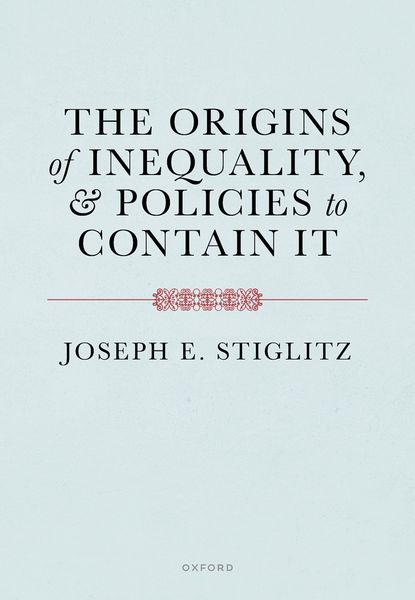
The Origins of Inequality and Policies to Contain It
-
- Hardcover
- Taschenbuch
- eBook ausgewählt
-
Form:Einzelkauf Download
-
Sprache:Englisch
-
eBook Format:ePUB
- PDF 151,20 €
- ePUB 151,20 € ausgewählt
151,20 €
inkl. gesetzl. MwSt.Beschreibung
Produktdetails
Format
ePUB
Kopierschutz
Ja
Family Sharing
Nein
Text-to-Speech
Ja
Erscheinungsdatum
03.04.2025
Verlag
Oxford University PressSeitenzahl
912 (Printausgabe)
Dateigröße
15339 KB
Sprache
Englisch
EAN
9780192520210
Joseph E. Stiglitz has had a remarkable career. He is a brilliant academic, capped by sharing the Nobel Memorial Prize in Economics and the Nobel Peace Prize, and honorary degrees from Harvard, Cambridge, Oxford and more than fifty other universities, and elected not only to the National Academy of Sciences and the American Academy of Arts and Letters but the Royal Society and the British Academy; a public servant, who served as Chair of President Clinton's Council of Economic Advisors and Chief Economist and Senior Vice President of the World Bank, headed international commissions for the UN and France, and was awarded the French Legion of Honor and Australia's Sydney Peace Prize; a public intellectual whose numerous books on vital topics have been best sellers.
What brought him to economics were his concerns about the inequality and discrimination he saw growing up. Wanting to understand what drives it and what can be done about it has been his lifelong passion. This book gathers together and extends to new frontiers this lifelong work, drawing upon the challenges and insights of each of these phases of his career.
In a still very widely cited paper written fifty years ago, Stiglitz set forth the fundamental framework for analyzing intergenerational transfer of wealth and advantage, which plays a central role in persistent inequality. That and subsequent work, developed most fully here for the first time, described today's inequality as a result of centrifugal forces increasing inequality and centripetal forces reducing it. In recent decades, the centrifugal forces have strengthened, the centripetal forces weakened. His general theory provides a framework for understanding the marked growth in inequality in recent decades, and for devising policies to reduce it.
A central message is that ever-increasing inequality is not inevitable. Inequality is, in a fundamental sense, a choice. Stiglitz explains that inequality does not largely arise from differences in savings rates between capitalists and others, though that may play a role (as Piketty, Marx, and Kaldor suggest); but rather, it originates importantly from the rules of the game, which have weakened the bargaining power of workers as they have increased the market power of corporations. He also explains how monetary authorities have contributed to increasing wealth inequality, and how, unless something is done about it, likely changes in technology such as AI and robotization will make matters worse. He describes policies that can simultaneously reduce inequality and improve economic performance.
What brought him to economics were his concerns about the inequality and discrimination he saw growing up. Wanting to understand what drives it and what can be done about it has been his lifelong passion. This book gathers together and extends to new frontiers this lifelong work, drawing upon the challenges and insights of each of these phases of his career.
In a still very widely cited paper written fifty years ago, Stiglitz set forth the fundamental framework for analyzing intergenerational transfer of wealth and advantage, which plays a central role in persistent inequality. That and subsequent work, developed most fully here for the first time, described today's inequality as a result of centrifugal forces increasing inequality and centripetal forces reducing it. In recent decades, the centrifugal forces have strengthened, the centripetal forces weakened. His general theory provides a framework for understanding the marked growth in inequality in recent decades, and for devising policies to reduce it.
A central message is that ever-increasing inequality is not inevitable. Inequality is, in a fundamental sense, a choice. Stiglitz explains that inequality does not largely arise from differences in savings rates between capitalists and others, though that may play a role (as Piketty, Marx, and Kaldor suggest); but rather, it originates importantly from the rules of the game, which have weakened the bargaining power of workers as they have increased the market power of corporations. He also explains how monetary authorities have contributed to increasing wealth inequality, and how, unless something is done about it, likely changes in technology such as AI and robotization will make matters worse. He describes policies that can simultaneously reduce inequality and improve economic performance.
Noch keine Bewertungen vorhanden
Verfassen Sie die erste Bewertung zu diesem Artikel
Helfen Sie anderen Kundinnen und Kunden durch Ihre Meinung.
Kurze Frage zu unserer Seite
Vielen Dank für Ihr Feedback
Wir nutzen Ihr Feedback, um unsere Produktseiten zu verbessern. Bitte haben Sie Verständnis, dass wir Ihnen keine Rückmeldung geben können. Falls Sie Kontakt mit uns aufnehmen möchten, können Sie sich aber gerne an unseren Kund*innenservice wenden.
zum Kundenservice