KI-Beratung Beta

Gutscheinbedingungen

**Gültig bis 11.11.2026 auf Spielzeug, Schreibwaren, Filme, Geschenke & Trends, Musik, tolino eReader & Zubehör, Hörbücher und Hörbuch-Downloads, nicht preisgebundene Bücher und Kalender online auf thalia.at und in der Thalia App. Einzelne Artikel können ausgeschlossen sein. Aufgrund der Buchpreisbindung sind deutschsprachige Bücher und eBooks ausgenommen. Zusätzlich ausgenommen sind Abos & Flatrates, Games, Geschenkkarten/-boxen, Shelfies, Software, Zeitschriften sowie einzelne Artikel von tonies®. Pro Einkauf einmal einlösbar. Click & Collect nur bei Onlinevorabzahlung möglich. Keine Barauszahlung. Nicht kombinierbar mit anderen Aktionen und Gutscheinen. Gutschein wird auf max. 500€ Bestellwert angerechnet. Nicht gültig für Versandkosten und Services.

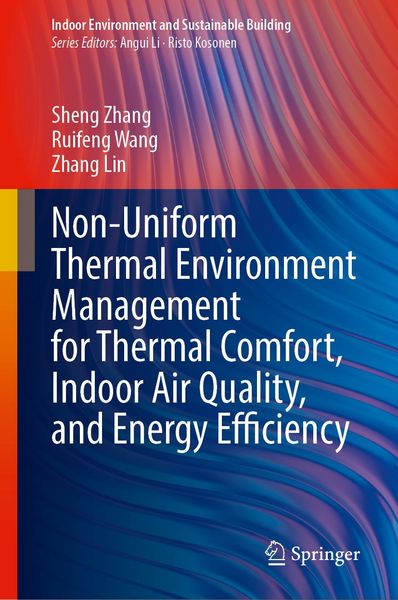
Produktbild: Non-Uniform Thermal Environment Management for Thermal Comfort, Indoor Air Quality, and Energy Efficiency
Vorbesteller Neu

Non-Uniform Thermal Environment Management for Thermal Comfort, Indoor Air Quality, and Energy Efficiency

197,99 €

inkl. gesetzl. MwSt., Versandkostenfrei


Beschreibung

This book introduces non-uniform thermal environment management methods. Vertically, the non-uniform thermal environment management methods focus on improving the supply efficiency of conditioned air into the occupied zone rather than the unoccupied zone for energy saving while maintaining thermal comfort...

Beschreibung

This book introduces non-uniform thermal environment management methods. Vertically, the non-uniform thermal environment management methods focus on improving the supply efficiency of conditioned air into the occupied zone rather than the unoccupied zone for energy saving while maintaining thermal comfort and indoor air quality. Horizontally, the non-uniform thermal environment management methods focus on differentiating subzone thermal conditions in the occupied zone according to the individual thermal demands for improved thermal preference satisfaction. The book is intended for undergraduate and graduate students, researchers, and engineers who are interested in cutting-edge technologies for sustainable and healthy built environments.

Occupants’ thermal demands are spatially non-uniform, which is ignored by the traditional thermal environment management. Managing indoor thermal environment with an air conditioning system according to the spatially non-uniform occupants’ thermal demands not only reduces the energy consumption by avoiding unnecessarily conditioning the unoccupied zone, but also improves thermal comfort by avoiding insufficient or excessive conditioning of the occupied zone.

Produktdetails

Einband

Gebundene Ausgabe

Erscheinungsdatum

24.02.2027

Abbildungen

XVI, 384 p. 146 illus., 135 illus. in color.

Verlag Springer Singapore

Produktdetails

Einband

Gebundene Ausgabe

Erscheinungsdatum

24.02.2027

Abbildungen

XVI, 384 p. 146 illus., 135 illus. in color.

Verlag Springer Singapore
Seitenzahl

384

Maße (B/H)

15,5/23,5 cm

Sprache

Englisch

ISBN

978-981-9265-83-1

Herstelleradresse

Springer Singapore
No. 12-2F 101 Business Park
47100 Puchong, Selangor D.E.
MY
Email: sdc-bookservice@springer.com
Telephone: +49 6221 3454301
Fax: +49 6221 3454229

Noch keine Bewertungen vorhanden

Verfassen Sie die erste Bewertung zu diesem Artikel

Helfen Sie anderen Kundinnen und Kunden durch Ihre Meinung.

Kundinnen und Kunden meinen

Bewertungen (0)

  • Produktbild: Non-Uniform Thermal Environment Management for Thermal Comfort, Indoor Air Quality, and Energy Efficiency
  • Overview of Non-uniform Thermal Environment.- Overview of Non-uniform Thermal Environment Management.- Vertically non-uniform thermal environment.- Empirical Model of Heat Removal Efficiency.- Heat Removal Efficiency based Multi-node Model.- Equivalent Air Temperature-based Cooling Load Estimation.- Fully Mixed Air Model based Cooling Load Estimation.- Room Air Temperature Optimization for Thermal Comfort and Energy Saving.- Dynamic control of room air temperature control.- Outdoor Air Ratio Optimization for Indoor Air Quality and Energy Saving.- Horizontally non-uniform thermal environment.- Modeling Non-uniform Thermal Environment with Supply and Exit Air Conditions.- Systematic Comparisons of Exit Air Temperature and Wall Temperature for Modelling Non-uniform Thermal Environment.- Robust Evaluation of Thermal Deviation for Differentiated Thermal Preferences.- Subzone Control for Differentiated Thermal Preferences.- Coupled Thermal Comfort Control of Thermal Condition Profiles and Thermal Preferences.- Subzone Division Optimization with Probability Analysis-based K-means Clustering.