KI-Beratung Beta

Gutscheinbedingungen

**Gültig bis 03.11.2026 auf fremdsprachige Bücher online auf thalia.at und in der Thalia App. Einzelne Artikel können ausgeschlossen sein. Ausgenommen sind preisgebundene Artikel & eBooks. Pro Einkauf einmal einlösbar. Click & Collect nur bei Onlinevorabzahlung möglich. Keine Barauszahlung. Nicht kombinierbar mit anderen Aktionen und Gutscheinen. Gutschein wird auf max. 500€ Bestellwert angerechnet. Nicht gültig für Geschenkkarten, Versandkosten und Services.

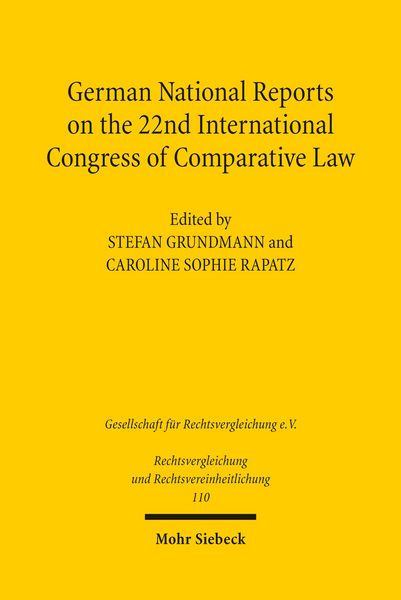
Produktbild: German National Reports on the 22nd International Congress of Comparative Law

German National Reports on the 22nd International Congress of Comparative Law

122,40 €

inkl. gesetzl. MwSt., Versandkostenfrei


Beschreibung

Produktdetails

Einband

Taschenbuch

Erscheinungsdatum

03.08.2026

Herausgeber

Stefan Grundmann + weitere

Verlag

Mohr Siebeck

Seitenzahl

640

Maße (L/B/H)

23,3/15,5/3,4 cm

Gewicht

935 g

Auflage

1

Sprache

Englisch

ISBN

978-3-16-200758-2

Beschreibung

Portrait

ist Inhaber des Lehrstuhls für Bürgerliches Recht, Deutsches, Europäisches und Internationales Privat- und Wirtschaftsrecht an der Humboldt-Universität zu Berlin..(Geboren Rupp) ist Professorin für Bürgerliches Recht, Europäisches und Internationales Privatrecht und Verfahrensrecht sowie Rechtsvergleichung an der Christian-Albrechts-Universität zu Kiel.

Produktdetails

Einband

Taschenbuch

Erscheinungsdatum

03.08.2026

Herausgeber

Verlag

Mohr Siebeck

Seitenzahl

640

Maße (L/B/H)

23,3/15,5/3,4 cm

Gewicht

935 g

Auflage

1

Sprache

Englisch

ISBN

978-3-16-200758-2

Herstelleradresse

Mohr Siebeck GmbH & Co. K
Wilhelmstraße 18
72074 Tübingen
DE

Email: info@mohrsiebeck.com

Noch keine Bewertungen vorhanden

Verfassen Sie die erste Bewertung zu diesem Artikel

Helfen Sie anderen Kundinnen und Kunden durch Ihre Meinung.

Kundinnen und Kunden meinen

Bewertungen (0)

  • Produktbild: German National Reports on the 22nd International Congress of Comparative Law
  • Mareike Schmidt : Teaching comparative law subjects in Germany - Caroline Sophie Rapatz : Mistrust in the trust, but overconfidence in fiducia? The uneasy relationship of German law to trust-like legal instruments - Gregor Kirchhof : Freedom and security - Malte Kramme/Lucas Gerlach : Artificial Intelligence in Civil Proceedings - Kai Purnhagen : Natural Resource Restoration: A Challenge for the Global Sustainable Food System - Lena Kunz : Innovative Complements and Substitutes for Contracts in German Digital Contract Law - Katharina de la Durantaye/Arne Radeisen : The Phenomenon of Intellectual Monopoly Capitalism - Judith Brockmann : The Future of Work in the Digital Context. Fears and Opportunities from a German Legal Perspective - Michael Stöber : Autonomous Ships in German Law - Frank Schorkopf : The Separation of Powers and Constitutional Review - Moritz Hennemann : Data Protection and Social Media - Michael Fehling : The Use of Foreign Law by German Courts. Dealing with Administrative Law Matters - Michael Droege : The State as Taxpayer Economic Activity of the State and Related Tax Obligations - Bettina Weisser : Sexual Offences in German Criminal Law. The Current State of the Law and Some Unresolved Questions - Anna Helena Albrecht : Participation of Non-Judges in the Administration of Criminal Justice in Germany. Also: Criminal Adjudication Under Pressure - Andreas von Arnauld : Germany's Commitment to the Rule of Law - Felix M. Wilke : The Application of the Lex Fori Developments in Practice and Foundations in Theory - Ben Köhler : The Aspiration of Self-Sufficiency of International Contracts and the Challenge of Their Uniform Interpretation in the Resolution of Commercial Disputes - Meik Thöne : Arbitration and the International Commercial Courts - Sabine Schlacke : Energy Transition: German Regulation of New Sources of Energy - Philipp Hacker : Artificial Intelligence in German Legal Education - Robert Magnus/Christian Reichelt : Property Law Issues in International Investment Arbitration. A German Perspective - Hannes Wais : Arts and Law: The Challenge of Contemporary Art to Private Law