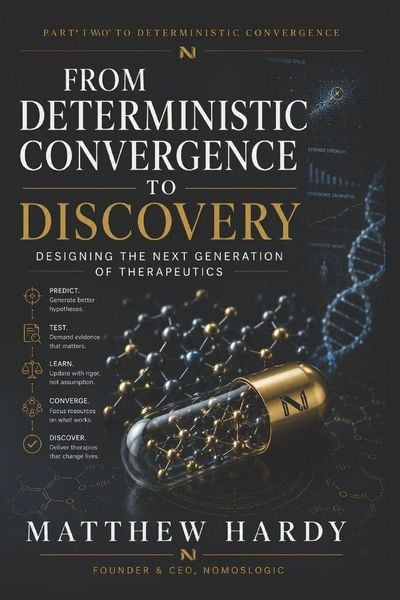
From Deterministic Convergence to Discovery Designing the Next Generation of Therapeutics
-
- Englisch ausgewählt
23,99 €
inkl. gesetzl. MwSt.,
- Kostenlose Lieferung ab 30 € Einkaufswert
- Versandkostenfrei für Bonuscard-Kund*innen
Beschreibung
Produktdetails
Einband
Taschenbuch
Erscheinungsdatum
27.08.2026
Verlag
Amazon Digital Services LLC - KdpSeitenzahl
344
Maße (L/B/H)
22,9/15,2/1,8 cm
Gewicht
458 g
Sprache
Englisch
EAN
9798186829645
FROM DETERMINISTIC CONVERGENCE TO DISCOVERY
Designing the Next Generation of Therapeutics
Matthew L. Hardy
Ninety percent of drug candidates that enter clinical trials fail - and half of those failures happen in Phase II, where the drug was safe but simply didn't work. The standard explanation is "translational failure." Hardy argues that's a description, not a diagnosis: the real cause is architectural. Targets are validated for visibility - expression levels, knockdown effects, biochemical potency - not for structural necessity within the disease system that actually has to be defeated.
Drawing on the PROTEUS cross-domain validation dataset - twenty-six studies spanning cardiovascular, neurological, oncological, and hepatic disease - this book builds the mathematical case that most disease-driving systems are architecturally distributed, not concentrated: redundant, reserve-holding, and built by billions of years of selection against fragility. Hardy introduces two operating tools for telling the difference before a program burns years and capital finding out the hard way:
- The Herfindahl-Hirschman Index, adapted from market-concentration economics, to classify a biological system as distributed, mixed, or concentrated.
- The concordance metric Cd, derived from a Sherrington-Kirkpatrick spin-glass formulation of variant fitness, to quantify whether a specific target is load-bearing, a bridge node, or architecturally redundant - i.e., whether hitting it will produce a durable clinical response or just a very well-characterized molecule with no future.
Chapter One lays the empirical and mathematical foundation; the eleven chapters that follow carry the framework through multi-omic interpretation, structural biology, protein and small-molecule design, synthesis, specialized modalities for CNS and "undruggable" targets, and clinical translation - closing with a quick-reference decision framework that compresses the full pipeline into a single navigable tool.
This is the companion volume to Deterministic Convergence, extending its architectural thesis - that biological systems must be read as architectures, not scored lists of parts - into an applied design discipline for the next generation of therapeutics. Written for computational biologists, medicinal chemists, and translational scientists who want the mathematics that separates a target worth pursuing from a beautiful dead end.
Noch keine Bewertungen vorhanden
Verfassen Sie die erste Bewertung zu diesem Artikel
Helfen Sie anderen Kundinnen und Kunden durch Ihre Meinung.
Kurze Frage zu unserer Seite
Vielen Dank für Ihr Feedback
Wir nutzen Ihr Feedback, um unsere Produktseiten zu verbessern. Bitte haben Sie Verständnis, dass wir Ihnen keine Rückmeldung geben können. Falls Sie Kontakt mit uns aufnehmen möchten, können Sie sich aber gerne an unseren Kund*innenservice wenden.
zum Kundenservice