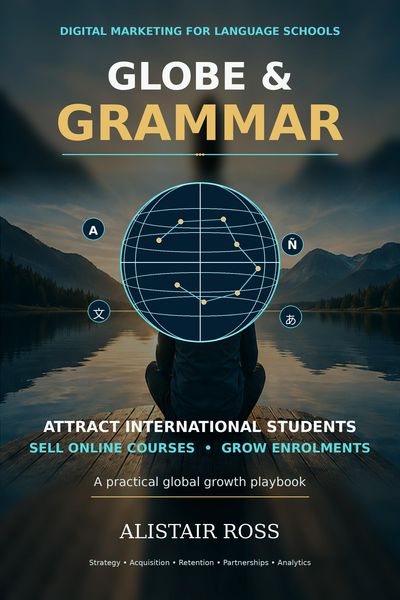
Globe & Grammar Digital Marketing for Language Schools to Attract International Students, Sell Online Courses, and Grow Enrolments
-
- Einzelkauf Download ausgewählt
-
Sprache:Englisch
4,49 €
inkl. gesetzl. MwSt.Beschreibung
Produktdetails
Format
ePUB 3
Kopierschutz
Nein
Family Sharing
Ja
Text-to-Speech
Ja
Erscheinungsdatum
25.08.2026
Verlag
Independent Authors GroupSeitenzahl
99 (Printausgabe)
Dateigröße
686 KB
Sprache
Englisch
EAN
6610001340803
Every day, prospective students compare your school against competitors on other continents-moving from a search result to a review, a short video, a messaging app, and another school's website within minutes. Globe & Grammar shows you how to win that sequence: how to turn scattered campaigns into one clear promise and one reliable handoff from discovery to enquiry to enrolment. Written for language school owners, marketing managers, admissions leads, and independent educators selling courses across borders, this book tackles the failures that quietly drain international enrolments. It names them precisely: channel collecting-adding platforms without clarifying how each moves a student toward booking a consultation; value propositions built on vague claims like "high quality" instead of specific proof such as class format, teacher access, and schedule flexibility; CRMs purchased before the admissions process was even defined; drip sequences that send identical messages to beginners, advanced learners, and everyone between. Inside, you'll learn to build the assets that compound: a structured enquiry database, a permission-based email list, a reusable content library, and clean conversion data tied to school economics-not vanity traffic. You'll segment markets by learner goal, origin country, delivery preference, budget, and decision timeline, then localize meaning and social context rather than trusting literal translation. You'll design a technology stack around a single system of record, map CRM stages admissions staff actually apply, integrate with your LMS so promises survive past enrolment, and automate follow-up with triggers, eligibility rules, and suppression logic that stops robotic messages the moment a human conversation begins. For schools selling online courses, the guidance gets tactical. Launch weeks follow a tested rhythm: cart opens to the waitlist first, daily proof replaces hype, live Q&A sessions run across two time zones, and reminders never exceed three-each adding real information. Because payment friction destroys more enrolments than weak copy ever will, you'll verify every advertised payment method, currency display, and instalment calculation before launch day, then counter the seventy-two-hour window of buyer's remorse with a welcome sequence that delivers visible first progress-the strongest known antidote to refunds. Between launches, an evergreen funnel converts demand that arrives anyway, built on searchable answers to real learner questions and honest urgency like genuine cohort dates-because international student communities are well connected, and deceptive countdown timers travel between them faster than good ones. The commercial chapters are equally concrete: price in local currency where confusion creates hesitation, offer instalments where cash flow matters, resist blanket discounting that trains prospects to wait, and deploy testimonials from a prospect's own country-they routinely outperform stronger stories from somewhere students can't relate to. Measurement stays grounded in enrolment economics: total campaign cost divided by enrolled students, weighed against lifetime tuition value, with special attention to the metric most schools forget-completion rate, since graduates become testimonials and referrers while silent non-finishers poison word of mouth. The closing chapters assemble everything into a twelve-month operating plan: an annual calendar built backwards from academic intakes, exam deadlines, and visa processing windows; a marketing budget managed as a portfolio with four distinct allocations; clear ownership so important work stops belonging to everyone and therefore no one; and staged international expansion governed by evidence gates rather than optimism.
Noch keine Bewertungen vorhanden
Verfassen Sie die erste Bewertung zu diesem Artikel
Helfen Sie anderen Kundinnen und Kunden durch Ihre Meinung.
Kurze Frage zu unserer Seite
Vielen Dank für Ihr Feedback
Wir nutzen Ihr Feedback, um unsere Produktseiten zu verbessern. Bitte haben Sie Verständnis, dass wir Ihnen keine Rückmeldung geben können. Falls Sie Kontakt mit uns aufnehmen möchten, können Sie sich aber gerne an unseren Kund*innenservice wenden.
zum Kundenservice