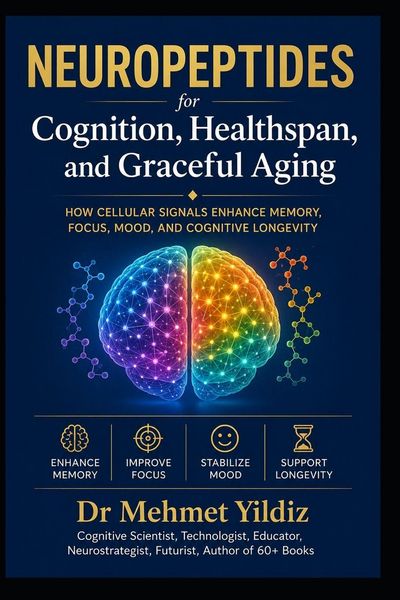
Neuropeptides for Cognition, Healthspan, and Graceful Aging How Cellular Signals Enhance Memory, Focus, Mood, and Cognitive Longevity
-
- Englisch ausgewählt
54,99 €
inkl. gesetzl. MwSt.,
Beschreibung
Produktdetails
Einband
Taschenbuch
Erscheinungsdatum
21.08.2026
Verlag
Amazon Digital Services LLC - KdpSeitenzahl
366
Maße (L/B/H)
22,9/15,2/1,9 cm
Gewicht
490 g
Sprache
Englisch
EAN
9798194051755
For decades, I've observed how conversations about brain health and cognitive function tend to follow a familiar pattern. New compounds emerge, early findings generate excitement, and before long, expectations begin to outpace evidence. Neuropeptides are now entering that cycle. I wrote this book to slow that process down, bring clarity, and help readers distinguish promising neurobiology from premature claims.
I draw on decades of work in cognitive science, neurobiology, biochemistry, biotechnology, health technologies, and practical experimentation in biohacking to examine how these signaling molecules influence memory, focus, mood, emotions, and long-term brain resilience. Rather than presenting peptides as solutions, I explain their roles within the body's communication systems, which influence how neurons interact, adapt, repair, and respond to stress over time.
The brain does not function as a static structure. It operates through dynamic networks of electrical, chemical, metabolic, and hormonal signals. Neuropeptides contribute to these networks by modulating synaptic plasticity, neurotransmitter activity, neuroendocrine signaling, inflammation, and other processes relating to cognition and aging.
In this educational book, I examine well-known and emerging compounds, including Semax, Selank, Dihexa, Cerebrolysin, BPC-157, GLP-1 receptor agonists, and Epitalon, as well as endogenous neuropeptides and related signaling systems involving IGF-1, oxytocin, orexin, vasopressin, GABA, NAD+, and others. I explore their relationships with neuroplasticity, synaptogenesis, brain metabolism, neuroinflammation, cognitive performance, and age-related cognitive decline.
I address a gap that has become increasingly visible. Much of the current discussion around peptides is driven by enthusiasm, selective interpretation of early findings, and a rapidly expanding commercial market. Important questions about the quality of evidence, safety, sourcing, regulation, and appropriate use can consequently receive less attention. Experimental findings in cells or animals can also be interpreted too readily as evidence of meaningful benefits in humans.
This book therefore takes a more disciplined approach. I examine what current research supports, what remains uncertain, and where caution is warranted. I discuss practical realities surrounding peptide use, including variability in product quality, limitations in human evidence, potential risks, the importance of qualified medical supervision, and the difficulty of translating experimental findings into everyday practice.
I place neuropeptides within the developing fields of neuroscience, longevity science, precision health, and biotechnology. By connecting molecular mechanisms with cognition, metabolic health, neuroinflammation, and aging, I aim to help readers distinguish biological plausibility from demonstrated benefit and promising research from claims that have outrun the evidence.
I focus on a principle that has guided my work: biological systems respond most effectively when their internal signals are coherent and well supported. Neuropeptides may influence these signals, but they cannot replace foundational conditions such as restorative sleep, adequate nutrition, metabolic health, physical activity, stress management, and appropriate clinical care.
This work isn't a book about shortcuts or quick results. I wrote it for discerning readers who want to understand the brain and nervous system in depth, explore where emerging interventions might fit within human biology, and evaluate them with scientific curiosity, critical thinking, and appropriate caution.
If you're seeking practical insight grounded in science, experience, and methodical observation, this book can provide a framework for understanding one of the most fascinating and developing areas at the intersection of neuroscience, cognition, biotechnology, healthspan, and graceful aging.
Noch keine Bewertungen vorhanden
Verfassen Sie die erste Bewertung zu diesem Artikel
Helfen Sie anderen Kundinnen und Kunden durch Ihre Meinung.
Kurze Frage zu unserer Seite
Vielen Dank für Ihr Feedback
Wir nutzen Ihr Feedback, um unsere Produktseiten zu verbessern. Bitte haben Sie Verständnis, dass wir Ihnen keine Rückmeldung geben können. Falls Sie Kontakt mit uns aufnehmen möchten, können Sie sich aber gerne an unseren Kund*innenservice wenden.
zum Kundenservice