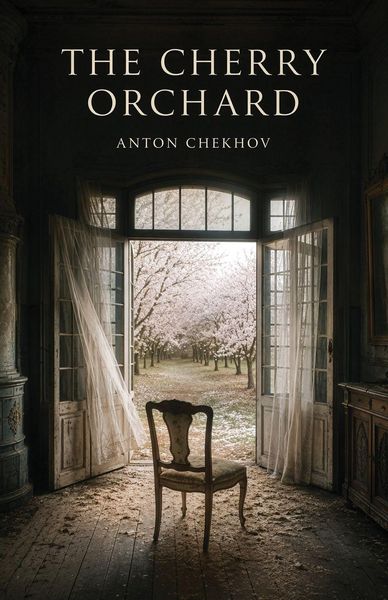
The Cherry Orchard A Tragicomedy of Memory, Change, and a Vanishing World
-
- Englisch ausgewählt
15,99 €
inkl. gesetzl. MwSt.,
- Kostenlose Lieferung ab 30 € Einkaufswert
- Versandkostenfrei für Bonuscard-Kund*innen
Beschreibung
Produktdetails
Einband
Taschenbuch
Erscheinungsdatum
01.08.2026
Verlag
Curated Collection PublishingSeitenzahl
84
Maße (L/B/H)
21,6/14/0,5 cm
Gewicht
119 g
Sprache
Englisch
EAN
9798240825040
Lyubov Ranevskaya returns from Paris to the family estate she has never stopped loving. The rooms hold childhood memories, familiar voices, and the celebrated cherry orchard in bloom-but the property is burdened by debt and scheduled for auction. Lopakhin, the prosperous son of a former serf, offers a practical solution: divide the land into summer cottages and cut down the orchard. To Ranevskaya and her brother Gaev, the proposal is not merely financial. It asks them to destroy the symbol of their family, their past, and the world in which they once knew their place. Around this crisis, Anton Chekhov assembles a household at once touching and absurd. Plans are announced and forgotten. Love is anticipated but rarely spoken plainly. Servants, students, relatives, and visitors talk past one another while time moves steadily toward the auction. Lopakhin understands the economic future yet cannot master his private emotions; Trofimov speaks passionately of work and renewal; aging Firs remembers the vanished order of serfdom; and Ranevskaya, generous and impulsive, remains caught between grief and the habits that helped bring the estate to ruin. Chekhov called The Cherry Orchard a comedy, even a work containing farce, though its first famous production emphasized tragedy. The tension between those modes is the source of its peculiar power. Comic entrances, missed proposals, misplaced possessions, and eccentric speeches unfold beside bankruptcy, separation, and the destruction of a home. No villain causes the loss. The characters simply fail, or refuse, to act before change acts upon them. Written in 1903 and first produced and published in 1904, Chekhov's final play captures a society suspended between eras. The orchard is beautiful, but beauty alone cannot preserve it; Lopakhin's triumph is real, but not uncomplicated. Humane, elusive, and endlessly playable, The Cherry Orchard asks what people owe the past, what the future demands, and why letting go can feel impossible even when there is no other choice. Its questions remain immediate because the characters are neither blind nor foolish: they often understand their situation and still cannot alter the patterns of feeling and behavior that bind them. In their hesitation, Chekhov finds both comedy and heartbreak.
Noch keine Bewertungen vorhanden
Verfassen Sie die erste Bewertung zu diesem Artikel
Helfen Sie anderen Kundinnen und Kunden durch Ihre Meinung.
Kurze Frage zu unserer Seite
Vielen Dank für Ihr Feedback
Wir nutzen Ihr Feedback, um unsere Produktseiten zu verbessern. Bitte haben Sie Verständnis, dass wir Ihnen keine Rückmeldung geben können. Falls Sie Kontakt mit uns aufnehmen möchten, können Sie sich aber gerne an unseren Kund*innenservice wenden.
zum Kundenservice