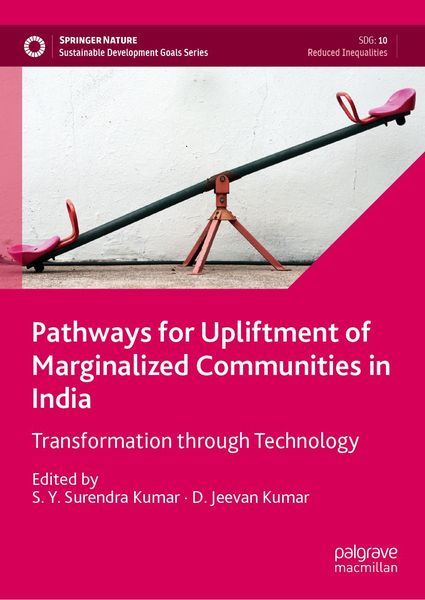
Pathways for Upliftment of Marginalized Communities in India Transformation through Technology
-
- Englisch ausgewählt
164,99 €
inkl. gesetzl. MwSt.,
Beschreibung
Produktdetails
Einband
Gebundene Ausgabe
Erscheinungsdatum
13.03.2027
Abbildungen
Approx. 240 p.
Herausgeber
S. Y. Surendra Kumar + weitereVerlag
Springer SingaporeSeitenzahl
20
Maße (B/H)
14,8/21 cm
Sprache
Englisch
ISBN
978-981-9261-28-4
This edited volume examines the evolving relationship between technology, social inclusion, and sustainable development in one of the world's largest and most diverse digital societies. It critically explores whether technological innovation can serve as a meaningful instrument of empowerment for marginalized communities or whether it risks reinforcing existing forms of exclusion. It situates technology within the broader political economy of development, constitutional commitments to social justice, and the lived experiences of disadvantaged communities, and brings together interdisciplinary perspectives to examine how digital technologies, public policy, governance frameworks, and institutional interventions can contribute to more inclusive development while acknowledging the structural constraints that continue to shape access and opportunity.
A distinguishing feature of the volume is its engagement with the United Nations Sustainable Development Goals (SDGs), particularly SDG 10: Reduced Inequalities. The chapters collectively examine how technology can support the objectives of SDG Target 10.2, Target 10.3, and Target 10.4. By placing the principle of "Leaving No One Behind" at the centre of its analysis, the book also contributes to broader discussions on inclusive governance, equitable access to public services, and the role of digital transformation in advancing sustainable development. Bringing together scholarship at the intersection of technology, public policy, and development studies, this volume will be of interest to researchers, policymakers, development practitioners, civil society organisations, and postgraduate students seeking to understand how technological transformation can be aligned with social inclusion and sustainable development in India.
Noch keine Bewertungen vorhanden
Verfassen Sie die erste Bewertung zu diesem Artikel
Helfen Sie anderen Kundinnen und Kunden durch Ihre Meinung.
Kurze Frage zu unserer Seite
Vielen Dank für Ihr Feedback
Wir nutzen Ihr Feedback, um unsere Produktseiten zu verbessern. Bitte haben Sie Verständnis, dass wir Ihnen keine Rückmeldung geben können. Falls Sie Kontakt mit uns aufnehmen möchten, können Sie sich aber gerne an unseren Kund*innenservice wenden.
zum Kundenservice