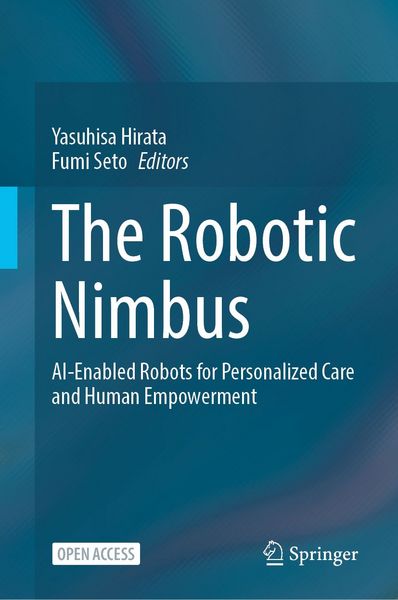
The Robotic Nimbus AI-Enabled Robots for Personalized Care and Human Empowerment
-
- Englisch ausgewählt
54,99 €
inkl. gesetzl. MwSt.,
Beschreibung
Produktdetails
Einband
Gebundene Ausgabe
Erscheinungsdatum
07.02.2027
Abbildungen
Approx. 300 p.
Herausgeber
Yasuhisa Hirata + weitereVerlag
Springer SingaporeSeitenzahl
224
Maße (B/H)
15,5/23,5 cm
Sprache
Englisch
ISBN
978-981-9261-44-4
This open access book presents Robotic Nimbus, a framework for AI-enabled assistive robots designed to provide minimal necessary support in response to each person’s abilities, intentions, and surroundings. Rather than simply performing tasks in place of the user, Robotic Nimbus aims to help people succeed while preserving the feeling of “I did it myself” and strengthening the confidence of “I can do it if I try.”
The book introduces the major hardware subsystems of Robotic Nimbus, including Nimbus Holder, a supporting arm for body support and posture assistance; Nimbus Limbs, robotic subsystems that provide additional support for standing and walking; Nimbus Wear, a wearable support system for upper-limb assistance in daily activities; and Nimbus Sheet, a flexible surface for manipulation, rehabilitation, and human transfer. These hardware technologies are presented together with intelligent Support strategies that combine subtle sensing, adaptive control, XR, and multimodal feedback so that robotic assistance remains both physically effective and psychologically meaningful.
In addition, the book explores lifelog-based AI, patient digital twins, multi-robot coordination, living lab demonstrations, and the ethical, legal, and safety conditions required for social implementation. Bringing together interdisciplinary achievements in robotics, AI, neuroscience, rehabilitation, and welfare engineering, it offers a roadmap toward a vibrant and inclusive society in which robotic support enhances independence, participation, and human potential.
Noch keine Bewertungen vorhanden
Verfassen Sie die erste Bewertung zu diesem Artikel
Helfen Sie anderen Kundinnen und Kunden durch Ihre Meinung.
Kurze Frage zu unserer Seite
Vielen Dank für Ihr Feedback
Wir nutzen Ihr Feedback, um unsere Produktseiten zu verbessern. Bitte haben Sie Verständnis, dass wir Ihnen keine Rückmeldung geben können. Falls Sie Kontakt mit uns aufnehmen möchten, können Sie sich aber gerne an unseren Kund*innenservice wenden.
zum Kundenservice