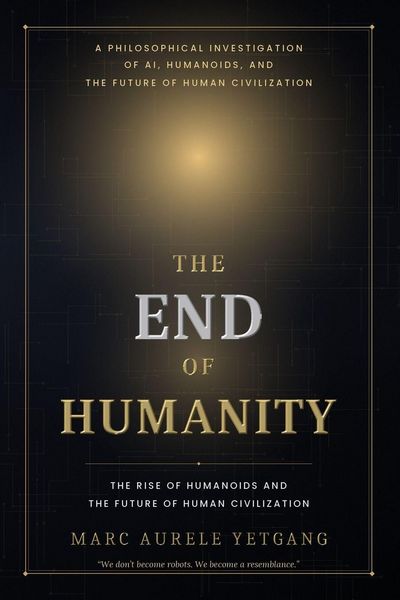
The End of Humanity The Rise of Humanoids and the Future of Human Civilization
-
- Englisch ausgewählt
23,99 €
inkl. gesetzl. MwSt.,
- Kostenlose Lieferung ab 30 € Einkaufswert
- Versandkostenfrei für Bonuscard-Kund*innen
Beschreibung
Produktdetails
Einband
Taschenbuch
Erscheinungsdatum
17.08.2026
Verlag
Amazon Digital Services LLC - KdpSeitenzahl
230
Maße (L/B/H)
22,9/15,2/1,2 cm
Gewicht
313 g
Sprache
Englisch
EAN
9798193111467
The danger is not that artificial intelligence will learn to think like a human being. It is that human beings will gradually cease learning how to think without it.
For seventy years the question has been whether a machine could think. It was always the less interesting question - it is empirical, it is being settled by engineers, and whoever settles it will announce it.
The interesting question is whether we will.
This book uses two words in a particular way, and says so on the first page. Humanity names not the body but the exercise: independent reasoning, imagination, moral judgment, creativity, wisdom, responsibility. And a humanoid is not a machine with a human shape. It is any being whose thinking is primarily directed by artificial intelligence rather than by its own reasoning - a definition that never mentions metal, and is therefore silent on what the being is made of.
What follows from those two definitions is the argument of this book, and it does not go where the shelf it sits on usually goes.
It is not a prediction. Freeze capability tonight and every claim here still holds.
It is not a panic. Chapter Two makes the strongest possible case against the whole thesis - and finds that Socrates, the greatest critic of intellectual shortcuts in the Western tradition, asked for precisely the technology this book is about.
It is not an accusation. The central chapter is built around a schoolchild who has done nothing wrong, whose parents have done nothing wrong, whose teacher has done nothing wrong - and the thing happens anyway.
What it is instead is a single distinction, carefully drawn and then tested to destruction: some work can be handed to a machine because the output is separable from the process, and some cannot, because the process is the thing that builds the person. The calculator took arithmetic and left mathematics. What happens when the offer is made for judgment itself?
The evidence is unusual and it is checked. London taxi drivers whose brains measurably changed - and the bus-driver control group that proves it was the navigating. An aviation paper from 1983 that predicted a class of accident before it happened, and was right at the cost of several hundred lives. A dying Gaelic dialect in the Scottish Highlands, where a linguist found people who understood every word and could no longer produce the language, and did not know. Their neighbours could hear it instantly and could not explain how.
She had to invent a term for them. It turns out to be the exact shape of this argument, documented decades early, by someone who had never heard of the machines.
Eight figures. Forty-seven sources, cited with their uncertainties confessed rather than hidden. Nineteen closing questions that cannot be answered by remembering what the book said.
Humanity survives wherever people continue to cultivate judgment, wisdom, imagination, and responsibility. Artificial intelligence has changed the conditions under which those capacities are exercised. It has not changed whose they are to exercise.
Noch keine Bewertungen vorhanden
Verfassen Sie die erste Bewertung zu diesem Artikel
Helfen Sie anderen Kundinnen und Kunden durch Ihre Meinung.
Kurze Frage zu unserer Seite
Vielen Dank für Ihr Feedback
Wir nutzen Ihr Feedback, um unsere Produktseiten zu verbessern. Bitte haben Sie Verständnis, dass wir Ihnen keine Rückmeldung geben können. Falls Sie Kontakt mit uns aufnehmen möchten, können Sie sich aber gerne an unseren Kund*innenservice wenden.
zum Kundenservice