KI-Beratung Beta

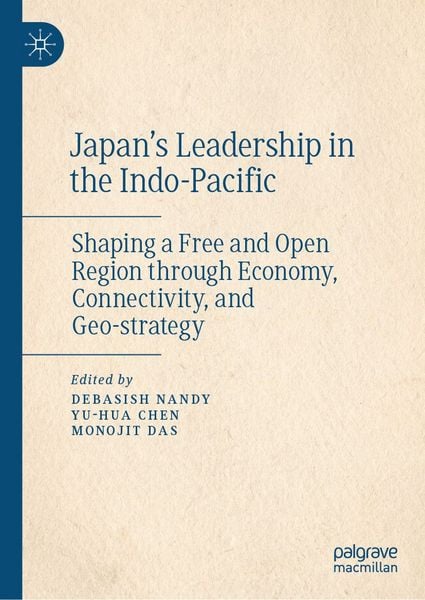
Produktbild: Japan's Leadership in the Indo-Pacific
Vorbesteller Neu

Japan's Leadership in the Indo-Pacific Shaping a Free and Open Region through Economy, Connectivity, and Geo-strategy

153,99 €

inkl. gesetzl. MwSt., Versandkostenfrei


Beschreibung

This edited volume examines Japan’s evolving strategic, economic, and diplomatic role in shaping the Indo-Pacific. It explores how Japan has advanced the vision of a Free and Open Indo-Pacific (FOIP) amid changing regional alignments, intensifying great-power competition, and growing economic interdependence....

Beschreibung

This edited volume examines Japan’s evolving strategic, economic, and diplomatic role in shaping the Indo-Pacific. It explores how Japan has advanced the vision of a Free and Open Indo-Pacific (FOIP) amid changing regional alignments, intensifying great-power competition, and growing economic interdependence. Bringing together perspectives from international relations, geopolitics, strategic studies, economics, and area studies, the book traces Japan’s transition from a reactive post-Cold War power to a more proactive regional actor. It also examines Japan’s engagement with China’s Belt and Road Initiative, India’s Act East Policy, ASEAN’s Indo-Pacific Outlook, and U.S. strategic rebalancing. 


The volume highlights the strategic, economic, and normative dimensions of Tokyo’s regional approach, while considering its implications for connectivity, regional cooperation, stability, and the evolving rules-based order. It offers readers a timely assessment of Japan’s partnerships, policy choices, and regional priorities, and considers how these shape the future of the Indo-Pacific in an era of strategic uncertainty.

Portrait

Dr. Debasish Nandy is an Associate Professor and Coordinator of the Centre for Studies of South and South-East Asian Societies at Kazi Nazrul University, India. His research focuses on Japan, Asia, international relations, and regional affairs. He has held visiting and fellowship positions at institutions in Japan, Germany, Bangladesh, and Tajikistan, including Osaka University. He is a Senior Fellow at the Pan-Asia Research Institute, Tokyo. He has published extensively and has edited 13 books and authored 8 books.

Dr. Yu-Hua Chen is an Associate Professor in the Global Studies Program at Akita International University, Japan. His research interests include China’s foreign and security policy, Taiwan-Japan relations, Asian history, and international relations. He has taught and conducted research at institutions including the Australian National University and George Washington University. His work has appeared in several leading publications on Asian affairs and international relations.

Dr. Monojit Das, PhD is an independent geopolitical analyst and the Hon. Executive Editor of IADN Indian Aerospace and Defence News, New Delhi.

Produktdetails

Einband

Gebundene Ausgabe

Erscheinungsdatum

24.02.2027

Abbildungen

XXXI, 325 p. 15 illus., 13 illus. in color.

Herausgeber Debasish Nandy + weitere

Produktdetails

Einband

Gebundene Ausgabe

Erscheinungsdatum

24.02.2027

Abbildungen

XXXI, 325 p. 15 illus., 13 illus. in color.

Herausgeber
Verlag Springer Singapore
Seitenzahl

325

Maße (B/H)

14,8/21 cm

Sprache

Englisch

ISBN

978-981-9260-50-8

Herstelleradresse

Springer Nature Customer Service Center GmbH
Europaplatz 3
69115 Heidelberg
DE
ProductSafety@springernature.com

Noch keine Bewertungen vorhanden

Verfassen Sie die erste Bewertung zu diesem Artikel

Helfen Sie anderen Kundinnen und Kunden durch Ihre Meinung.

Kundinnen und Kunden meinen

Bewertungen (0)

  • Produktbild: Japan's Leadership in the Indo-Pacific
  • Chapter 1: Introduction.- Chapter 2: The River World Order: Society 5.0 and the Moral Currents of ASEAN Integration.- Chapter 3: The Evolution of Japan–Taiwan Security Relations in the Post–Cold War.- Chapter 4: An Axis of Stability? A Critical Analysis of India–Japan Strategic Cooperation in the Indo-Pacific.- Chapter 5: India and Japan in the Indo-Pacific: Maritime Security and Defense Cooperation for Enhancing Bilateral Relations.- Chapter 6: The Impact of Japan’s FOIP on Sino–Japanese Relations: Navigating Cooperation and Competition in the Indo-Pacific.- Chapter 7: Maritime Defence Diplomacy of Japan in the Indo-Pacific to Ensure FOIP.- Chapter 8: Japan’s “One Theater Theory” and the Maritime Security in the Relation Between Japan and Korea in Terms of Indo-Pacific Strategy.- Chapter 9: Japan’s Global Transformation: A Smart Power Strategy for Future Vision.- Chapter 10: Japan’s Struggle for Leadership in the Indo-Pacific and Sino–Japanese Competition.- Chapter 11: Anchoring a Free and Open Indo-Pacific: Japan's Maritime Security Strategy and Defence Partnership.- Chapter 12: Japan’s FOIP Strategies in the Small Islands of the Indo-Pacific.- Chapter 13: Conclusion.