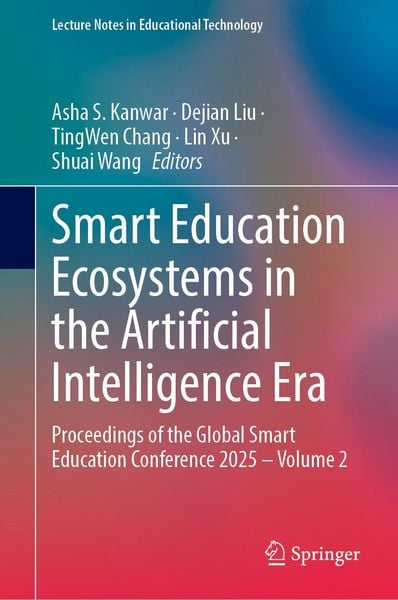
Produktbild: Smart Education Ecosystems in the Artificial Intelligence Era
Vorbesteller Neu

Smart Education Ecosystems in the Artificial Intelligence Era Proceedings of the Global Smart Education Conference 2025 – Volume 2

241,99 €

inkl. gesetzl. MwSt., Versandkostenfrei


Beschreibung

Produktdetails

Einband

Gebundene Ausgabe

Erscheinungsdatum

22.01.2027

Abbildungen

Approx. 400 p.

Herausgeber

Asha S. Kanwar + weitere

Verlag

Springer Singapore

Seitenzahl

144

Maße (B/H)

15,5/23,5 cm

Sprache

Englisch

ISBN

978-981-9259-51-9

Beschreibung

Portrait

Professor Asha Singh Kanwar is the Chair of the Governing Board of the UNESCO (United Nations Educational, Scientific and Cultural Organization) Institute for Information Technologies in Education (IITE), and Chair Professor at the Smart Learning Institute of Beijing Normal University (China). She also chairs the Advisory Committee of the World Health Organization (WHO) Academy. Previously, she served as the President and Chief Executive Officer (CEO) of the Commonwealth of Learning (Canada). As a globally recognized leader in learning for sustainable development, her research focuses on open educational resources (OER), open and distance learning, and smart education. She has received the International Council for Open and Distance Education (ICDE) Prize of Excellence, and the Meritorious Service Award from the Asian Association of Open Universities for her outstanding contributions to open and distance education.

Dr. Dejian Liu is the Founder and Chairman of NetDragon Websoft Holdings Limited, and serves as Co-Dean of the Smart Learning Institute and the National Engineering Research Center for Big Data Application in Education at Beijing Normal University, China. He is a member of the Governing Board of the UNESCO (United Nations Educational, Scientific and Cultural Organization) Institute for Information Technologies in Education (IITE), and is widely regarded as a leader in the field of smart education innovation. As a contributor to China’s National Smart Education Platform, Dr. Liu has driven technological innovations aimed at enhancing educational equity. He has played a pivotal role in global education initiatives under UNESCO and the Belt and Road Initiative, with impact across Africa, the Middle East, and the Association of Southeast Asian Nations (ASEAN) regions. Through NetDragon’s education technologies, his work now supports over 1.3 million classrooms in more than 150 countries. Dr. Liu and his team hold over 1,400 patents and have authored 17 books and more than 30 academic papers.

Dr. Ting-Wen Chang is Associate Research Fellow, Director of the International Cooperation Center, and Assistant to the Dean at the Smart Learning Institute of Beijing Normal University (SLIBNU), China. Since 2014, he has been dedicated to advancing smart learning research and fostering international collaboration. He has worked closely with a wide range of global experts and institutions, and has collaborated with organizations such as UNESCO IITE (United Nations Educational, Scientific and Cultural Organization Institute for Information Technologies in Education), UNESCO IIEP (International Institute for Educational Planning), the Global Education Monitoring (GEM) Report, the Arab League Educational, Cultural and Scientific Organization (ALECSO), and the International Society for Technology in Education (ISTE), to co-organize international conferences and jointly develop research and policy reports on educational innovation and digital transformation. His research interests include adaptive learning, user modeling, multimedia instruction, and personalized learning environments. He has published over 40 refereed journal articles, book chapters, and conference papers, and has received several academic awards, including the IEEE TCLT (Technical Community on Learning Technology) Young Researcher Award.

Ms. Lin Xu holds a Master of Arts in Education from University College London (UCL) and a Bachelor of Arts in Applied Linguistics from the University of Warwick, United Kingdom. She currently serves as a Research Assistant and International Project Officer at the Smart Learning Institute of Beijing Normal University, China. Her research focuses on technology-enhanced language learning and digital education, with a commitment to promoting international collaboration in the field.

Mr. Shuai Wang is an engineer of the National Engineering Research Center of Cyberlearning and Intelligent Technology, China.

Produktdetails

Einband

Gebundene Ausgabe

Erscheinungsdatum

22.01.2027

Abbildungen

Approx. 400 p.

Herausgeber

Verlag

Springer Singapore

Seitenzahl

144

Maße (B/H)

15,5/23,5 cm

Sprache

Englisch

ISBN

978-981-9259-51-9

Herstelleradresse

Springer Singapore
No. 12-2F 101 Business Park
47100 Puchong, Selangor D.E.
MY
Email: sdc-bookservice@springer.com
Telephone: +49 6221 3454301
Fax: +49 6221 3454229

Noch keine Bewertungen vorhanden

Verfassen Sie die erste Bewertung zu diesem Artikel

Helfen Sie anderen Kundinnen und Kunden durch Ihre Meinung.

Kundinnen und Kunden meinen

Bewertungen (0)

Weitere Artikel finden Sie in

  • Produktbild: Smart Education Ecosystems in the Artificial Intelligence Era
  • Part I. Governing Smart Education: Theory, Agency and System Transformation.- Chapter 1. Smart Education: Theoretical Construction and Practical Pathways toward Education 2050.- Chapter 2. Smart Education as an Example of Global Artificial Intelligence Governance.- Chapter 3. Professional and Institutional Agency in AI Smart Education: The Case of the SELFIE Tools.- Chapter 4. From Pre-Service to Future-Oriented Teacher Development: AI-Empowered Pathways for High-Quality Teacher Education.- Chapter 5. Bridging the Complexity Gap: Toward Dynamical Modeling and Real-Time Personalization in Education.- Part II. Leading Educational Change: Teachers, Classrooms and Schools.- Chapter 6. Leadership in the Digital Transformation of Education: Roles, Practices, and Development Pathways.- Chapter 7. Exploring Pathways for High-Quality School Development in the Context of Educational Digital Transformation.- Chapter 8. Future Teachers and Future Classrooms in the Intelligent Era.- Chapter 9. Leading Teachers and Smart Teaching in the Age of Artificial Intelligence.- Chapter 10. Smart Teachers in the Age of Human-AI Collaboration: Role Reconfiguration, Competence Reconstruction and Practice Pathways.- Part III. Scaling Smart Education Ecosystems: Regional Transformation and Inclusive Innovation.- Chapter 11. Practical Paths and Suggestions for Artificial Intelligence-Empowered Smart Education.- Chapter 12. Integrated, Intelligent and International Pathways for Educational Digital Transformation in Schools and Regions.- Chapter 13. Scoping Opportunities and Challenges, Theoretical References, and Practical Pathways for Transforming Education for Smart Villages and Sustainable Rural Development.- Chapter 14. Innovative Paths and Ecological Construction of AI-Driven Integration of Science, Education, and Industry.- Part IV. Emerging Learning Paradigms and the Development of Learner-Centred Ecosystems.- Chapter 15. On-Demand Learning as Higher-Order Entertainment in the Age of AI.