KI-Beratung Beta

Gutscheinbedingungen

**Gültig bis 30.11.2026 auf Spielzeug, Schreibwaren, Filme, Geschenke & Trends, Musik, tolino eReader & Zubehör, Hörbücher und Hörbuch-Downloads, nicht preisgebundene Bücher und Kalender online auf thalia.at und in der Thalia App. Einzelne Artikel können ausgeschlossen sein. Aufgrund der Buchpreisbindung sind deutschsprachige Bücher und eBooks ausgenommen. Zusätzlich ausgenommen sind Abos & Flatrates, Games, Geschenkkarten/-boxen, Shelfies, Software, Zeitschriften sowie einzelne Artikel von tonies®. Pro Einkauf einmal einlösbar. Nur gültig mit im Onlineshop hinterlegter Bonuscard. Click & Collect nur bei Onlinevorabzahlung möglich. Keine Barauszahlung. Nicht kombinierbar mit anderen Aktionen und Gutscheinen. Gutschein wird auf max. 500€ Bestellwert angerechnet. Nicht gültig für Versandkosten und Services.

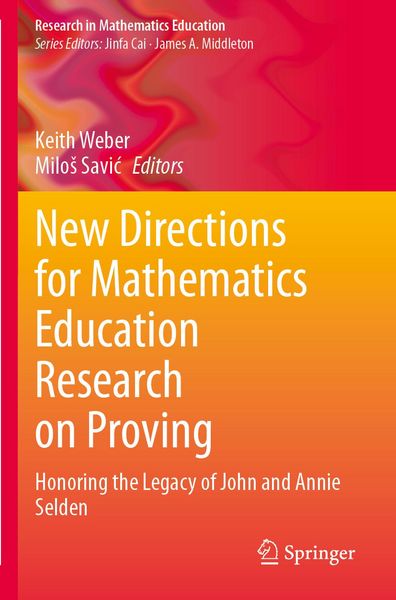
Produktbild: New Directions for Mathematics Education Research on Proving

New Directions for Mathematics Education Research on Proving Honoring the Legacy of John and Annie Selden

197,99 €

inkl. gesetzl. MwSt., Versandkostenfrei


Beschreibung

This book summarizes new directions in mathematics education research on proving at the university level, thereby providing contemporary extensions of the sub-fields of proof that Annie and John Selden introduced to the field. The chapters each describe an emerging new area of proof research, review...

Beschreibung

This book summarizes new directions in mathematics education research on proving at the university level, thereby providing contemporary extensions of the sub-fields of proof that Annie and John Selden introduced to the field. The chapters each describe an emerging new area of proof research, review the relevant findings in this area, present open research questions and the tools to address them. The book also discusses proof as a literary genre, and how students' feelings during the proof writing process can influence their behavior. The concluding chapter of the book reflects on new directions for research on proving. As such, this book provides mathematics educators, who have extensive experience researching proof, with an up-to-date review of the new methodologies and research questions with regard to proof, and young scholars, interested in proof, can use these chapters as primers on which they can build a research program.

Portrait

Keith Weber is a distinguished professor of mathematics education at Rutgers University. Since earning his Ph.D in 2001, he has published 100 articles in on mathematics education topics, 25 of which have appeared in JRME and ESM, the two top journals in mathematics education. He has also published in other outlets, including journals in educational psychology (Cognition and Instruction, Educational Psychologist), philosophy (Philosophia Mathematica, Synthese), and psychology (Topics in Cognitive Science, JEP:HPP), as well as expository outlets for mathematicians (Notices of the AMS, Mathematics Intelligencer).

Dr. Weber's research on proof has received awards from the Mathematical Association of America, the American Education Research Association, the National Science Foundation, and the British Society for Research into Learning Mathematics. This includes the MAA's Annie and John Selden Prize for outstanding research in undergraduate mathematics education (the prize was named after whom this volume will honor). At the annual Conference for Research in Undergraduate Mathematics Education, he received the Best Paper Award on four occasions, and the Runner-Up for Best Paper three other times.


Milos Savic is an associate professor of mathematics education at the University of Oklahoma. Since earning his Ph.D in mathematics education from New Mexico State University in 2012, Dr. Savic has published 15 articles, mostly focusing on the teaching of proof. Particularly novel about Dr. Savic's research is his innovative focus on creativity in the proving process. Dr. Savic is a member and co-founder of the Creativity Research Group, which is supported by the National Science Foundation to develop and analyze methods for teaching creativity in the mathematics classroom. Dr. Savic was advised by John and Annie Selden, for whom this volume is honoring.

Produktdetails

Einband

Taschenbuch

Erscheinungsdatum

04.07.2026

Abbildungen

VIII, 372 p. 38 illus., 21 illus. in color.

Herausgeber Keith Weber + weitere

Produktdetails

Einband

Taschenbuch

Erscheinungsdatum

04.07.2026

Abbildungen

VIII, 372 p. 38 illus., 21 illus. in color.

Herausgeber
Verlag Springer
Seitenzahl

372

Maße (L/B/H)

23,5/15,5/2,1 cm

Gewicht

575 g

Sprache

Englisch

ISBN

978-3-031-85006-6

Herstelleradresse

Springer-Verlag KG
Sachsenplatz 4-6
1201 Wien
AT

Email: ProductSafety@springernature.com

Noch keine Bewertungen vorhanden

Verfassen Sie die erste Bewertung zu diesem Artikel

Helfen Sie anderen Kundinnen und Kunden durch Ihre Meinung.

Kundinnen und Kunden meinen

Bewertungen (0)

Weitere Artikel finden Sie in

  • Produktbild: New Directions for Mathematics Education Research on Proving
  • Part I: Introductory chapters.- Chapter 1. The legacy of John and Annie Selden on proof and proving.- Chapter 2. My take: Proof research at the undergraduate level—how it evolved.- Part II: New directions for research on proof writing.- Chapter 3. Undergraduate students’ mathematical proof skills: Examining the impact of six cognitive resources.- Chapter 4. New directions for domain-specific aspects of proof: The case of combinatorics and graph theory.- Chapter 5. Researching collaborative proving in real university classrooms: The role and utility of theoretical framing.- Chapter 6. Categorizing undergraduates’ proving processes through the lenses of their “stuck points”.- Part III: New directions for research on proof reading.- Chapter 7. Student performance on proof comprehension tests in transition-to-proof course.- Chapter 8. The summary task and its potential for proof comprehension.- Chapter 9. Incorporating self-explanation in undergraduate proof-based courses: The role of expertise, textual coherence, and instructor modeling.- Chapter 10. Investigating strategies undergraduates and mathematicians use for enriched proof-reading experience.- Part IV: New directions for research on proof as a genre.- Chapter 11. Exploring how undergraduate students cope with learning the genre of proof: Their conception about linguistic convenctions.- Chapter 12. Microcosms in the classroom: An ethnographic study of equity in inquiry-based introduction to proof courses.- Chapter 13. Researching proof viewed as a genre of text.- Part V: New directions for research on affect and proving.- Chapter 14. In-the-moment affect and proving: Research on student emotions.- Chapter 15. The aesthetic challenge of doing visual proofs.- Part VI: Conclusion.- Chapter 16. Theoretical and methodological diversity in undergraduate mathematics education: The influence of John and Annie Selden on our field.