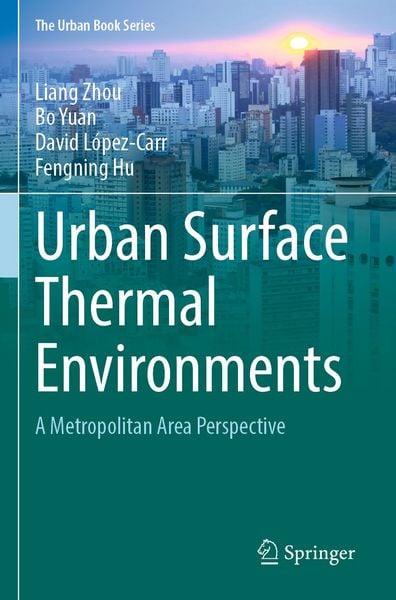
Urban Surface Thermal Environments A Metropolitan Area Perspective
-
- Hardcover
- Taschenbuch ausgewählt
- eBook
-
Sprache:Englisch
164,99 €
inkl. gesetzl. MwSt.,
Beschreibung
Produktdetails
Einband
Taschenbuch
Erscheinungsdatum
22.06.2026
Abbildungen
XXI, 243 p.
Verlag
SpringerSeitenzahl
243
Maße (L/B/H)
23,5/15,5/1,4 cm
Gewicht
460 g
Sprache
Englisch
ISBN
978-3-031-94501-4
Urban Surface Thermal Environments: A Metropolitan Area Perspective presents a comprehensive exploration of urban heat dynamics through the perspectives of climate change, urbanization, green infrastructure, and two- and three-dimensional urban morphology. It analyzes the key drivers of surface urban heat islands (SUHI), reveals spatial and temporal patterns of warming, assesses population heat risks, and proposes practical strategies to mitigate thermal impacts. Incorporating spatial analysis, multi-source data integration, and urban-scale simulation, the book provides effective solutions for megacities worldwide under increasing heat stress—supporting adaptive governance, enhancing livability, and advancing SDG 11.
The book presents a series of analytical frameworks designed to capture thermal heterogeneity, identify vulnerable populations, and inform intervention strategies across scales—from site-specific cooling measures to integrated regional spatial planning. By bridging climate science, urban design, and geospatial technologies, it offers actionable approaches to enhance urban resilience and guide climate adaptation efforts. This integrated framework aligns with the Paris Agreement, including the 1.5°C climate target, and is informed by recent scientific assessments from IPCC, offering spatially explicit support for evidence-based decision-making.
As a valuable reference for researchers, urban planners, environmental professionals, policymakers, and graduate students, this book informs decisions in the fields of climate adaptation, sustainable urban development, and spatial planning. It contributes to key global and national initiatives, including SDG11 and SDG13, Future Earth, and China’s new urbanization strategy. Through its interdisciplinary and geography-informed perspective, the book enhances cities’ adaptive capacity and contributes to the development of cooler, more equitable, and climate-resilient human settlements in an era of global warming.
Noch keine Bewertungen vorhanden
Verfassen Sie die erste Bewertung zu diesem Artikel
Helfen Sie anderen Kundinnen und Kunden durch Ihre Meinung.
Kurze Frage zu unserer Seite
Vielen Dank für Ihr Feedback
Wir nutzen Ihr Feedback, um unsere Produktseiten zu verbessern. Bitte haben Sie Verständnis, dass wir Ihnen keine Rückmeldung geben können. Falls Sie Kontakt mit uns aufnehmen möchten, können Sie sich aber gerne an unseren Kund*innenservice wenden.
zum Kundenservice